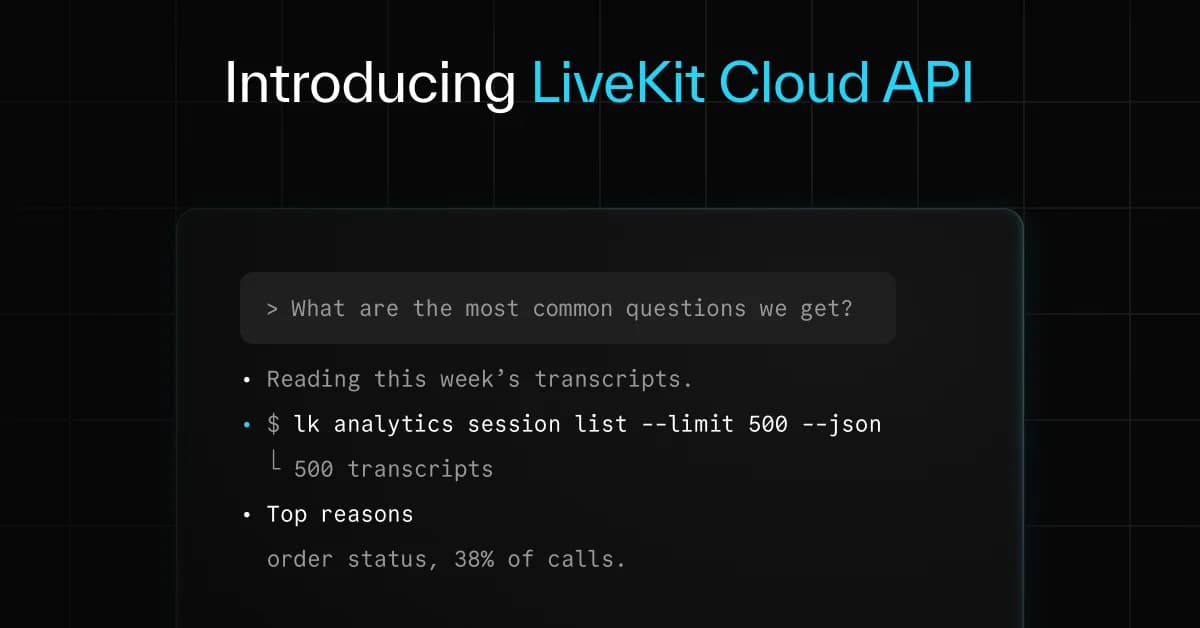
We recently launched the LiveKit Cloud API, which lets your coding agent read the transcripts, logs, traces, and recordings from your voice agent's calls.
This post walks through three ways to use it to improve your voice agent, and how to turn what it finds into a fix.
Before you startLink to this section
You'll need:
- A voice agent on LiveKit Cloud that has taken calls with Agent Observability turned on.
- The admin role on the project.
- LiveKit CLI 2.19.4 or later.
Update the CLI, sign in, and install the LiveKit skills:
On Linux or Windows? See the CLI docs.
Then open your coding agent in your voice agent's repo. If you work across several projects, name the project in your prompt. Otherwise the CLI uses your default project.
1. Fix the issues that hit the most callsLink to this section
Try pasting something like this into your coding agent:
You'll get back something like this:
We ran this prompt on LiveKit's own docs assistant. Our coding agent read 4,321 sessions from the past week and came back after about 30 minutes of work with 8 ranked issues. It found that 28% of sessions were automated traffic, that slow turns came from chained tool calls, and which doc topics people asked about but couldn't get answers to.
Tip
If your agent takes a lot of calls, start with a sample, like the last 100 sessions or the last 24 hours. Your coding agent reads every transcript it pulls, so a smaller set is faster and uses fewer tokens. The biggest issues show up in a sample anyway.
2. Get to the bottom of a bad callLink to this section
Sometimes you already know which call went wrong. Grab its session ID from the Sessions page in LiveKit Cloud, or ask your coding agent to find it with lk analytics session list. Then ask:
Your coding agent lines up what the caller said with what your agent did, turn by turn. Because each turn carries its own timing, it can tell you whether a long pause came from the model, the voice, or a tool.
3. Find what to build nextLink to this section
Your transcripts don't only show what's broken. They also show what callers want that your agent can't do yet. Ask:
This is how you find the next tool to build, the knowledge your agent is missing, or a language more of your callers are speaking. It's also a quick way to cut the number of calls that end with "Can I talk to a person?"
Then fix it, and prove the fixLink to this section
Once you've picked something to fix, have your coding agent turn the real call into a test before it touches the code:
Your coding agent writes the scenario from the real conversation, replays it locally against your agent, makes the change, and shows you the diff and the results before anything ships. The scenario stays in your repo, so if a later change breaks the same thing, you'll know before it reaches production.
When you're happy with the fix, ask it to deploy. Then run the first prompt again next week and see what moved.
Try it on your agentLink to this section
Run the setup, open your coding agent, and paste in the first prompt. Fix the top issue on the list, prove the fix with a scenario, and ship it.