Adi Agrawal | September 17, 2026
Three hundred twenty-five. On average, that’s how many focus advisors a single external wholesaler is responsible for, according to FUSE Research. If the wholesaler is talking to each advisor a few times per year, that’s a lot of context that has to be retained between each meeting.
For many wholesalers, it’s often starting from scratch each time. The big picture — the advisor’s book, their platform limits, how they weigh private credit against private equity, and which funds fit — gets buried across notes, emails, and the company CRM.
Following up with personalized recommendations for each advisor? An overwhelming feat, even for the most experienced wholesalers. Simply working harder doesn’t scale for this task.
Yet the capital is ready, even if the distribution side isn’t. AUM in semi-liquid and evergreen private markets structures has more than doubled since 2022. Companies like Blackstone, KKR, and Apollo are all expecting to expand.
Before I came to WRITER, I managed multi-asset portfolios and worked with distribution teams at the largest alternatives firms in the country. AI can solve many of these scalability and personalization challenges, ensuring that a wholesaler knows an advisor well enough to make the case for specific products and platforms.
The wholesaler’s day in a pre-AI world
Undoubtedly, you know the scene. An external wholesaler covers Oklahoma and northern Texas. They have eight meetings across two cities, driving across state lines to meet with advisors.
First up: a wirehouse veteran with $400 million under management. For a productive meeting, the wholesaler has to walk in knowing which funds are already in the advisor’s platform, what they allocated last quarter, and what the advisor’s clients have been asking about.
Next: An independent RIA who has never put money into private credit, so it’s a completely different conversation. It starts with education, rather than a pitch.
Proper preparation means tailoring the conversations to each advisor. When there are hundreds of relationships and dozens of meetings each week, prep time becomes a limiting factor.
The traditional approach is to fall back on templates. Personalization is only the first name in an email, and replies happen on the road with no real research behind the responses.
Generic outreach feels transactional. There’s no way to build a relationship — which is a critical component in a business built on trust — without your unique voice, and you’ve sent nothing more than a fact sheet, which is the same thing every other wholesaler is already sending.
Why Conversational AI doesn’t help
AI promises to be the solution for many challenges a wholesaler faces. Feed it an advisor’s information from your CRM and the funds on their platform, and AI can generate outreach in seconds.
While many large language models (LLMs) can meet this demand, there’s a catch. Without fine-tuning and training a model on your unique voice, the output sounds like AI slop. It may happen faster, but it’s not an improvement over the generic outreach.
One of our financial services clients at WRITER put it this way: if a client can tell they’re reading something written with AI, it’s offensive. In private markets, the standard is even higher because the advisor’s trust in the wholesalers is the entire relationship.
A templated follow-up tells the advisor that the wholesaler didn’t really think about them. Off-the-shelf AI products lack industry nuance. But follow-up written in the wholesaler’s unique voice, plus referencing prior discussions, tells the advisor, “This person knows me and made the effort.”
The same day with WRITER
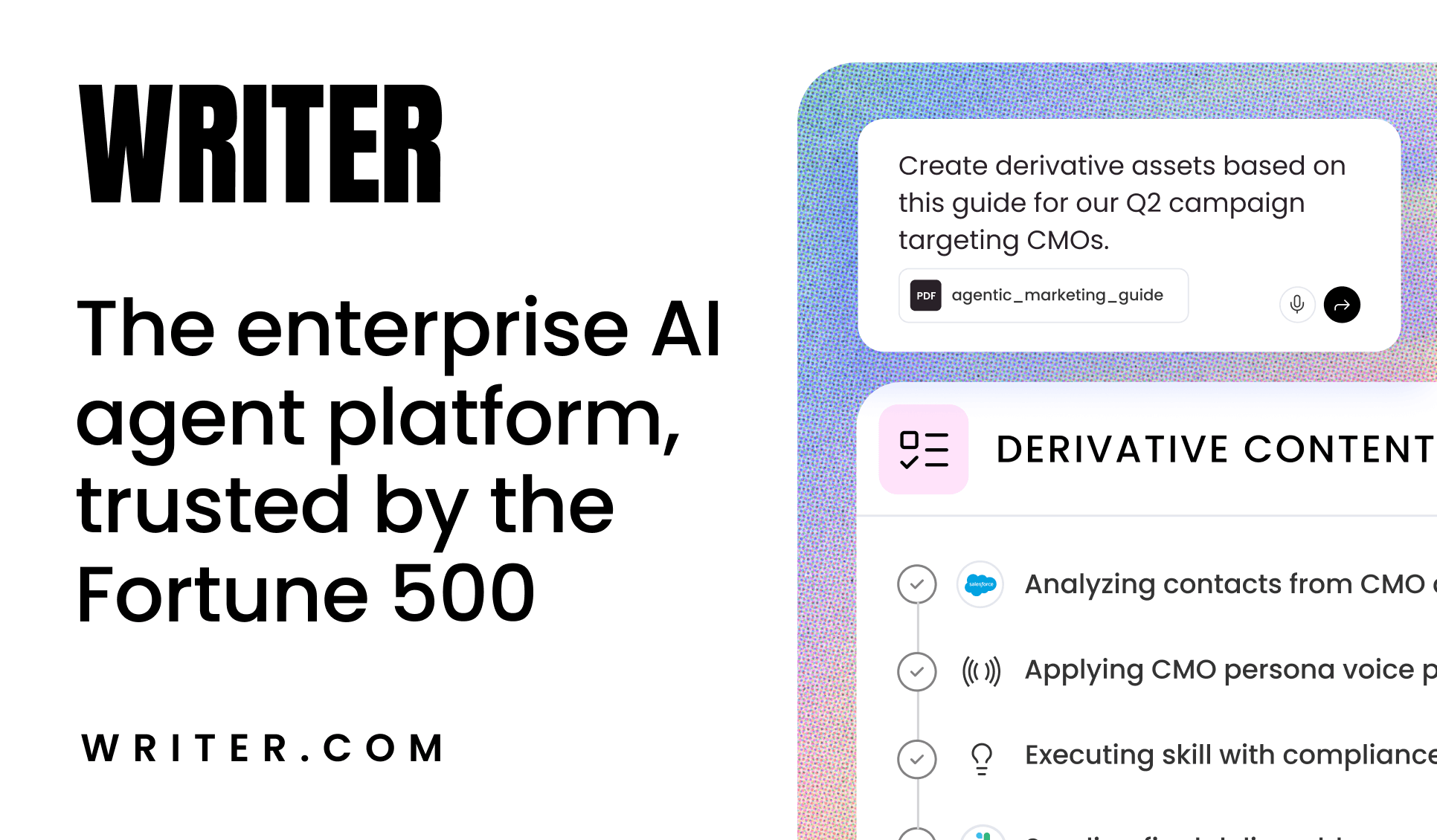
Now let’s re-examine the same wholesaler’s busy day with AI powered by WRITER Agent and Palmyra X6, our latest foundation model.
Agent 1: Meeting preparation
The wholesaler drives to the first meeting of the day, with a detailed brief already on their phone. WRITER’s connectors pulled data from Salesforce and Outlook for the advisor’s recent allocations and correspondence. The brief includes the funds on that advisor’s specific platform and several talking points relevant to that advisor.
Agent 2: Follow up in the wholesaler’s voice
After the meeting ends, AI drafts the follow-up, referencing specific funds that came up in the conversation, written in the wholesaler’s voice. The draft is added to Outlook for review. The wholesaler reads it and makes a few tweaks before hitting “send.”
WRITER’s voice feature learns the individual wholesaler’s writing style, including phrasing and habits that make an email recognizably theirs. The draft is written that way, so editing is minimal.
Agent 3: Always-connected context
While traveling between cities, a question lands in the wholesaler’s inbox from a different advisor. Instead of digging through the company’s CRM while on the road, the wholesaler uses an AI skill to ask for what they need. No matter what systems your firm uses, you can access data through WRITER’s connectors, or we can build a custom connector for you.
WRITER provides financial services firms with market intelligence. Combined with context about a specific advisor, it creates fast, personalized responses at scale. That type of follow-up makes the advisor pick up the phone and connect.
Compliance is a feature, not a bottleneck
Every piece of advisor-facing content is subject to FINRA and SEC review, which most AI tools ignore — and this can get companies into trouble.
Without built-in guardrails, a personalized draft goes into a compliance queue and sits, waiting for review. The wholesaler gives up and sends the pre-approved template, reintroducing the generic correspondence that an AI-powered workflow aimed to avoid.
WRITER has guardrails built into any generated content, so the company’s compliance requirements govern every word. A quality-control agent flags problems before a human reviewer opens the draft. Any correspondence follows the company’s specific requirements: what an email must say, and what it can never say. Every skill and playbook incorporates these requirements and enforces them automatically.
Of the PE firms exploring or piloting AI, only 22% feel confident they could pass an independent audit of their AI governance. With WRITER, compliance is built-in from the beginning.
Deepening wholesaler relationships with AI
In Edelman Smithfield’s 2026 Global Limited Partner Survey, every LP surveyed said it matters that a GP can show real AI capability when they decide where to allocate. With fundraising timelines stretched from 18 to 24 months, distribution teams have to reach more advisors with the same number of hours in the day.
Firms that solve the personalization problem will convert independent RIAs. Today, these RIAs allocate under 7% to alternatives. An advisor who allocates once and has a good experience will allocate again. It’s a compounding effect, since a book of advisors like that becomes the track record before the next round of LP capital.
The capital is ready, and the products are ready. Relationships at scale — the wholesaler making hundreds of relationships feel personal — is the last challenge. With WRITER, firms can clear this hurdle and give wholesalers the tools they need to connect with more advisors.