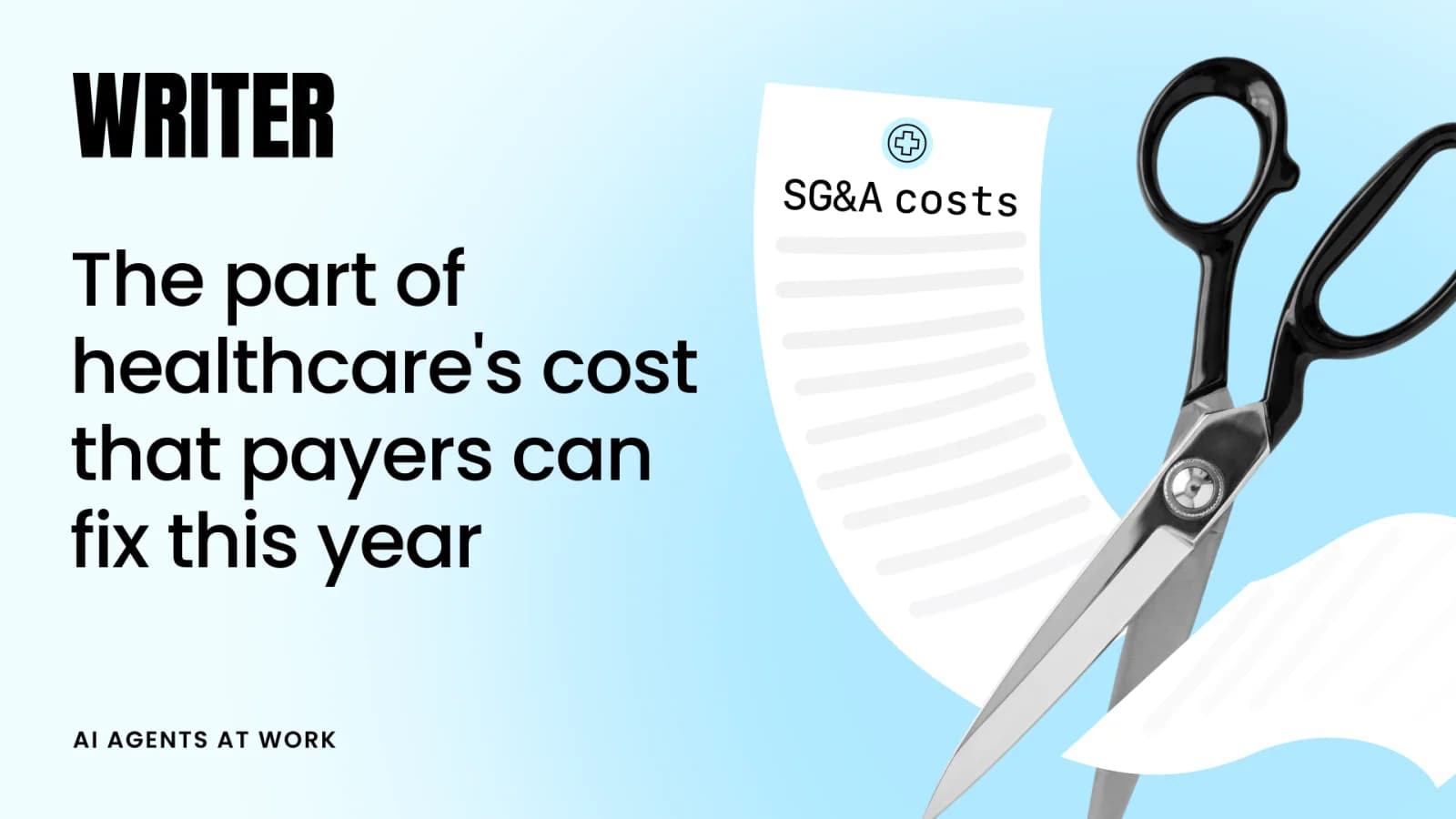
Healthcare costs are a system-wide problem. Plans, providers, and employers are all working to bend the cost curve, and it’s genuinely complex: misaligned incentives, fragmented data, years of accumulated process. There’s no single fix. But there is one area within a health plan’s SG&A that plans can address now, without unraveling that complexity: marketing and sales.
Care is becoming unaffordable for families. Family coverage through an employer now costs an average of $28,303 a year [1], and employers expect costs to keep climbing — increases have ranged from 5% to 7% annually in recent years [2]. According to a 2019 study, roughly 25 cents of every dollar in private US healthcare goes plans goes to administration — billing, authorizing, denying, appealing, selling, and managing coverage, on both the payer and provider side [3]. A meaningful part of that 25¢ is marketing and sales. That’s the lane where a plan can drive real efficiency this year, and it’s the lane we focus on at WRITER.
Why marketing and sales is the place to start
For health plans, the pressure is constant. They have to keep proving their value to employers at renewal, to brokers who decide which plans to recommend, and to members choosing during open enrollment. The work behind that is substantial.
An enrollment campaign moves from brief to research to drafts, then through brand, compliance, and legal review, then gets localized county by county before it goes out. An employer RFP runs from intake through requirements analysis, pulling plan details from several systems, drafting, expert review, and approvals. Broker kits and renewal decks follow similar paths. At each step, a different person picks up the work, usually in a different tool, and costs rise with every new market or product.
I’ve watched this up close with the plans we work with. The pattern is always the same: smart people spending their days on handoffs instead of on strategy.
What changes when the whole workflow is orchestrated
Most AI deployments so far have helped individual employees write a single email or summarize a single document faster. Those are good efficiencies, but they don’t show up in true ROI. What moves the needle isn’t using AI to speed up an existing process — it’s using it to transform the process itself.
McKinsey’s 2026 State of AI survey [4] found that nearly three-quarters of companies seeing real financial returns from AI had fundamentally redesigned workflows around it, compared with about a quarter of everyone else.
At WRITER, we orchestrate the entire marketing or sales workflow for health plans. Agents grounded in a plan’s approved content, benefit documents, brand standards, and CMS marketing rules produce the drafts, localize them, and run compliance pre-checks before anything reaches a reviewer. Marketers and sellers spend their time on positioning and on relationships with brokers and employer groups. Compliance teams review cleaner first drafts and focus on the judgment calls.
One top-five health plan working with us reports 60% productivity gains [5] and cut legal compliance review from six weeks to five days.
The same approach applies to employer RFPs. Agents pull plan designs, network details, and previously approved answers from the systems where they live, draft each response in the plan’s voice, and flag the questions that need an underwriter or account manager. The sales team spends its time on pricing strategy and the employer relationship — and can answer more RFPs each season without hiring in proportion.
The cost of running those agents matters too. Our Palmyra models are very cost-effective — in our own evaluation, models priced two to nine times higher [6] scored no better.
Where the savings go
Every dollar a plan takes out of marketing and sales overhead without losing results is a dollar it can put back into benefits, member service, or more competitive premiums. Administrative savings won’t bend the medical cost curve on their own — but they’re available now, and they don’t depend on provider negotiations or policy reform.
We work with national carriers, Blue plans, and regional plans on these workflows. If you’d like to talk through where your marketing and sales costs sit today, I’d welcome the conversation.
Sources
[1] Average annual premium for employer-sponsored family coverage: $28,303, up 5% from $26,993 in 2025. Workers contribute $7,471; employers pay the rest.
[2] KFF Employer Health Benefits Survey, historical data. Family premium increases: 5% in 2026, 6% in 2025, 7% in 2024, 7% in 2023. Five-year increase: 28%.
[3] . Administrative spending at $950 billion of $3.8 trillion (about 25%) in 2019. Health Affairs research brief, Oct. 2022: administration is 15% to 30% of spending; at least half is wasteful. Approximately 30% of private health plan administrative costs reflect sales and marketing activities (Healthcare Value Hub, citing National Academy of Medicine).
[4] . Nearly three-quarters of AI high performers fundamentally redesigned workflows vs. about one-quarter of others.
[5] WRITER for healthcare. “Top 5 health plan achieves 60% productivity gains and reduces legal compliance review from 6 weeks to 5 days.” Anonymous; needs clearance.
[6] WRITER Engineering, Palmyra X6, Aug. 13, 2026. “Models priced two to nine times higher score no better on this work,” from WRITER’s internal evaluation on marketing and revenue tasks.