This is not a defensive move. It is a recognition that the future of connectivity is hybrid, that terrestrial and satellite networks must work together, and that open, standards-based solutions are the only path that scales.
The Competitive Reality Behind the JV
It is worth being direct about what is also driving this moment. Starlink Mobile has built a significant lead in the satellite D2D market. As of April 2026, it has 650 first generation Direct-to-cell / Mobile satellites in orbit, partnerships with 27 mobile operators across 22 countries, and over six million monthly active customers. The AT&T, T-Mobile, and Verizon JV is, in part, the US industry’s answer to that reality. It signals a shift toward standards-based, vendor-neutral infrastructure that no single proprietary platform can lock up.
That shift matters not just competitively, but strategically. A unified MNO platform built on common 3GPP specifications creates the right conditions for a healthy, multi-vendor satellite ecosystem to grow alongside it.
What This Means for Satellite Operators
Here is the part that often gets overlooked in coverage of this JV: the MNOs are not buying the RAN and Core software that powers the satellite side of D2D. The satellite network operators (SNOs) are. And for them, this JV is not a threat. It is an accelerant.
A unified MNO platform with pooled spectrum and common technical specs dramatically simplifies the integration challenge that has held back D2D at scale. SNOs that can deliver 3GPP-compliant RAN and Core software compatible with this platform on day one will win the next wave of contracts. Those that cannot will be left behind.
As per Ookla, Global D2D connections grew roughly 24.5% between July 2025 and March 2026, with the US accounting for nearly 46% of all global D2D connections. Omdia projects smartphone D2D revenue will reach approximately $12 billion by 2030. The market is real, it is growing fast, and the JV just added fuel to it.
This is precisely where Mavenir’s work over the past several years has become directly relevant.
What this looks like in production: Iridium & Terrestar
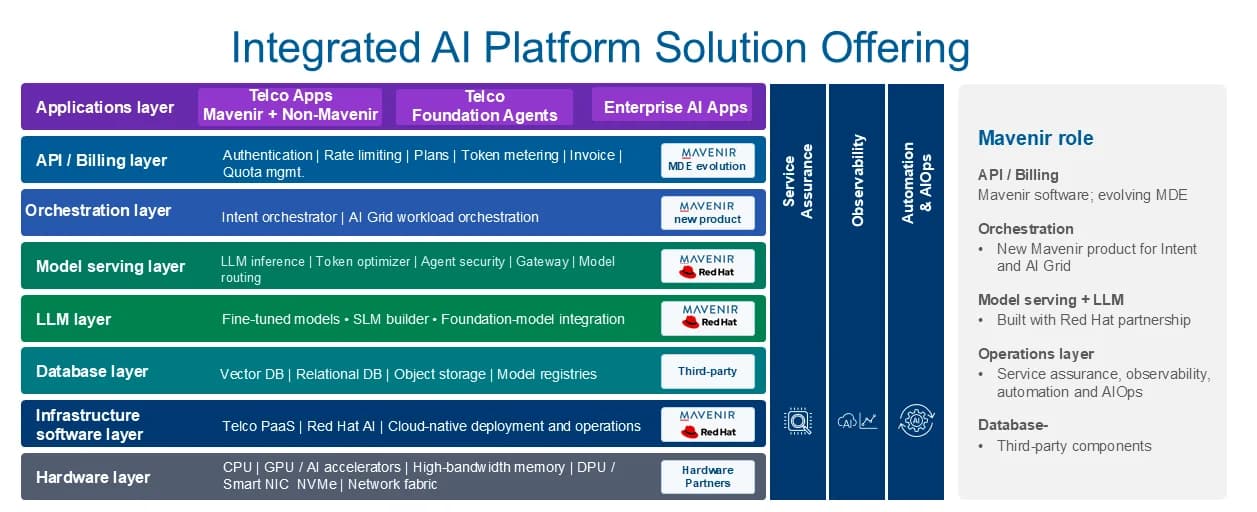
Mavenir has been building a full-stack NTN portfolio spanning packet core, NTN RAN, IMS, billing, and AI-driven network intelligence, all cloud-native and designed to run across GEO, MEO, and LEO satellite environments. Our track record with real commercial deployments sets us apart.
Iridium Communications selected Mavenir to deploy the core network for its NTN Direct service, enabling 3GPP-based D2D connectivity globally. Mavenir’s fully containerized, cloud-native Converged Packet Core runs on AWS and supports Iridium’s satellite-terrestrial NB-IoT integration, with commercial launch planned for 2026.
Terrestar Solutions partnered with Mavenir to commercially launch Canada’s first Hybrid Satellite IoT connectivity service, the first Canadian-controlled hybrid satellite-cellular IoT platform built entirely on 3GPP Release 17 standards. The service also achieved the industry’s first Voice over NB-IoT call in NTN mode, delivered via 3GPP-compliant S-band spectrum. These are not lab demonstrations. They are commercial-grade milestones that prove the technology works at scale.
In March 2026, Mavenir received the President’s Award for Outstanding Innovation at the MSUA 2026 Satellite Mobile Innovation Awards, recognized for our AI-driven, cloud-native approach to bridging terrestrial and satellite networks.
Omdia’s April 2026 LEO Satellite Communication Market Dynamics report lists Mavenir as an active vendor in the LEO satellite communication ecosystem, specifically citing our engagements with Terrestar and Iridium and our NTN-ready portfolio spanning packet core, IMS, OSS/BSS, and cloud-native vRAN.
Standards, AI, and What Comes Next
The JV’s commitment to common technical specifications and industry-wide device compatibility lines up directly with how Mavenir builds. Our solutions are grounded in 3GPP compliance (Release 17, 18, and beyond), O-RAN architecture, and cloud-native principles that work across satellite constellations and terrestrial networks without requiring proprietary lock-in.
On AI, we want to be specific rather than just use a label. Managing a D2D platform that spans multiple satellite constellations, shared MNO spectrum, and millions of connected devices is a genuinely complex orchestration problem. Static software cannot handle it well. AI-native capabilities built into the RAN and Core, covering dynamic spectrum management, predictive satellite payload maintenance, intelligent traffic routing, and monetization insights, are not a nice-to-have. They are what makes a multi-operator, multi-orbit platform work reliably at commercial scale.
“Non-terrestrial direct-to-device services unlock a new era of connectivity, delivering ubiquitous outdoor mobile coverage worldwide, even in the most remote locations. At Mavenir, we work with both mobile and satellite operators to accelerate the convergence of terrestrial and non-terrestrial networks, with our AI-by-Design NTN architecture delivering not just coverage, but a scalable service platform for continuous innovation.” — Pardeep Kohli, CEO, Mavenir
“Non-terrestrial direct-to-device services unlock a new era of connectivity, delivering ubiquitous outdoor mobile coverage worldwide, even in the most remote locations. At Mavenir, we work with both mobile and satellite operators to accelerate the convergence of terrestrial and non-terrestrial networks, with our AI-by-Design NTN architecture delivering not just coverage, but a scalable service platform for continuous innovation.” — Pardeep Kohli, CEO, Mavenir
Looking Ahead
The AT&T, T-Mobile, and Verizon joint venture sends a clear signal: the industry is done with fragmented, proprietary approaches and is ready to build on collaboration, open standards, and shared infrastructure. With 3 billion people globally still unconnected or under-connected, and a satellite D2D market projected to reach $12 billion by 2030, the urgency and the opportunity are both real.
For satellite operators building or upgrading their networks to serve this MNO platform, the infrastructure decision they make in the next 12 to 24 months will define their competitive position for years. Mavenir is ready to support that transition today, with proven deployments, a full-stack carrier-grade portfolio, and a roadmap that runs through 5G Advanced and into 6G.
The end of dead zones is not just an aspiration. It is an integration problem across spectrum, constellations, and standards. Mavenir is ready for what comes next because we’ve already shipped what came before.