*Blog by Jitin Bhandari, EVP, NeoCloud Platform and Forward Deployment Engineering, Mavenir
The Agentic Economy Playbook: Architecture, Unit Economics and Go-to-Market for CSPs and NeoClouds
Where the series has taken us
Paper 1 made the market case: agentic demand is larger and less predictable, and the durable opening sits above raw capacity. Paper 2 defined the platform: seven capabilities, built on selective ownership, that turn heterogeneous AI resources into trusted agentic services.
This paper addresses the question every board will ask next: how do we turn that into a business without making an uncontrolled capital or product bet?
Estimates of the prize vary with scope, and that range is itself instructive:
The gap between what is addressable and what operators are forecast to capture is the central point. Capacity alone will capture a modest share; the rest depends on whether providers can move up to governed services, platforms and ecosystems. And execution risk is real: as Paper 1 noted, Gartner expects more than 40% of agentic AI projects to be canceled by the end of 2027.
The winners will not be the providers with the largest announced capacity. They will be those that convert accepted capacity into trusted, billable and repeatable agentic outcomes fastest.
A vendor-neutral, staged path: decide where to play, build what to sell, scale with discipline.
Step 1: Choose the strategic position
The capacity position is the most cyclical. On-demand H100 rates fell from above $7 per GPU-hour in early 2024 to a median near $3 by mid-2026, while one-year committed rates rose about 40% between October 2025 and March 2026 as inference absorbed supply. Owners benefit when markets tighten and absorb the losses when they loosen. One independent analysis estimates hardware amortization at about 28% of a NeoCloud H100-hour price at 70% utilization. The remainder covers power, facilities, networking, operations, cost of capital and margin, and the margin portion is the part most exposed to competition. Capacity returns depend on timing, utilization and refresh cycles, not on demand alone.
TM Forum points to the other end of the spectrum: a CSP- or consortium-owned plane for agent lifecycle, policy, execution and settlement, rather than CSPs participating only as consumers in hyperscaler-governed marketplaces. Most providers will combine positions over time, but should enter through one.
Step 2: Select the first market wedge
Telenor AI Factory illustrates an operator-led model: GPU-as-a-service and models-as-a-service with more than 190 open models hosted in Norway, internal network use cases alongside external customers, and an open platform stack chosen explicitly for portability and freedom from lock-in.
Step 3: Build an asset-light supply model
As Step 1 showed, spot and term markets are moving in opposite directions, and a tight term market raises the cost of leasing. That is why the case for an asset-light model does not rest on falling prices. It rests on three risks a provider should not take before demand is proven: demand risk (capital committed before consumption is contracted), refresh risk (accelerators losing value as new generations arrive) and capital-allocation risk (balance sheet consumed by hardware rather than by the software and services layers where differentiation sits). Asset-light is a risk-allocation choice, not a bet on falling prices. In practice, that means a portfolio:
- Match commitment to demand: commit term capacity against contracted demand, use partner and operator-owned facilities where they exist, and reserve spot capacity for validation and burst
- Multi-source portability: workloads move between owned, partner and leased capacity without re-engineering.
- No capital commitment before validated demand: expand owned capacity only against contracted or observed consumption.
- Counterparty resilience: public filings from scaled NeoClouds disclose heavy customer concentration; diversify suppliers and customers from the start.
Step 4: Define the initial service catalog
Suggested starting rule (author’s recommendation): launch with two or three families and expand only as blueprints become repeatable.
Step 5: Create the commercial control plane
Pricing is moving beyond seats. Bain finds that most AI software companies are layering new meters on top of seats rather than replacing them, and that capacity-based commitments with overages are emerging as the preferred model — predictable budgets for customers, stable revenue for providers. Bain distinguishes three meters: effort (tokens, agent-hours), output (records processed) and outcome (issues resolved).
- Entitlement and pre-use authorization: confirm a tenant may run a workflow and reserve budget before execution.
- Wallets, commitments, quotas and budgets: prepaid, postpaid and committed-use constructs with hard and soft limits.
- Effort, output and outcome pricing on one rating engine.
- Supplier-cost reconciliation: every token and workflow traced to its capacity source and cost.
- Partner and reseller settlement: revenue share, wholesale rates and dispute handling
In effect, this is online charging applied to agents: reserve budget before execution, re-authorize as the workflow runs, and release it on completion. Operators have run real-time consumption control at national scale for decades. What is new is rating tokens, workflows and outcomes on one engine, and settling across multiple model, agent and capacity providers within a single transaction. Providers that already run real-time charging start with the hardest part of this problem solved.
Metering after the fact tells you what happened. Authorization before the fact decides what is allowed to happen. Agentic economics needs both.
Step 6: Establish real unit economics
Token prices are falling fast: a16z estimates the price of a fixed capability level has declined about 10x per year, and Epoch AI finds declines of 9x to 900x per year depending on the task. Yet total spend keeps rising,because consumption per task is growing faster than unit prices fall in many agentic workloads. GPU-hour and headline token prices are therefore incomplete measures.
Cost per useful output = (capacity + platform + operations + supplier cost) ÷ outputs that met quality and latency targets
The business model matters as much as the cost base. Selling capacity by the hour and selling governed services earn different margins, not just different revenue. The services model adds platform, serving and operating cost, but it captures value that raw capacity cannot: governance, evidence, routing and outcome-based pricing. Whether it pays depends on cost per useful output, sustained utilization and how much traffic is served from cache or smaller models. Because token prices are falling quickly, the services model has to win on margin per useful output, not on headline token price.
Revenue and margin must be visible by tenant, model, workflow and capacity source. CloudZero’s survey of 260 finance leaders found that 75% of organizations unable to measure AI outcomes had held back investment, compared with 38% of those that could.
Step 7: Use Forward-Deployed Engineering as the launch mechanism
As Paper 2 noted, demand for forward-deployed engineers has surged, reflecting that deployment, not models, is the constraint. For a CSP or NeoCloud, FDE is how the first customers become references:
The fourth milestone is the one most often skipped – and the one that proves a business rather than a pilot.
Step 8: Design the GTM ecosystem
An operator that becomes an AI provider brings its enterprise, public-sector and wholesale relationships with it. Channel rules – who owns the account, who sets price, how revenue is shared — must be defined before the first partner-sourced deal, not after.
Step 9: Apply disciplined stage gates
Indicative roadmap (author’s recommendation, to be adapted per provider): Foundation (lighthouses committed), Prove (repeatable outcomes and reconciled revenue), Scale (multi-tenant and partner-sourced growth), Monetize (marketplace and ecosystem revenue) — each with a measurable kill-gate.
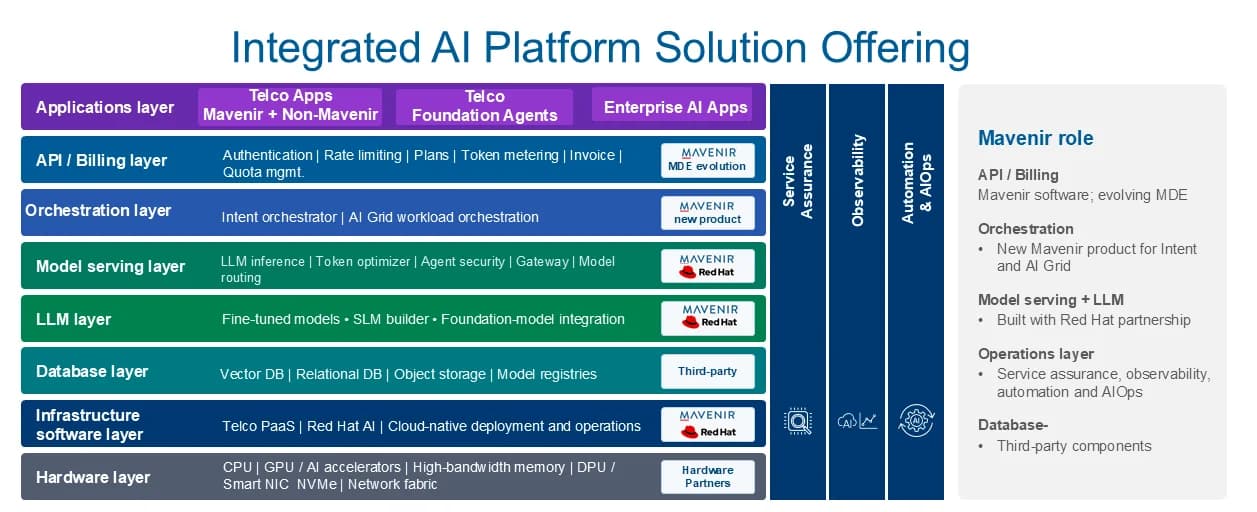
At Mavenir, our forward-deployed engineering practice is built around exactly these gates: a lighthouse is not complete until an outcome is in production and consumption has been authorized, metered and reconciled end to end. Two areas of our experience apply directly. Real-time policy and charging, built for operators running consumption control at national scale, is the foundation the commercial control plane in Step 5 requires. Voice, messaging and IMS, the systems that carry the communications session, are where communications agents will run. Applying this operating discipline to agentic services is how capacity becomes a business rather than a stranded asset.
Note: Frameworks, thresholds and phase timings in this series are the author’s recommendations, not industry benchmarks.
A 12-question readiness framework
A discussion framework for CSP and NeoCloud executives (not a validated maturity model). Score each question 0 (no), 1 (partly) or 2 (yes). As a starting heuristic, a score below 12 suggests beginning with internal or partner-led lighthouses before external commitments.
Closing: an invitation
Market opening → Platform design → Commercial execution
The Agentic Economy is creating demand that CSPs and NeoClouds are structurally placed to serve. Capturing it does not require building a hyperscaler or making an undisciplined capital bet. It requires a clear position, a bounded first wedge, a supply model that matches capital commitment to proven demand, a platform that owns the right control points, real unit economics, and a delivery motion that turns each lighthouse into a repeatable blueprint.
If you are exploring a lighthouse, a sovereign AI program or an agentic marketplace, I would welcome the conversation. Take the 12-question assessment, and let’s compare notes on where your organization stands.
References
- Analysys Mason, GPUaaS worldwide forecast 2025–2030 (Oct 2025)
- McKinsey, AI infrastructure: a new growth avenue for telecom operators (2025)
- Gartner press release, June 25, 2025 (agentic project cancellations)
- TM Forum, The Agentic AI Marketplace Opportunity (June 2026); TM Forum Autonomous Network validations
- NVIDIA, Telcos Across Five Continents Are Building Sovereign AI Infrastructure (May 2025)
- Telenor AI Factory; Telenor and Red Hat announcement (MWC 2026)
- AIMultiple Cloud GPU Rental Price Index and SemiAnalysis H100 1-year rental index, as reported (2026)
- Silicon Analysts, GPU rental premium decomposition (July 2026)
- Bain & Company, AI Pricing: A Reality Check on Effort, Usage, and Outcomes (Aug 2026)
- a16z, Welcome to LLMflation (Nov 2024); Epoch AI, LLM inference price trends (Mar 2025)
- CloudZero 2026 AI ROI survey