SWE-2 had a weak spot, and it was not the one its launch post advertised. On Terminal-Bench 4 it scored 27.3%, roughly 28 points behind Claude Fable 5.1, while its best-looking number came from the retired 2.1 edition of the suite. Ten weeks later, Cognition SWE-2.1 scores 50.0 on Terminal-Bench 4.1. Same base model, same training philosophy, a different result on the row that mattered. That is the comparison worth making, and it is unusually clean: both are pure reinforcement-learning post-trains on Kimi K3, and Cognition re-ran SWE-2 on the new benchmark set rather than quoting its old scores, so all five rows below are the same edition of the same test for both models.
The caveat attaches to every number: they are Cognition's, published on 24 November 2026, and no outside lab has reproduced them.
A cleaner experiment than the last one
Comparing successive releases from one vendor is normally a trap, because the benchmark suite moves with the model. This pair avoids most of that. Cognition published SWE-2.1 against a re-run of SWE-2 on every row, which means the deltas are model deltas rather than edition deltas. It is the kind of thing vendors rarely do, because re-running the predecessor on a harder suite tends to make the predecessor look worse.
What the two models share is the important part of the setup. Both are post-trained on Kimi K3, the 2.8-trillion-parameter mixture of experts with roughly 104B active parameters. Neither has published weights, an API or a per-token price. Both ship inside Devin. The training recipe differs in scope rather than in kind: SWE-2.1 expands the task mix into science, performance engineering and cybersecurity, and changes the post-training algorithm to reduce oscillation in rollout length, which is what lets training stay stable from minute-long tasks to multi-hour ones.
So the delta between the two models is close to a clean measure of what one more RL pass on a fixed base can do. Not perfect — the task mix changed too, so it is RL plus a broader curriculum — but far closer than a comparison across base models would be.
The row that flipped
Terminal-Bench is where the story turns. Under SWE-2 the family had an awkward split: 92.8% on Terminal-Bench 2.1, the saturated edition, and 27.3% on Terminal-Bench 4, the current one. The high number travelled; the low one did not.
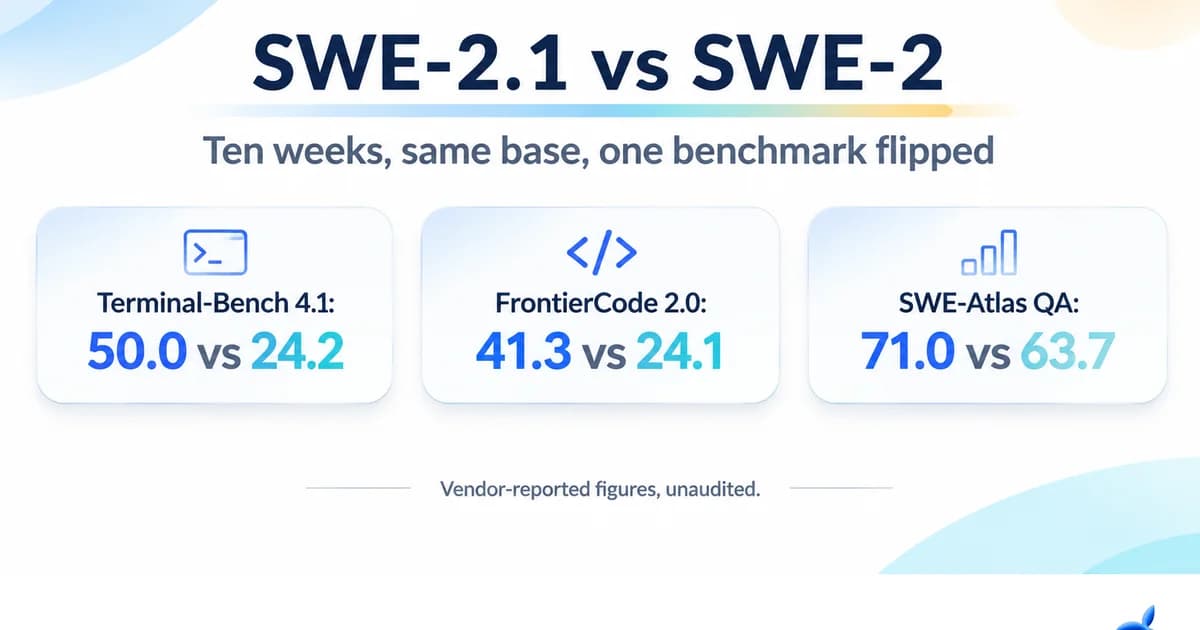
SWE-2.1 posts 50.0 on Terminal-Bench 4.1 against SWE-2's 24.2 on the same revision — a gain of 25.8 points, or 107%. That is the largest absolute improvement in the coding table and the one that changes the shape of the model's profile rather than just its level. A model that was roughly 28 points behind the frontier on long-horizon terminal work is now roughly 16 points behind Claude Opus 5.5 at 65.8, and ahead of Grok 4.7 at 38.8 and Muse Wonder at 47.0.
It is still behind K3.1, which scores 59.7 on the same row — worth sitting with, because K3.1 is the open-weight successor to the base SWE-2.1 was trained on, and it beats the post-train on the benchmark the post-train improved most.
Where ten weeks of RL bought least
The five rows do not move together, and the pattern is the most useful thing in the release:
• ProgramBench — 44.0 against 17.0. Plus 27.0 points, 159%.
• Terminal-Bench 4.1 — 50.0 against 24.2. Plus 25.8 points, 107%.
• SWE Marathon v1.2 — 54.9 against 32.5. Plus 22.4 points, 69%.
• FrontierCode 2.0 — 41.3 against 24.1. Plus 17.2 points, 71%.
• SWE-Atlas QA — 71.0 against 63.7. Plus 7.3 points, 11%.
ProgramBench and SWE Marathon reward sustained execution: keep working until a test suite passes, keep a coherent plan across a long horizon. SWE-Atlas QA is the row that reads most like answering questions about a codebase rather than changing it, and it is the row the training pass barely touched. The inference — and it is an inference from benchmark names, not a claim Cognition makes — is that this RL pass bought agentic execution, not repository knowledge. The model did not learn more about code; it got better at acting on what it already knew, for longer.
That is a different result from SWE-2's own post-train. In September the gain over Kimi K3 was between 4.5 and 5.8 points on all four published benchmarks — a constant offset, which is why the "K3 plus five" heuristic worked. SWE-2.1's percentage gains span 11% to 159%. Whatever changed in the recipe, it stopped moving every benchmark by the same amount.
The FrontierCode edition trap
One number will be misread, so it is worth naming. SWE-2's best headline figure was 50.0 on FrontierCode 1.1 Main. SWE-2.1's FrontierCode figure is 41.3. Read side by side, that looks like a nine-point regression.
It is not a comparison. The 50.0 is FrontierCode 1.1; the 41.3 is FrontierCode 2.0, a different and harder edition. On the edition both models ran — 2.0 — SWE-2 scores 24.1 and SWE-2.1 scores 41.3, a gain of 17.2 points. That is the only FrontierCode comparison the release supports, and it is a strong one. The 50.0 simply does not belong in the same sentence as the 41.3, and any chart that puts them there is measuring the benchmark revision, not the model.
The same discipline applies upward. SWE-2.1's 41.3 is 6.0 points behind Claude Opus 5.5's 47.3 on FrontierCode 2.0, and FrontierCode is Cognition's own instrument: the company writes the tasks with outside maintainers, runs the leaderboard and grades the submissions. Cognition also says it ran open models in its Devin CLI harness and closed models in each vendor's preferred harness. None of that invalidates the row; all of it belongs next to it.
What the free windows tell you
Neither model has a rate card, so price is a schedule rather than a number. SWE-2's free window for Devin Pro, Max and Teams ran through 10 October. SWE-2.1's runs through 8 December, with discounted pricing across Devin through 30 January 2027.
That structure says something about how Cognition sells. The model is not a product you buy at a token rate; it is a reason to keep a Devin subscription, and the promotion is timed to get teams onto the new checkpoint before the discount ends. If you already pay for Devin, the upgrade is close to free for two weeks and cheap for two months. If you do not, there is no path to SWE-2.1 at any price — which makes the cost comparison against any API-priced model a comparison of business models, not of tokens.
Same base, outside Devin
The base is the part you can reach. Kimi K3 is routed on OrcaRouter at $3.00 per 1M input and $15.00 per 1M output with a 1M-token context and native image input. Its successor, Kimi K3.1 Pro, is routed at $2.00 per 1M input and $10.00 per 1M output — cheaper than the model it replaces — with the same context window and an Artificial Analysis Intelligence Index of 55.1. Both are list prices passed through with no markup, so a Moonshot price change is live on our side the same day.
The honest framing is that neither is SWE-2.1. The post-train adds something specific: 41.3 on FrontierCode 2.0 against K3.1's 19.9 is a 21-point gap that no amount of base-model quality closes, because it comes from training on Cognition's own task distribution. What the base gives you is the other half — 59.7 on Terminal-Bench 4.1 against SWE-2.1's 50.0 — at a published price, in your own harness, callable from one OpenAI-compatible endpoint.
Put both behind one key and the split becomes a routing rule rather than a vendor decision: terminal-heavy agent work to the base lineage, Cognition-style repository tasks to Devin. Add a fallback chain and a model you are still evaluating does not become a production dependency the week it disappoints you.
What would make this conclusive
Two things are missing, and both are structural rather than accidental. The first is an independent run. Every number above comes from Cognition, on a suite where FrontierCode is the company's own and the harness differs by model class. A third-party Terminal-Bench 4.1 result for SWE-2.1 would settle the claim that matters most, because that is the row where the improvement is largest and the easiest to falsify.
The second is the control Cognition dropped. The SWE-2.1 table lists K3.1 in the comparison column, not Kimi K3, so the base the model was actually trained on is absent. That means the "K3 plus five" heuristic from September cannot be re-run on the new suite, and there is no way to separate how much of the 11-to-159% spread is the recipe and how much is the base having moved underneath it.
Until then the fair summary is narrower than "doubles" and more useful. SWE-2.1 is what a second RL pass on a fixed, very large base buys when the first pass was already good: a model that finally competes on long-horizon terminal work, gains least where the task is knowledge rather than action, and still sits behind the frontier on every coding row Cognition published. It is a real improvement in shape, not just in level — and the shape is the part that tells you where to use it.