The newer Kolibri is worse at English. That is not a claim from a competitor's benchmark or a hostile teardown — it is on Aleph Alpha's own model cards. Kolibri 1.1, published 23 November 2026, reports an English aggregate of 72.2 and a German aggregate of 74.2. Kolibri 1.0 — the 78-billion-parameter release from 3 October, published as Kolibri-1 — lists 75.5 English and 70.8 German. Read literally, the upgrade gives back 3.3 points of English to buy 3.4 points of German, and charges less for the privilege. Whether that is a real regression or an artefact of a revised evaluation suite is the first thing to settle before migrating anything.
The compute side is unambiguous even if the quality side is not. Kolibri 1.1 is 75.1 billion parameters with 3.44 billion active, against 78.1 billion and 3.46 billion for 1.0. Aleph Alpha models 3.4 times less GPU time per task, 30 per cent fewer output tokens on non-truncated runs, and a serving cost of 0.208 GPU-hours per thousand tasks against 0.718. Those are vendor figures on vendor hardware, and the sections below separate what is measured from what is asserted.
Two numbers moving in opposite directions
Start with the comparison the announcement leads with: an aggregate of 73.2 for 1.1 against 66.6 for 1.0. That 6.6-point gain is real as a statement about the announcement's own evaluation run, and it is the number in every headline. But the 1.0 aggregate in that comparison was re-measured, not copied from the older card, and the two published cards disagree on several sub-scores.
• SWE-bench Verified — 70.4 on 1.1. The 1.1 announcement gives 1.0's baseline as 64.0; the 1.0 card itself says 66.4.
• Terminal-Bench 2.1 — 35.6 on 1.1, against 25.8 in the announcement's baseline and 27.7 on the 1.0 card.
• AIME 2026 — 95.8 English / 94.0 German on 1.1; 96.0 English / 90.0 German on 1.0.
• GPQA Diamond — 87.1 English on 1.1 against 84.3 on 1.0.
• AgentDojo resistance — 99.1 on 1.1 against 30.3 on 1.0, which is the largest single move in the table.
The pattern is that agentic, safety and German-language scores improved, while English static benchmarks moved sideways or slightly down. That is a coherent story for a mid-training revision that emphasised tool use and the German half of the corpus. It is also exactly what you would see if the harness changed and the aggregates stopped being comparable. Aleph Alpha does not say which it is. Both readings are supported by the published documents, and the only way to resolve it is to run your own evaluation on your own traffic.
What sparse attention bought and cost
The architecture change is the part that cannot be a measurement artefact. In Kolibri 1.1's full-attention layers, each token attends to the 2,048 most relevant tokens plus the 128 most recent, with relevance scored first over 16-token block summaries and then over individual tokens in the surviving blocks. Key-value caches are shared between full-attention layers, and the first layers were densified — which is why total parameters fell by three billion while active parameters barely moved.
The benefit is at long range. At one million tokens, decode throughput rises up to 14 times: roughly 4.4 times faster per request multiplied by 3.2 times more concurrent requests, with prefill up 3.9 times. On a modelled B200 node, a thousand tasks cost 0.208 GPU-hours instead of 0.718.
The cost is at short range. Below 8K tokens, at a floor of 20 output tokens per second per user, Kolibri 1.1 decodes at 0.86 times the speed of 1.0 at 4K and 0.76 times at 1K and 2K. If your calls are chat turns, classification or short extraction, the newer model is slower on identical hardware. The crossover sits somewhere around 8K to 16K tokens, and Aleph Alpha does not publish a precise crossover point — it publishes the two ends.
There is a second confounder. Kolibri 1.0 used an FP8 KV cache; 1.1 uses NVFP4 for the main and indexer caches and BF16 for the sliding-window layers, on top of quantization-aware training. The measured speedup bundles three changes, so attributing all of it to sparse attention overstates the architecture and understates the quantization work.
The bill, on the vendor's own model
If the workload is long, the economics are not close. A 3.4-times reduction in GPU-hours per task, on the same class of hardware, is the difference between four nodes and twelve for the same throughput. Add the 30 per cent token reduction and the case for 1.1 on document-scale work is straightforward.
If the workload is short, the case inverts and the only thing that saves it is the reasoning dial. Kolibri 1.1 accepts effort levels of none, low, medium and high per request. On the vendor sweep, none averages 53.5 and emits 1,761 tokens; low averages 81.1 at 4,254; medium 84.2 at 7,632; high 85.4 at 10,925. Kolibri 1.0 also supported effort levels, including disabling thinking, but the 1.1 card is the first to publish a scored sweep. For a short-prompt workload, running 1.1 at low effort is the configuration that makes it competitive — not the default.
A denser model you can actually download
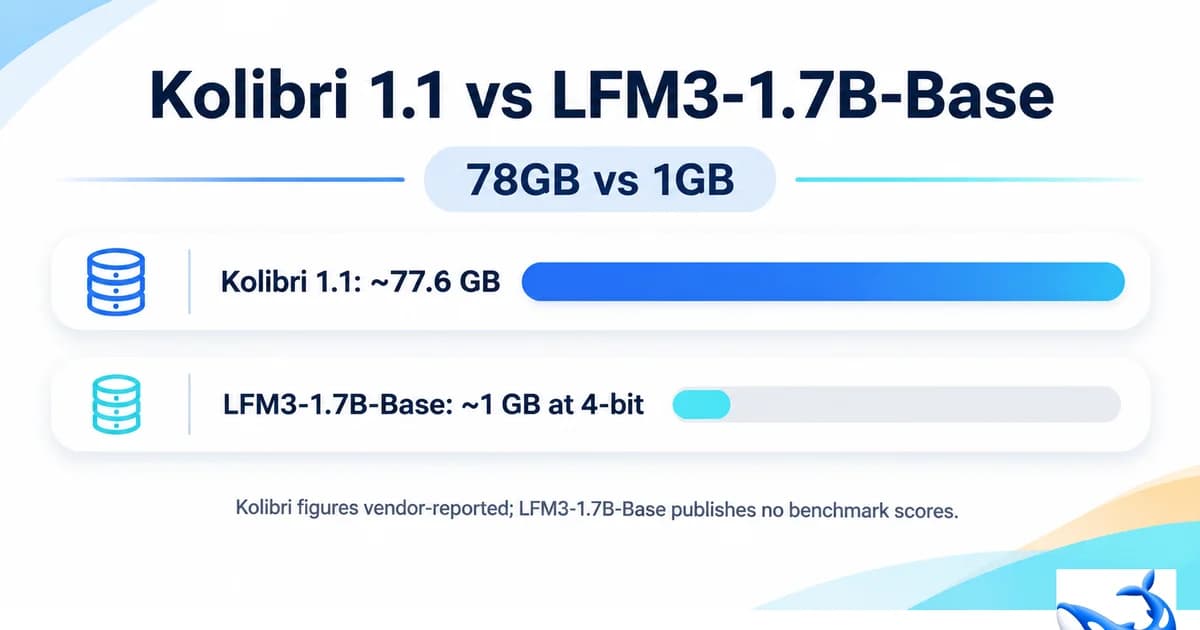
This is the least discussed improvement and probably the most consequential for anyone who is not a cloud provider. Kolibri 1.0 was published as FP8 weights at roughly 78 GB, with a minimum of two A100 80 GB cards, two H100s, one H200, one B200 or one B300. There was no official 4-bit build.
Kolibri 1.1 ships official GGUF quantizations, and the quality table is unusually candid. Q8_0 is 80 GB. Q4_K_M is 45.5 GB and loses 0.7 aggregate points. Q4_0 is 42.6 GB and loses 0.2. IQ4_XS is 40.2 GB and loses 0.4. Q3_K_M is 36 GB and loses 1.2. The sub-2-bit builds collapse: 1.75 bits per weight costs nine points. So a usable Kolibri now fits in about 40 GB of accelerator memory, which is a different procurement conversation from 78.
Two practical warnings. First, mainline llama.cpp cannot load the architecture yet — the vendor's own GGUF card says so and points at an unmerged pull request, so "GGUF support" currently means building from a branch. Second, ExLlamaV3 has no loader and there is no EXL3 artifact, so the 4-bit path through that stack is closed for now. If you need a supported, boring deployment today, it is vLLM with the vendor's package.
The migration checklist nobody writes
The two checkpoints are close enough that migration looks trivial and is not. The things that bite:
• Re-run your evaluation. The English aggregate moved down on the published cards; do not assume your English workload is unaffected because the headline went up.
• Check your prompt lengths. Under 8K tokens, 1.1 is slower. Measure before you switch, and consider keeping 1.0 for short-path traffic.
• Re-tune the reasoning effort. The scored sweep starts at none. A workload that was implicitly "high" on 1.0 may be better served by medium on 1.1, at roughly 70 per cent of the output tokens.
• Verify the serving stack. vLLM needs the vendor's inference package; llama.cpp needs a branch build; ExLlamaV3 does not support it.
• Re-baseline the licence review. Both are Apache 2.0 for the weights, but the licence does not extend to architecture, training methods or code — unchanged from 1.0, and still worth telling legal.
• Keep a control. If you are comparing the upgrade against a frontier model rather than against 1.0, put the frontier model on the same key. One OpenAI-compatible endpoint for 200-plus hosted models, at provider list price with no markup, is the shortest path to a like-for-like bill — and the failover means a provider outage does not quietly become a data point in your comparison.
Which one belongs in production
Migrate to Kolibri 1.1 if your prompts are long, your language mix is German-heavy, or you need the agentic and prompt-injection gains — the jump from 30.3 to 99.1 on AgentDojo resistance alone justifies the move for anything that touches untrusted text. Migrate if you were blocked by the 78 GB FP8 footprint, because the 40 GB GGUF tier is new and usable.
Stay on Kolibri 1.0 if your traffic is short English prompts, if your evaluation shows the English dip is real for your domain, or if you need a stack that mainline tooling supports today. The 3.4-times serving saving is real, but it is a long-context saving, and a short-prompt deployment will not see it.
The one thing not to do is treat 73.2 against 66.6 as the whole story. The aggregate moved because German, agentic and safety scores moved. English did not, and the vendor's own two cards are the evidence. A migration decided on the headline is a migration decided on the half of the model you may not be using.