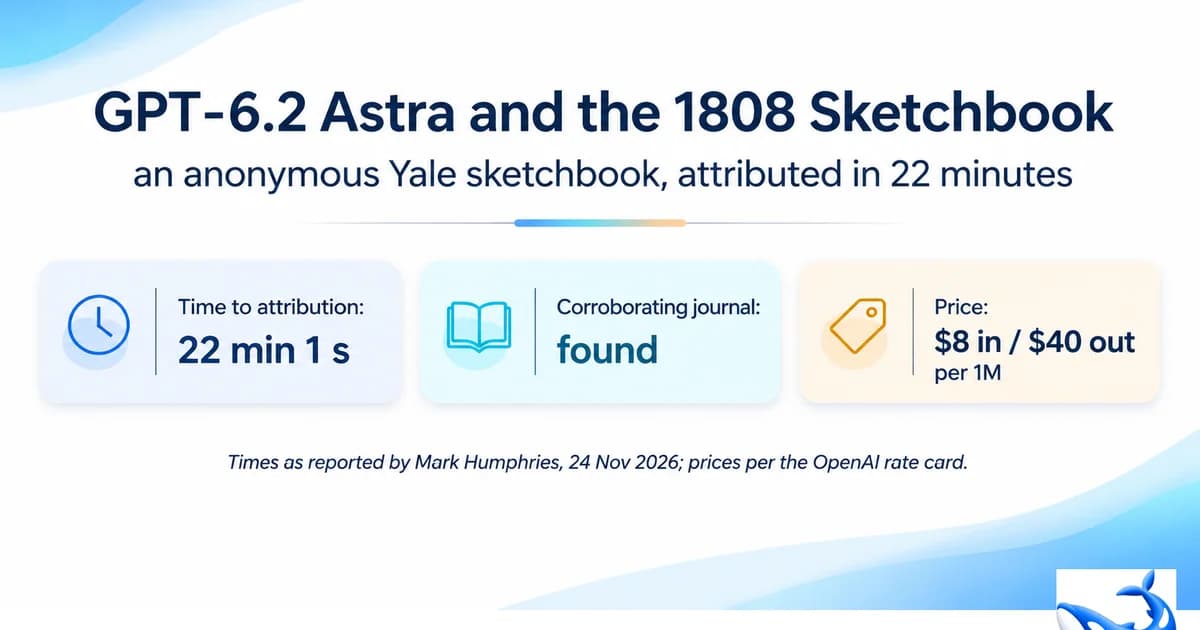
On 18 June 1808, a French traveller at Fort St. Joseph, on the north shore of Lake Huron, opened a notebook and wrote five words: "I took a sketch." Two hundred and eighteen years later, on 24 November 2026, the historian Mark Humphries published an account of how GPT-6.2 Astra had predicted that a journal it had never read would confirm an attribution it had just made — and how the journal, ordered on microfilm from Cleveland State University, did exactly that. The same prompt given to Claude Fable 5.2 reached the same name in about 35 minutes and never found the journal at all, which is the comparison that makes the case worth reading rather than just repeating.
The object at the centre of it is small. Yale's Beinecke Library holds an anonymous 1808 sketchbook, catalogue number WA MSS S-4271, recording a journey from Montreal to Lake Superior and back. Humphries gave the model the images, a short prompt, and his own published article on a different authorship question. GPT-6.2 Astra named the artist — Louis-Guy-Charles-Guillaume de Rohan-Chabot, vicomte de Chabot, a minor French aristocrat — and then proposed a way to test the answer. Both models had shipped on 17 November, a week before the post. The demonstration is the news here, not the launch.
What follows is what Humphries actually documented, where the claim is weaker than the headline suggests, and what a run of this shape costs if you want to try one.
What the model was asked, and what it ruled out
The prompt was deliberately thin. Humphries asked it to "identify the artist who painted these images", told it the images sit in the Yale Beinecke Rare Book Room, explained that he had found them while researching the authorship of Alexander Henry's Travels and Adventures, and offered two candidates he had considered and never pursued: Kendall and Berczy. He attached his own 2022 article on the Henry question, which is not neutral evidence — it points at the wrong people. He ran the model at what he describes as Ultra effort in goal mode.
Astra spent a little time on the two suggestions, then dropped them. The chronology does not work and the geography does not work. What it did next is the part worth reading closely, because it is not retrieval: it treated the sketchbook's dated drawings as testable anchors, then went looking for someone whose documented movements would pass through those places on those days.
The sketchbook itself is a modest object. Eighty-four pages, thirty-four of them carrying drawings or watercolours, a handful dated: Chaudière Falls on 8 June, the Rivière Creuse on 11 June, Lake Champlain seen from the St. Lawrence on 16 August on the return leg. That is very little to go on. A person with a good map and a week could eliminate most of Lower Canada and still not name the artist.
The finding was a prediction, not a search
The pivotal document was not about art at all. It was the Montreal diary of Joseph Frobisher, a retired fur trader who recorded the town's social and commercial comings and goings, held in McGill University's archival collections. The passage Astra surfaced, quoted in Humphries' published reasoning trace, reads: "on June 6, 1808, the vicomte de Chabot left Lachine for Kaministiquia with William McGillivray and William McKay. Five days later, the sketchbook places its traveller on the Ottawa River."
From there it extended the thread west. A letter by John Askin Jr., printed in a document collection nearly a century ago and held at Michigan State University, put Chabot at Fort St. Joseph later the same month. A 2014 doctoral thesis by Juliette Reboul, at the University of Leeds, carried a footnote — page 138, note 468 — that pointed to Chabot's own "Journal to the Upper Country". That journal survives as 162 notebook pages on the Lafayette papers microfilm, reel 55, in the special collections at Cleveland State University, and it is not online.
So the model did the thing that separates research from summarisation. It committed to an answer, named the document that would break it, and waited. Humphries ordered the scans. The handwriting matched. The itinerary lined up with the dated drawings. And on 18 June 1808, at Fort St. Joseph, in the entry corresponding to folio 17r, Chabot wrote that he had taken a sketch, then described the view in the drawing. A separate contemporary source, the George Nelson journal at Toronto Public Library's Baldwin Collection, records on 1 August 1808 that "A Great Personage is said to have come to Fort William by the name of Count de Chabot."
The document trail, gathered in one place:
• The sketchbook — Beinecke Library, Yale, WA MSS S-4271; begun March 1808, acquired 2020, digitised.
• Frobisher's diary — McGill University archives; the 6 June 1808 entry naming Chabot, McGillivray and McKay.
• The Askin letter — Michigan State University archive; printed in a collection nearly a century old.
• Reboul's thesis — University of Leeds, 2014, p. 138 n. 468; the footnote that located the journal.
• Chabot's journal — 162 notebook pages, Library of Congress Lafayette papers microfilm reel 55, Cleveland State University Special Collections; not digitised.
• Nelson's journal — Toronto Public Library, Baldwin Collection, S 13; the 1 August 1808 corroboration.
The journal is a genuine by-product of the exercise. Humphries notes that it carries attached excerpts from North West Company papers that no longer exist, which makes it a new primary source for fur-trade historians regardless of how it was found.
Fable 5.2 found the name but not the journal
The comparison is the most useful part of the post for anyone choosing a model, and it is the part the aggregator coverage dropped. Humphries reran the identical prompt on Claude Fable 5.2. It named the same artist in about 35 minutes, wrote a more coherent explanation, and followed an almost identical research path — and it never found Chabot's journal. The corroborating document, the thing that turns a plausible answer into a verified one, was missing.
Read that carefully before drawing a leaderboard from it. This is one prompt, one case, run twice, self-timed by the person who wrote it up. It is not a benchmark, it has no error bars, and the two runs were not blinded. What it does support is narrower and still interesting: the attribution capability appears to be present in more than one frontier model, while the persistence to keep hunting for a confirming source differed between them on this task. That is a difference in agentic follow-through under a long horizon, which is exactly the property a single-turn eval cannot measure.
Humphries is careful about this himself. He calls the result "humanlike at first glance although it most certainly is not", says the mechanism cannot be inspected because "the models are black boxes", and warns that excessive doubt is its own failure mode — Astra later hedged by describing the diary as "an anonymous diary attributed to Chabot" after having correctly identified it. He also suspects that math-heavy post-training may limit how well these models chain research problems, which is a hypothesis, not a finding.
What a 22-minute research run costs
Nobody in the coverage has published a price for this run, and Humphries does not give a token count, so any dollar figure attached to the 22 minutes is a guess. What can be stated exactly is the rate card, and it matters more than usual here because a run of this shape is input-heavy: archive scans, long documents, and repeated context re-sends across many tool calls.
• Rate — GPT-6.2 Astra bills at $8 per million input tokens and $40 per million output tokens on requests up to 272K input tokens.
• Long-context tier — above 272K input tokens per request, the same model bills at $16 and $60, with cache reads moving from $0.40 to $0.80 per million.
• Compared with Fable 5.2 — $8 and $40 per million flat, with a 1M-token context and no long-context surcharge.
• Context and output — Astra carries a ~1.05M-token context window and up to 128K output tokens, with selectable reasoning effort.
• What is not published — the number of tokens the run consumed, which is the only figure that would turn these rates into a bill.
The practical consequence is a decision, not a curiosity. If you reproduce this kind of archival loop, the difference between the two models is not the headline rate, which is identical, but where the long-context surcharge starts. A workflow that stuffs whole document sets into a single request crosses 272K quickly and doubles its input cost on Astra while staying flat on Fable 5.2. Chunking, retrieval, or aggressive prompt caching changes the arithmetic more than the model choice does.
This is the part of the pipeline where a routing layer is not decoration. OrcaRouter passes provider list price through at 0% markup, so Astra is $8 and $40 here for the same reason it is $8 and $40 on OpenAI's card, and the long-context tier applies exactly as above. Both models sit behind one key and one base URL, which means the only honest way to answer "does this reproduce?" — running the same prompt against both and diffing what comes back — is a configuration change rather than two contracts and two SDK setups.
What this case does not prove
It is one attribution, in one subfield, with a human in the loop doing the verification and supplying the domain framing. Humphries calls it a "narrow example" himself. It does not show that the model can interpret historical evidence, weigh competing interpretations, or write history; it shows that it can search a very large space of digitised and microfilmed records, hold several threads at once, and generate a falsifiable hypothesis. The failure mode matters too: the model hedged its own correct conclusion afterwards, which is the opposite of the overconfidence people usually worry about.
It is also not a clean capability comparison. Fable 5.2 found the same answer, and a reader could reasonably conclude that the durable capability is emerging across labs and the difference here is variance. The stronger signal is the shape of the method — forward from the sketchbook's dated drawings, backward from the documentary record of 1808 British North America, meeting in the middle — because that is a procedure a researcher can copy, and it is why the result landed the way it did.
How to run the comparison yourself
The test is cheap to design and hard to fake. Take a document set with a known-but-unpublished answer, give the model only the object and a thin prompt, and ask it to name the source that would settle the question before it looks. Score the run on whether that named source exists and whether it actually confirms the answer, not on whether the prose sounds confident.
Run it against more than one model on the same inputs, because the interesting variable is not the first answer but how long each one keeps looking. On OrcaRouter the two ids are openai/gpt-6.2-astra and anthropic/claude-fable-5.2, both at $8 and $40 per million tokens, reachable from the same endpoint. Automatic failover is the other half of the argument: an unproven long-horizon workflow is exactly the thing you do not want to hang a production path on, and a routed request that falls back to a second provider is a cheaper way to find out whether the loop completes than a dedicated integration with one vendor.
What to watch next is Humphries' own prediction rather than a benchmark. He expects historians to face, by spring or summer, "a sort of crisis of confidence" over systems that can do parts of the work they cannot — and argues it will be milder than in mathematics, because history is interpretive rather than a single-answer game. This sketchbook is a data point for that argument, not a verdict on it. The attribution is verified; the general claim about what these models can do to a discipline is still open, and one 22-minute run does not close it.