Thermal management challenges are becoming increasingly complex across industries, from electronics and aerospace to industrial equipment and energy systems. Engineers are challenged to improve performance, reliability, safety, and cost efficiency while simultaneously accelerating product development timelines.
Today, the question is no longer whether simulation should be part of the engineering process but what kind of simulation best suits the engineering decision needed.
Why Thermal Simulation Matters
Thermal performance affects far more than temperature. Inadequate thermal management can reduce product reliability, cause structural deformation and thermal stress, compromise cooling efficiency, increase development costs, lengthen validation cycles, and create greater reliance on physical prototypes.
Simulation helps engineers understand heat transfer behavior early in the design process, identify potential risks, and evaluate alternatives before costly design changes become necessary. Just as importantly, simulation enables teams to balance speed and accuracy. Not every engineering challenge requires a detailed computational fluid dynamics (CFD) model, and not every design decision should wait for high-fidelity analysis. The most effective workflows generate rapid insights early and introduce greater detail only when it adds value.
Building a Thermal Simulation Strategy Around Engineering Decisions
Ansys, part of Synopsys, approaches thermal simulation with a portfolio of solutions designed to support different stages of product development and varying levels of engineering complexity.
Rather than functioning as stand-alone tools, these solutions work together in an integrated workflow, enabling engineers to apply the appropriate level of simulation fidelity for each decision.
Thermal Desktop Software: Efficient System-Level Thermal Analysis
As products become larger, more interconnected, and increasingly complex, engineers often need to assess complete thermal systems rather than individual components.
This is where Ansys Thermal Desktop thermal-centric modeling software delivers substantial value. The platform combines 0D and 1D flow networks with 2D and 3D thermal modeling, radiation analysis, two-phase flow capabilities, and parametric studies in a single environment.
Thermal Desktop software enables efficient system-level thermal analysis and early-stage design evaluations by combining multiple fidelity levels to model complex thermal interactions at a fraction of the computational cost and runtime of full-scale high-fidelity analyses, such as CFD simulations.
Example Applications
Heat Exchanger Analysis
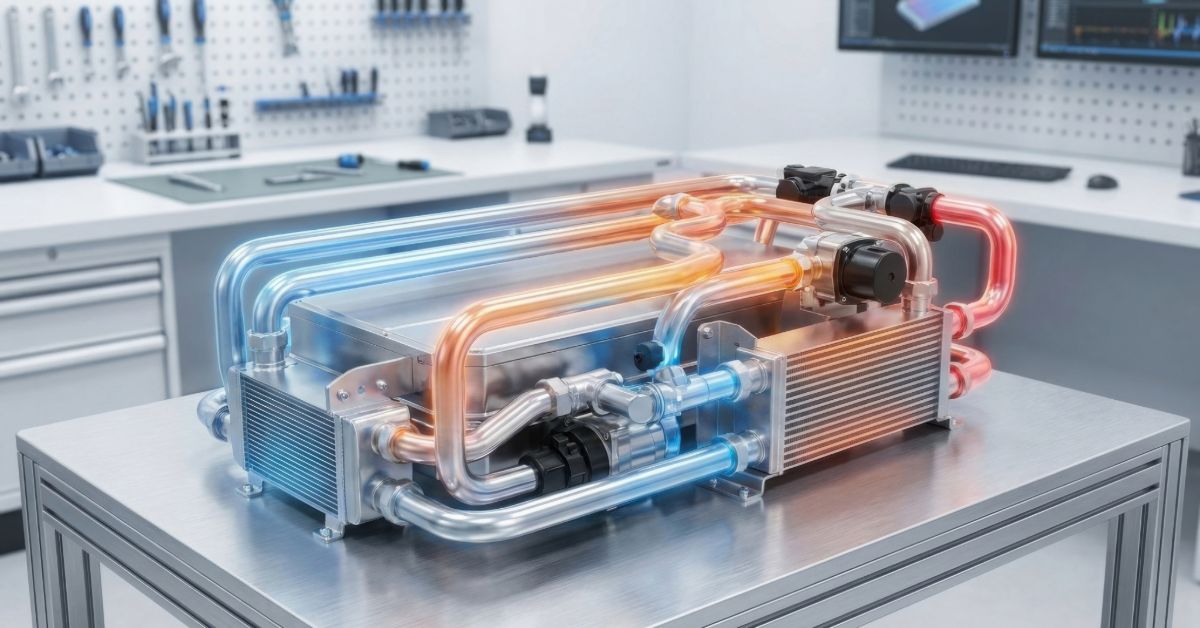
By combining flow networks with thermal models, engineers can evaluate two-phase heat exchanger performance in seconds rather than hours. This accelerated analysis supports more design iterations and faster optimization.
Industrial Cooling Systems
Complex cooling loops that incorporate pumps, valves, and heat exchangers can be analyzed across extended transient operating periods with minimal computational resources. This lets engineers better understand performance under realistic operating conditions without the expense and time associated with large-scale simulations.
Manufacturing Processes
Processes such as quenching involve rapid temperature changes, phase transitions, and boiling effects that can be challenging to predict through testing alone.
Request a 30-day free trial of Thermal Desktop software.
Ansys Fluent Software: High-Fidelity Thermal CFD Analysis
When fluid flow and convection become the dominant drivers of thermal behavior, higher-fidelity analysis is often required.
Ansys Fluent fluid simulation software, a leading CFD platform, provides detailed thermal insights for complex flow-driven applications. Fluent software supports a broad range of physics, including conduction, convection, radiation, multiphase flow, conjugate heat transfer, chemical reactions, and high-performance computing. Continued advances in graphics processing unit (GPU) acceleration are also enabling engineers to solve increasingly sophisticated thermal simulations faster than ever.
Real-World Applications of Fluent Software
Heat Exchanger Optimization
Heat exchanger performance depends on accurately capturing the interaction between fluid flow and heat transfer.
Using Fluent software, engineers can model fluid convection, solid conduction, and thermal interactions between hot and cold streams. This level of detail helps teams optimize thermal performance while balancing pressure drop and overall system efficiency.
Electronics Cooling
For high-power electronics and densely packed systems, thermal performance is often a critical design constraint.
The Fluent tool enables engineers to analyze coolant flow paths, optimize cold plate designs, identify localized hot spots, and improve overall thermal management strategies. The result is more effective temperature control without unnecessary cooling system penalties.
Battery Thermal Runaway Analysis
Battery safety remains one of the most significant thermal challenges facing modern engineering teams.
Fluent software can simulate thermal propagation, gas generation and release, heat transfer mechanisms, radiation effects, and mitigation strategies. These insights help engineers evaluate safer battery designs while reducing dependence on extensive physical testing programs.
Turbine Blade Life Prediction
High-temperature turbine applications require a detailed understanding of thermal behavior and cooling effectiveness.
Fluent simulation provides valuable insight into cooling channel performance, temperature distributions, conjugate heat transfer, and localized hot spots. The resulting thermal data can then be transferred to Ansys Mechanical structural finite element analysis software for structural, fatigue, and life prediction analyses, creating a comprehensive multiphysics workflow.
Request a 30-day free trial of the Fluent GPU solver.
Choosing the Right Tool for the Right Question
Successful thermal management is not about performing more simulations. It is about performing the right simulations at the right stage of the design process.
A practical approach is to use Thermal Desktop software when modeling complete thermal systems at an early design stage, analyzing flow networks, evaluating radiation effects, studying two-phase flow behavior, or performing rapid system-level assessments.
Fluent software is the better choice when fluid flow dominates thermal performance, high-fidelity CFD analysis is required, detailed heat transfer behavior must be captured, or local temperature distributions and hot spots are critical design considerations.
Key Takeaways
As thermal challenges continue to grow in complexity across industries, simulation strategies must evolve in parallel. The most successful engineering teams recognize that different design questions require different levels of fidelity and analysis.
By combining Thermal Desktop software and Fluent software in a connected simulation workflow, organizations can move efficiently from early concept exploration to detailed design validation. The result is faster development cycles, improved product performance, and greater confidence in engineering decisions.
In thermal management, success does not come from running more simulations. It comes from running smarter simulations.
To learn more about how Ansys solutions support thermal decisions from concept development through validation and troubleshooting, explore the webinar on simulation solutions for heat transfer and thermal management.