Wildfires are becoming increasingly frequent, intense, and destructive worldwide — and they’re appearing in areas that rarely faced them before. This is causing significant harm to both people and the environment at unprecedented levels. To manage this, governments, emergency responders, and infrastructure operators require access to faster, more accurate information to prevent small fires from escalating into large-scale disasters.
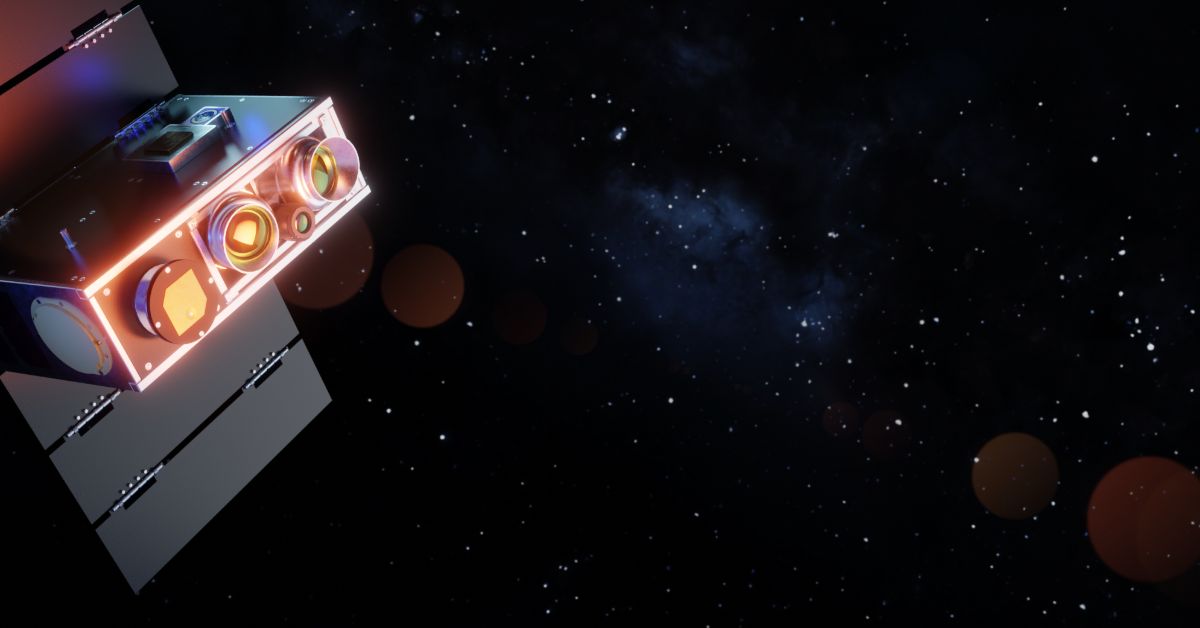
OroraTech's Wildfire Solution platform combines data from satellites and ground-based sources to provide near-real-time wildfire detection and monitoring around the world, using highly sensitive infrared cameras to detect fires from space. These optical systems must remain precisely aligned despite experiencing extreme acceleration, vibration, and shock during launch. Here, we discover how OroraTech uses Ansys, part of Synopsys, simulation solutions to help address this issue, reducing overall optomechanical development effort and design iteration time by 50%, to create a mechanically robust thermal camera solution for its satellites.
Imagine you’re a fire lookout gazing across a seemingly endless horizon of treetops from your lookout tower in the northern Quebec territory. This is no simple job. Quebec is twice the size of Texas, and forest fire ignition can easily go unnoticed in this sparsely populated area.
And in Quebec, these fires are not uncommon. As Zach Ricklefs, a senior communications and content manager from the German-based aerospace startup OroraTech shared, there can be around 15-20 fires happening in Quebec at any one time.
Today, even if these wildfires are seen by fire lookouts or airplanes, they take time to act on. For instance, if you spot the tell-tale signs of a wildfire from your tower, that’s just the beginning. In this remote location, it can take hours for help to arrive, and, by then, the fire may have spread.
The innovative wildfire detection company OroraTech has been focused on addressing this challenge, asking how we can better detect and prevent wildfires — especially in remote areas. As a result, SOPFEU, Quebec’s provincial fire authority, has become one of OroraTech’s many global customers.
By integrating structural and thermal simulation solutions from Ansys, part of Synopsys, OroraTech offers an alternative to traditional methods of wildfire detection through a growing constellation of thermal imaging satellites designed specifically to detect and monitor wildfires from space, which is a significant improvement on existing wildfire monitoring systems that rely on human observation, land-based cameras, and structures such as fire lookout towers.
With access to the software through the Ansys Startup Program and support from CADFEM Germany GmbH, an Ansys Elite Channel Partner, OroraTech designs satellite technology to power a wildfire intelligence platform to deliver near-real-time wildfire intelligence and prediction that can help emergency teams make faster, more informed decisions.
Fire detection and fire spread prediction
The Importance of Turning Satellite Data Into Wildfire Intelligence
OroraTech enables those preventing, fighting, and analyzing fires on Earth to more easily turn data into actionable insights. “OroraTech’s space-based wildfire intelligence platform helps users to understand, detect, monitor and predict wildfires efficiently, enabling them to allocate resources more effectively to manage the fire with data-backed insights,” explains Tarakaram Kolusu, a mechanical simulation engineer at OroraTech. “Helping with the wildfire crisis is essential because it helps to prevent human and wildfires tragedies, forest and vegetation loss, and also pollution to the environment from the fire’s smoke,” Kolusu adds.
OroraTech data detecting wildfires (in orange) and their predicted spread (with each hour represented by a new color)
With a constellation network of 35+ satellites that spans all of Earth and detects fires as small as a car, it’s no surprise that OroraTech is scaling its impact worldwide, with customers spanning North America, South America, Europe, Asia, and Australia. Their goal is to have satellites overpass a fire every 30 minutes, giving first responders new fire detections and updated data as frequently as possible. “It really is a global solution to what is increasingly a global problem, so we’re trying to scale as quickly as we can,” says Ricklefs.
Top: A regular satellite image of the Mauna Loa volcano in Hawaii on the left, with a thermal heat image of the same volcano on the right; bottom: OroraTech’s Forest-3 satellite
Part of this scaling means using the latest technology available. For instance, the team relies on artificial intelligence (AI) “in every part of our pipeline, from first detection to … building data tools,” says Ricklefs. “AI is built into the satellites to detect fires in orbit before downloading the data to Earth, built into our data processing system to quicken results, and into our Fire Spread tool to predict a fire’s next move. New technology creation and adoption is very important to us.”
But detecting wildfires from orbit depends on more than advanced sensors and AI. OroraTech must also ensure that its sensitive thermal imaging payloads can survive the extreme conditions of a satellite launch. To address that challenge, the team turned to simulation.
Solving Satellite Design Challenges With Simulation
For OroraTech’s technology to function optimally and achieve mission success, it needs to detect active and potential wildfires with the utmost precision. However, this is difficult due to the fragile and sensitive optical elements in OroraTech’s thermal imaging payloads. These delicate payloads must survive severe mechanical environments during satellite launch, including quasi-static acceleration, sine and random vibration, and shock loads.
According to Kolusu, OroraTech needed to overcome the key optomechanical challenge of developing a lens-mounting and support architecture that could withstand launch-induced loads while minimizing stress and deformation in sensitive optical components.
Solving this problem isn’t easy due to the satellite structure research and development (R&D) process, which Kolusu tells us is resource-intensive, requiring significant time, engineering effort, and costs that only increase when manufacturing and testing structural prototypes.
As such, OroraTech used Ansys Mechanical structural finite element analysis software to perform mechanical analyses to evaluate the satellite’s structural integrity, stability, stiffness, and survivability under launch-induced loads. “The simulation results help identify critical stress and deformation regions, verify margins of safety, and support design optimization prior to physical qualification testing,” says Kolusu.
By evaluating the satellite structure early in the design process, OroraTech iteratively optimized and tailored its components to meet mission requirements before manufacturing and physical qualification testing.
“One of the primary benefits of structural simulation is the significant reduction in development time, engineering effort, and prototyping cost,” says Kolusu. “Virtual testing enables multiple design concepts to be evaluated under representative launch-load conditions before hardware manufacturing and physical testing, significantly accelerating the development cycle.”
For OroraTech’s thermal imaging payloads specifically, this iterative approach helps develop a mechanically robust thermal camera that can handle the loads and stresses experienced during launch, including within the sensitive optical components. “By reducing the risk of lens fracture, displacement, or deformation, the structural design helps preserve optical alignment and imaging performance, thereby supporting accurate Earth observation and high-quality image acquisition,” explains Kolusu.
Ansys structural simulations reduced OroraTech’s optomechanical development and design iteration time by approximately 50%, to create a mechanically robust thermal camera solution for their satellites.
These benefits were made possible through OroraTech’s participation in the Ansys Startup Program and collaboration with CADFEM. “This support has helped us better evaluate structural performance, improve our simulation methodology, and use the software more efficiently to optimize and enhance our product design,” says Kolusu. “Gaining affordable access to cutting-edge simulation and analysis tools through the Ansys Startup Program has helped us develop innovative solutions faster and more efficiently. This helps us to reduce the cost of physical prototyping and get our important solutions to market faster at a time when this technology is really needed.”
Building the Future of Wildfire Monitoring From Orbit
By adopting advanced technology solutions, OroraTech is constantly elevating its product and achieving new milestones, thereby demonstrating how rapidly its vision is becoming reality. For example, the company has expanded its satellite capabilities, having recently launched thermal satellites for Greece’s Hellenic Fire System (HFS).
The HFS project aims to deliver a constellation of four satellites for the Greek government for wildfire detection, scanning the entirety of Greece to provide continuous thermal monitoring to support emergency response and climate research activities.
Photos of the FOREST-17 and FOREST-18 of Greece’s Hellenic Fire System (HFS)
This collaboration resulted in the world’s first national wildfire detection constellation. Through this work, Greece can now serve as “an example for other governments, not only Europe, but all over the world,” says Kolusu.
OroraTech Wildfire Solution platform, Crete, Greece
The company plans to scale to over 100 satellites over the next two to three years. This would shorten their fire revisit times, enabling quicker updates such as being able to give firefighters new data every 20-30 minutes. “This has never been done before, and it's something we can pioneer to support firefighters with great impact,” says Ricklefs.
To make this future a reality, Kolusu emphasizes the importance of using simulation to reduce physical testing and the associated costs for each design modification as OroraTech expands its satellite constellation network. “Simulation significantly reduces development time and testing effort, accelerates design iterations, and supports a more scalable production process while maintaining the required structural reliability and launch survivability,” says Kolusu.
See how the Ansys Startup Program supports startups developing the next generation of breakthrough technologies.
Want to learn more about how simulation enables aerospace companies to make positive global changes? Visit our site exploring the future of space.
Just for you. We have some additional resources you may enjoy.
TAKE A LOOK
“One of the primary benefits of structural simulation is the significant reduction in development time, engineering effort, and prototyping cost. Virtual testing enables multiple design concepts to be evaluated under representative launch-load conditions before hardware manufacturing and physical testing, significantly accelerating the development cycle.”
— Tarakaram Kolusu, Mechanical Simulation Engineer, OroraTech