On Small Business Saturday, more money went back to brands consumers had bought from before: repeat customers spent 14.5% more than last year, and every business-size group grew by double digits.
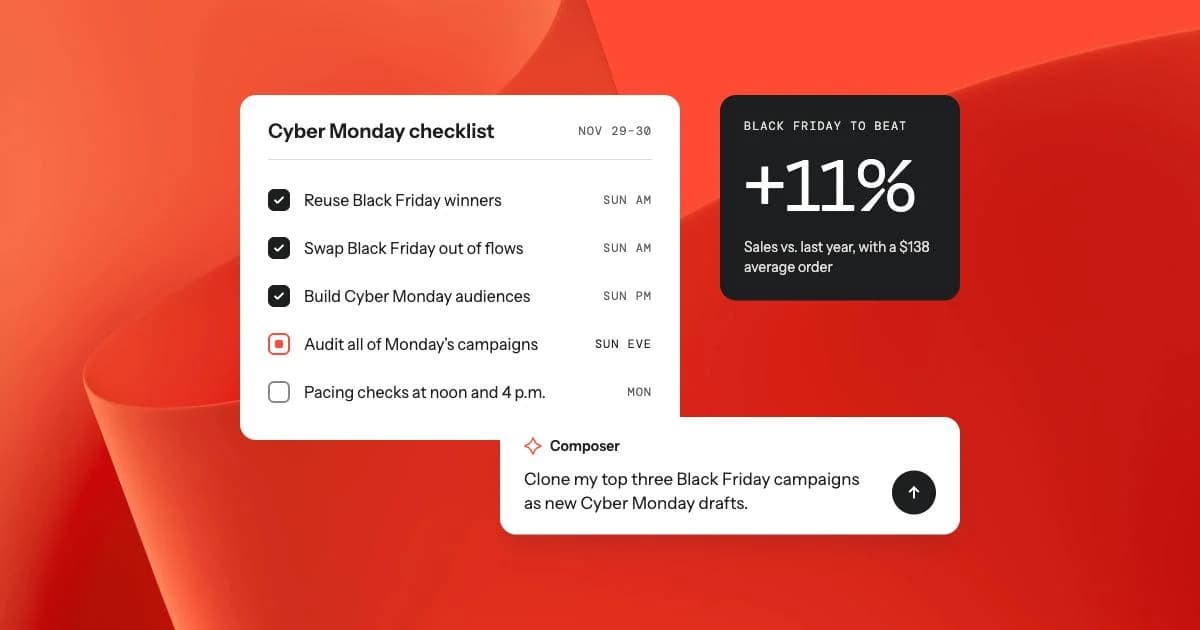
Small Business Saturday grew same-site sales for Klaviyo brands 11% year-over-year (YoY), in step with the rest of Black Friday Cyber Monday (BFCM) 2026 so far. All three days have grown between 10% and 11%, and Thanksgiving through Saturday is up 11% combined.
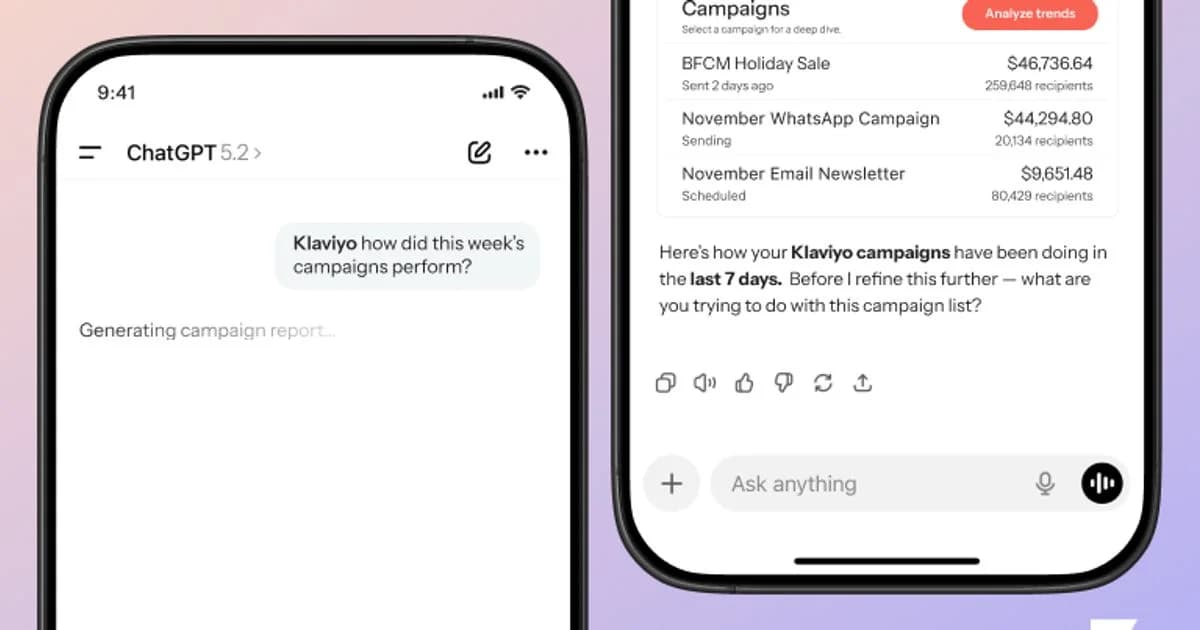
Brands are leaning on AI to keep up, too. More than 50,000 brands used Klaviyo's AI marketing agent, Composer, in the first days of BFCM, about 1 in 4 of active brands on Klaviyo. Roughly 70% of the campaigns brands made in a Composer chat went out within a day of being created. Among brands that joined Klaviyo in November, those that used Composer earned about twice as much per campaign as those that didn't. The largest brands leaned on Composer for analysis, putting 35% of their Composer use into analytics.
For the two days still ahead, this data suggests retailers should give their repeat customers first pick, reach shoppers on more than one channel, start building the relationship with this weekend's new buyers before December arrives, and use Composer to move faster.
Repeat customers led Small Business Saturday
Revenue from repeat customers grew 14.5% on Saturday, well ahead of the 9% growth from new buyers. New buyers still brought in more of the day's revenue, but spending from the customers brands already knew grew faster, and by a wide margin.
Apparel had a big day, too. After home and garden led on Thanksgiving and Black Friday, apparel took the top spot on Saturday with 15.5% growth. Home and garden (13.9%) also beat the 11% average across all Klaviyo brands.
That makes Small Business Saturday a retention win as much as a sales one.
Use this prompt to drive more repeat customer business with Composer now:
ComposerBFCM + peak seasonReward top customers with early BFCM accessBuild a genuine early-access program for your best customers before the noise.See full prompt
Brands big and small grew by double digits
The day named for small businesses turned out to be a good day for brands of all sizes. Sorted by gross merchandise value (GMV) over the past 12 months, all four size groups Klaviyo tracks grew same-site revenue by double digits on Saturday.
Brands with $100 million or more in GMV grew fastest, at 12.1%. They were followed by brands at $30 million to $100 million (11.6%), $10 million to $30 million (11.4%), and under $10 million (10.4%).
The spread is narrow season to date, too, with every size group between 12.2% and 13.6%. This means that growth this season isn't just landing on the biggest brands.
Use this prompt to drive more revenue with Composer now:
ComposerCampaign creationBuild a campaign: create a ready to send campaign based on past performanceBuild a campaign: create a ready to send campaign best of past performanceSee full prompt
Shoppers reached on email and text pulled more than their weight
Shoppers who hear from a brand on more than one channel are responding more, too. At same-site brands that send both email and text messages (SMS, MMS, and RCS), shoppers reached on both channels during Thanksgiving and Black Friday made up 14.6% of the shoppers reached. They accounted for 35.1% of responders (the shoppers who clicked) and 29.2% of revenue. That's 2.4 times their share of reach in responses, and twice their share in revenue.
This comparison is at the shopper level: it looks at shoppers at the same brands who were reached on one channel or on both. It shows a pattern, not proof that a second channel causes the extra spend, since shoppers who opt into both may already be a brand's most engaged. Either way, it's a strong reason to make sure your repeat customers hear from you on both channels.
Season to date is up 12.7%, with nearly half of last season in
Same-site revenue is up 12.7% season to date (November 1–28). So, how much shopping is still ahead? Based on last year's spending patterns, we're just about halfway through the holiday shopping season and 62% of the way through BFCM. There's still plenty of shopping to come, with two of the biggest days still ahead.
Daily growth ran hottest in the first days of November, then settled into a steadier range through the run-up to BFCM, where it has held through Saturday.
Revenue from text messaging is up 16.8% season to date, ahead of other site revenue (13.3%) and email (10.3%). Repeat customers (13.5%) are growing faster than new buyers (11.9%). Germany (20.4%) and France (14.9%) lead by market, the US (13.1%) is tracking just above the overall average, and the UK (9.7%) trails it. Home and garden still leads the verticals season to date at 16.4%.
The five-day total isn't settled yet. Sunday and Cyber Monday are still ahead, and the latest day's figures can move as late activity comes in, as Thanksgiving's did.
Use this prompt to turn new BFCM buyers into 2027 repeat buyers in 2027:
ComposerBFCM + peak seasonTurn BFCM buyers into loyal, profitable customersBuild a 90-day plan that turns first-time BFCM buyers into loyal, repeat customers.See full prompt
How brands are using Composer this BFCM
Composer has been busy this BFCM week. Usage data from Monday, November 23, through Black Friday points to 4 patterns.
Composer campaigns drove 2x more revenue
About 1 in 4 brands on Klaviyo used Composer for BFCM this year. And of brands that relied on Composer entirely for BFCM, most were new to Klaviyo and saw 2x more revenue using Composer than new brands that did not.
Composer in action: A wellness-tech brand ran its first BFCM campaigns. It joined Klaviyo in 2025 and sent no campaigns in last year's BFCM week. This year it used Composer to write its first two and build 4 flows. Revenue is up 384%.
Composer is where brands go when the clock runs down
70% of the campaigns brands made in a Composer chat and sent this week were created the same day or the day before they went out. Across all email campaigns on Klaviyo, that share was 56%.
Composer in action: A footwear brand kept its campaign count and quadrupled its reach. It sent 3 BFCM campaigns, the same as last year, built with Composer and its templates, to 4 times as many recipients. Revenue is up 312%.
Large brands use Composer to analyze, and small brands use it to build
Large brands spent 35% of their Composer use on analytics, against 9% for the smallest brands. The smallest brands put 30% of theirs into writing emails and campaigns, against 11% for large brands.
Composer in action: A home goods brand in Australia used Composer as an analyst. It asked about performance and ran audits more than it built emails, sent 3 campaigns (down from 7), and built 7 flows. Revenue is still up 20%.
On Black Friday, brands fine-tuned with Composer.
Compared with the Friday before, requests to update a campaign rose 29% and requests to build a segment rose 17%. Requests to create a new campaign or email fell 28%. Some of that shift is holiday demand, but the building happened earlier in the month. See how to use Composer for Cyber Monday, now.
Composer in action: A European supplement brand doubled its BFCM calendar. Most of its Composer requests were for emails and campaigns, plus segments and performance checks. It sent 20 BFCM campaigns, up from 10 last year, to about 3 times as many recipients. Revenue is up 224%.
What to do with the rest of BFCM
- Give repeat customers the first pick. Repeat customer revenue grew 14.5% on Saturday. Build a repeat purchaser segment and open your Cyber Monday offer to them first, on Sunday night, with a line like "You've shopped with us before, so you get first pick. Cyber Monday starts now for you."
- Ask for the second channel. Shoppers reached on email and text brought in twice their share of revenue. Give email-only subscribers a reason to opt into text, like "Want the restock alert before it sells out? Get it by text." You can collect consent right inside an email or a post-purchase message.
- Run Sunday and Cyber Monday as one campaign. Shoppers are treating BFCM as one long spree, so pick up where Saturday left off instead of starting over. Coordinate your campaigns so email carries the details and text carries the deadline: "Your weekend picks are still here. Cyber Monday ends at midnight."
- Teach this weekend's new buyers before you sell to them again. New buyers brought in more of Saturday's revenue, and they're the repeat customers you want next November. Set up flows that help them use what they bought first, like "3 ways to wear the jacket you just ordered," then follow with a reason to return.
- Use Composer for the last-minute work. 70% of campaigns made in a Composer chat went out within a day of being created, and on Black Friday, requests to update campaigns rose 29%. Give it the job in plain language, like "Build a segment of people who clicked Saturday's email but didn't buy, and draft a Cyber Monday reminder for them." Composer drafts it, and nothing customer-facing sends until you approve it. The AI prompt library has more to start from.
- Put an agent where shoppers are ready to buy: web chat and text messaging. Half of Black Friday conversations were shoppers asking about products, pricing or discounts. Web chat carried nearly 8 in 10 dollars of AI assisted sales, and text conversations were followed by 1.5x the sales of an average conversation. Put sizing, ingredients and shipping cutoffs on your product pages, and let Customer Agent cover the rest.
Small Business Saturday showed that BFCM's growth isn't only coming from new faces. The brands that give returning customers first pick, and reach them on more than one channel, have the most to gain from the two days left.
Follow BFCM 2026 live on Klaviyo's dashboard, with updates through Cyber Monday. See the dashboard
About the data: All figures are Klaviyo same-site sales, which compare the same brands year over year. Each day and period is measured against the same day last year, aligned on Black Friday. Business size groups brands by gross merchandise value over the past 12 months. Text messaging figures show revenue from text messages across brands that send both email and text. Channel reach figures cover same-site brands that send both email and text, include only shoppers known before BFCM, and are based on aggregated, anonymized shopper data sampled at 1 in 100. Saturday results include an estimate for activity that hasn't been reported yet.