Salesforce today predicts that the 2026 Cyber Week (Tuesday, November 24, through Monday, November 30) will drive a record $357 billion in global online sales, and $75.8 billion of that figure will be influenced by AI and agents, up 13% from 2025. AI-driven traffic to retailer sites is up 104% year over year, and AI-driven recommendations are expected to influence 1 in 5 holiday shopping orders.
Powered by aggregate data from Agentforce, Commerce Cloud, Service Cloud, and Marketing Cloud, these Cyber Week predictions are developed from Salesforce’s Shopping Index, which analyzes the real shopping activity of over 1.5 billion global shoppers across 1.5 trillion page views.
The index finds that global online sales this fall are up 5.5% from 2025, despite higher rates of consumer pessimism this year. As retailers begin the season with 5% higher discount rates, shoppers are not only spending more but also placing more orders and buying more at checkout than they did last year. And with nearly 70% of shoppers waiting for Cyber Week to make big purchases, Salesforce predicts a record kickoff to the holiday shopping season.
“We’re expecting a blockbuster Cyber Week despite economic headwinds,” said Caila Schwartz, Head of Agentic Commerce Shopper Insights at Salesforce. “This year, AI is playing a big role for both shoppers and retailers, from discovery to checkout. Consumers are turning to personal agents to discover gifts and find the best deals, and the brands ready to meet that demand with their own shopper agents will see the biggest returns this holiday season.”
Salesforce data finds that both brands and shoppers are using AI to optimize the holiday shopping season. The Salesforce Consumer Shopping survey found that 31% of consumers have already tried a personal agent like Meta’s Muse or OpenAI’s Dots, and nearly 20% use AI tools as the first stop in their holiday shopping journey. Retailers with agents — like SharkNinja and Hibbett Sports — will see healthier holiday spending, as shoppers who engage with agents spend 8% more per order and build 23% bigger baskets. In fact, Salesforce predicts 1 in 3 retailers will have agents like Carter, the Shopper Agent, available on their site by Cyber Week.
“Personalization is our core focus this holiday season,” said Sarah Wangaard, SVP, Marketing, Hibbett Sports. “Hibbett AI, our Salesforce-powered shop agent, helps us do this at scale. It now handles 90% of core shopper journeys, guiding customers from product discovery all the way to purchase. Paired with Agentforce Voice, which handles order status, returns, and FAQs with a seamless handoff to a live team member, it helps us bring the personal, low-friction experience our customers love in our stores to every channel, even at peak volume.”
Salesforce’s Cyber Week 2026 Predictions
- Cyber Week sales are expected to hit all time highs: Cyber Week online sales are expected to reach $357 billion worldwide (up 6% year over year) and $84 billion in the U.S. (up 6% year over year). Online sales are up this fall, with sales between October 1 and November 15 increasing 5% year over year in the U.S. and 5.5% globally.
- Online sales are up this fall, with sales between October 1 and November 15 increasing 5% year over year in the U.S. and 5.5% globally.
- AI will drive 21% of Cyber Week sales: Salesforce anticipates that $75.8 billion, or 21% of all global sales, will be influenced by AI and agents during Cyber Week. This is a significant increase from $67 billion in 2025. AI-driven traffic to retailer websites is up 104% year over year. Twenty percent of holiday shopping traffic will be nonhuman. Shoppers arriving via AI referrals are two times as likely to convert compared with typical ecommerce shoppers.
- AI-driven traffic to retailer websites is up 104% year over year.
- Twenty percent of holiday shopping traffic will be nonhuman.
- Shoppers arriving via AI referrals are two times as likely to convert compared with typical ecommerce shoppers.
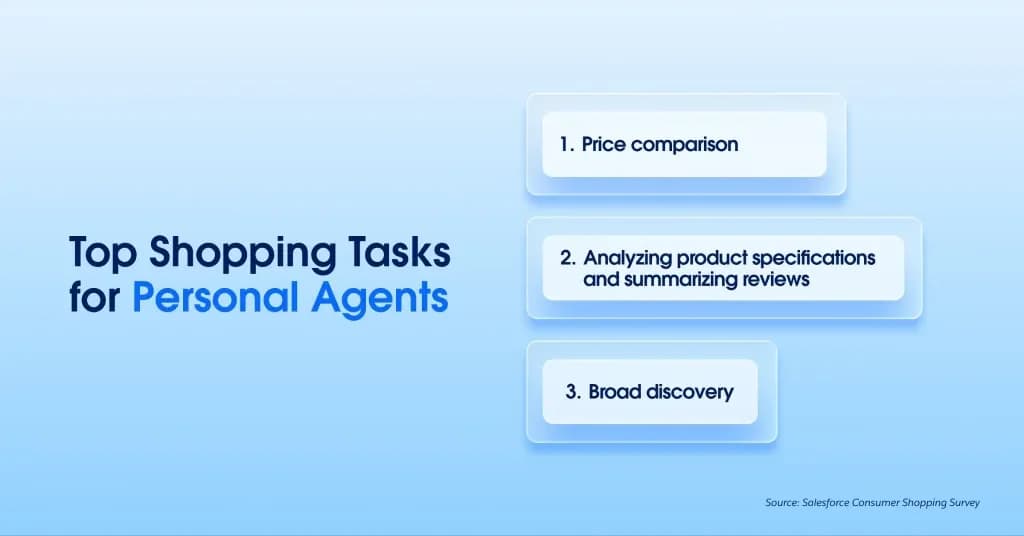
- Consumers turn to AI and personal agents to kick off their shopping: One in five shoppers will start their holiday shopping with AI — including personal agents — and 74% of consumers trust the recommendations they get from AI. One in three shoppers are introduced to new brands through AI assistants, and 11% say they won’t buy something if AI tells them not to. Thirty-one percent of consumers have already tried personal agents, and 8% have had their agent make purchases for them. The top use case for personal agents is price comparison, as budget-conscious shoppers look for deals. But 73% of shoppers still aren’t ready to hand over their credit card details to a personal agent.
- One in three shoppers are introduced to new brands through AI assistants, and 11% say they won’t buy something if AI tells them not to.
- Thirty-one percent of consumers have already tried personal agents, and 8% have had their agent make purchases for them.
- The top use case for personal agents is price comparison, as budget-conscious shoppers look for deals.
- But 73% of shoppers still aren’t ready to hand over their credit card details to a personal agent.
- Retailers with agents will see bigger orders: One in three brands will have shopper agents on their websites by Cyber Week, and those brands will see boosts in holiday orders and customer loyalty. Thirty-nine percent of shoppers have used a brand’s shopper agent, and 80% of them had a good experience. Of those shoppers, 75% felt more loyal to the brand. Shoppers who engage with a brand’s shopper agent spend 8% more per order and purchase 23% more items. Brands that deploy shopper agents also see seven times faster sales growth than competitors that don’t offer agents.
- Thirty-nine percent of shoppers have used a brand’s shopper agent, and 80% of them had a good experience. Of those shoppers, 75% felt more loyal to the brand.
- Shoppers who engage with a brand’s shopper agent spend 8% more per order and purchase 23% more items.
- Brands that deploy shopper agents also see seven times faster sales growth than competitors that don’t offer agents.
- Social media will dominate Cyber Week: Social shopping will peak on the Tuesday and Wednesday before Thanksgiving, with 16% planning to shop inside social media platforms through the holidays. Twenty-three percent of ecommerce traffic is coming from clicks in social media channels, up 13% year over year, led by increases from TikTok and Instagram. The share of orders from social media referrals grew 27% year over year across October and November. Over 1 in 4 shoppers have made a purchase inside a social media app, such as TikTok Shop, in the past three months.
- Twenty-three percent of ecommerce traffic is coming from clicks in social media channels, up 13% year over year, led by increases from TikTok and Instagram.
- The share of orders from social media referrals grew 27% year over year across October and November.
- Over 1 in 4 shoppers have made a purchase inside a social media app, such as TikTok Shop, in the past three months.
- Tech-savvy Gen Z will shop in store: In-store shopping remains the number one holiday shopping destination, with 71% of shoppers planning to shop in store this holiday season. One in three Gen Z shoppers plan to visit a store for an early-morning Black Friday promotion. Sixty-three percent of Gen Z shoppers plan to shop in store this holiday season.
- One in three Gen Z shoppers plan to visit a store for an early-morning Black Friday promotion.
- Sixty-three percent of Gen Z shoppers plan to shop in store this holiday season.
- Retailers look to make holidays affordable amid economic headwinds: Shoppers are seeing higher discounts than this time last year, with discount rates up 5% globally and up 8% in the U.S. in November. The result is flat pricing compared with last holiday, with average selling prices for physical goods down 2% year over year globally and down 1% year over year in the U.S. Retailer efforts to control pricing are enabling shoppers to build bigger baskets early in the season, with basket sizes up 3% year over year globally and in the U.S.
- The result is flat pricing compared with last holiday, with average selling prices for physical goods down 2% year over year globally and down 1% year over year in the U.S.
- Retailer efforts to control pricing are enabling shoppers to build bigger baskets early in the season, with basket sizes up 3% year over year globally and in the U.S.
- Cyber Week is still the best time of year to find the steepest discounts: Retailers are prepared to offer enticing deals to lure shoppers this Cyber Week. Salesforce expects the highest discounted categories globally to be: Beauty, makeup (38%) General apparel (33%) Beauty, skincare (30%) It projects the highest discounted categories in the U.S. to be: General apparel (38%) Health and beauty (33%) Home (furniture, dining, decor, appliances) (23%)
- Salesforce expects the highest discounted categories globally to be: Beauty, makeup (38%) General apparel (33%) Beauty, skincare (30%)
- Beauty, makeup (38%)
- General apparel (33%)
- Beauty, skincare (30%)
- It projects the highest discounted categories in the U.S. to be: General apparel (38%) Health and beauty (33%) Home (furniture, dining, decor, appliances) (23%)
- General apparel (38%)
- Health and beauty (33%)
- Home (furniture, dining, decor, appliances) (23%)
- Visit Salesforce’s Shopping Insights HQ for real-time Cyber Week results
- Learn how consumers are using personal agents to get a jump on holiday shopping
2026 Salesforce holiday insights and predictions methodology
Powered by Agentforce, Commerce Cloud, Service Cloud, and Marketing Cloud, Salesforce analyzed aggregated data to produce holiday insights from the activity of more than 1.5 billion global shoppers across more than 89 countries, with a focus on 18 key markets: the United States, Canada, the United Kingdom, Germany, France, Italy, Spain, Japan, the Netherlands, Australia, New Zealand, the Asia-Pacific (excluding Japan, Australia, and New Zealand), Switzerland, Latin America (LAM), the Middle East and Africa (MEA), Eastern Europe, Belgium, and the Nordics. This battery of benchmarks provides a deep look into the last nine quarters and the current state of digital commerce. Several factors are applied to extrapolate macroeconomic figures for the broader retail industry. These and other results are not indicative of Salesforce performance.
The prediction data that we present are from proprietary Salesforce research. The calculations we use blend together first-party and third-party data, as well as several market assumptions.