Somewhere on Cyber Monday, a shopper will ask AI to find the best price on a stand mixer for their sister-in-law, check whether the reviews recommend it, and flag anything that won’t arrive before December 20. Then they’ll close the app and buy it themselves.
For millions of people in 2026, holiday shopping starts with AI. Salesforce proprietary research shows that AI is projected to drive $75.8 billion in Cyber Week spending, up 13% from 2025. AI-driven recommendations are expected to influence more than 1 in 5 holiday orders. Traffic flowing to ecommerce sites from AI tools has more than doubled, up 104% year over year.
And, according to a new Salesforce Consumer Shopping survey of more than 2,500 shoppers in the U.S., the U.K., Canada, and Australia, almost 20% of shoppers now say that AI is their first stop on the way to the store, and 74% trust the recommendations it gives them. AI is also reshaping which brands get noticed: 30% of AI shoppers say these tools frequently introduce them to brands they didn’t know. And it can stop a sale as easily as start one. Eleven percent of shoppers say they’d skip a purchase if an AI assistant advised against it.
“AI is no longer a niche tool just for tech-savvy shoppers,” said Caila Schwartz, Head of Agentic Commerce Shopper Insights at Salesforce. “Everyday shoppers are asking AI what to buy, where to buy it, and whether it’s worth the money before they ever land on a retailer’s site.”
Personal agents are catching on, but shoppers aren’t handing over their wallets yet
Shoppers are adopting personal AI agents to compare products and check reviews, but for now, they’re treating these agents like advisors rather than buyers.
- Thirty-one percent of consumers have tried a personal AI agent. Meta Muse is the most widely adopted, used by 12% of consumers surveyed. It’s also the most recognized, followed by Grok Bot.
- Among people who use them, agents are becoming a daily habit: 28% of personal agent users give their agent tasks multiple times a day.
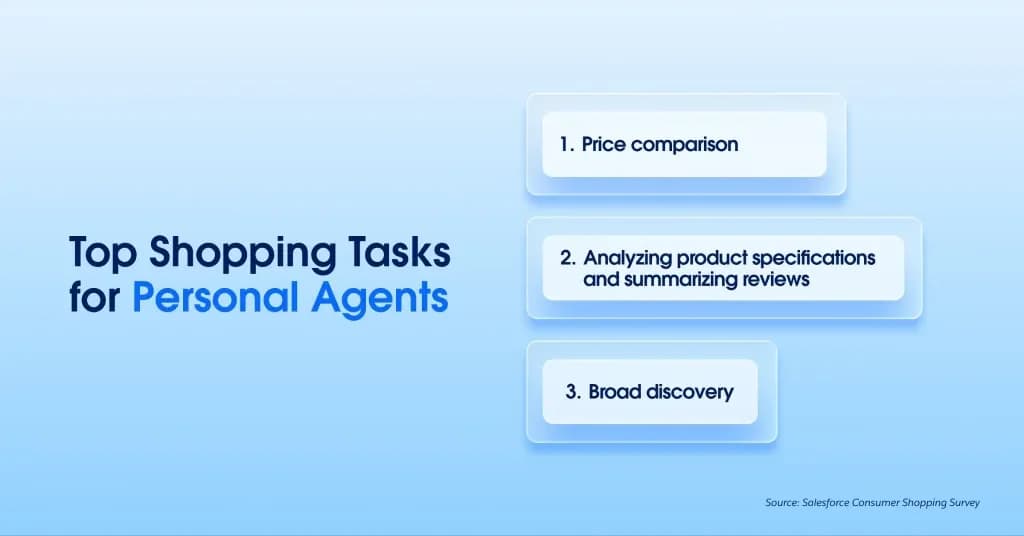
- The most common shopping tasks people use their agents for are to compare prices, analyze product specifications and reviews for sizing quirks or technical differences and product discovery like brainstorming gifts based on criteria.
However, shoppers are not quite ready to let agents check out for them. That might change as trust grows.
- Only 19% of personal agent users have deployed their agents at checkout.
- Shoppers who do let agents buy are setting firm limits. Just 9% of personal agent users give their agents unrestricted access to their financial details, and 36% have set up a separate credit card just for their agent.
- About three-quarters of shoppers (76%) aren’t interested in having a personal AI agent make purchases for them at all. The biggest obstacles are unwanted sharing of purchase history or personal data and accidental or unwanted charges.
Agents pay off for retailers, but shoppers won’t forgive many mistakes
Retailers that offer their own shopper agents are seeing bigger orders and more loyal customers. The catch is that shoppers have very little patience for AI that gets things wrong.
- Shoppers who arrive through AI referrals are more than two times as likely to convert as typical ecommerce shoppers.
- Thirty-nine percent of shoppers have used a brand’s shopper agent on an ecommerce site. Eighty percent of them reported a good experience, and 75% of that group felt more loyal to the brand afterward.
- Shoppers who engage with a brand shopper agent spend more, with an 8% higher average order value, and buy 23% more items than the average order.
- Brands that deploy AI shopping agents see seven times faster sales growth than brands without them.
However, trust in AI is fragile and brands need to nurture it carefully.
- Most shoppers will abandon an AI assistant after just two or three mistakes, and when AI makes a bad recommendation, 32% of shoppers blame the AI.
- Twenty-seven percent of personal AI agent users say their agent has bought something that was too expensive, 22% have had their agent blocked from completing a purchase, and only 32% report no major errors at all.
The bottom line: Be ready for agents, and earn consumers’ trust
As more shoppers send personal agents to compare prices and read reviews for them, retailers will need to handle that nonhuman traffic without slowing their sites or degrading the experience for human shoppers. Their own shopper agents and product data will also need to be ready for the questions those personal agents ask.
“My advice before Cyber Week is simple: Be the brand that AI can find and humans can trust,” Schwartz said. “Shoppers are starting with AI this season, so make sure your product data is accurate, your prices and inventory are current, and your own agent is ready to answer the hard questions.”
For now, the shopper buying a stand mixer is still the one entering their card number. The retailers that earn their trust this season will be in the best position when they’re ready to hand that over too.
- Your customer’s personal agent is knocking. Is your business ready to answer?
- Five 2026 holiday retail predictions for 2026