- Product & Technology
For many conventional robot applications, small variations like these create a disproportionate amount of engineering work. Fixtures need adjustment. Programs need updating. In some cases, the process simply remains manual because designing enough predictability into the application makes the automation case difficult to justify.
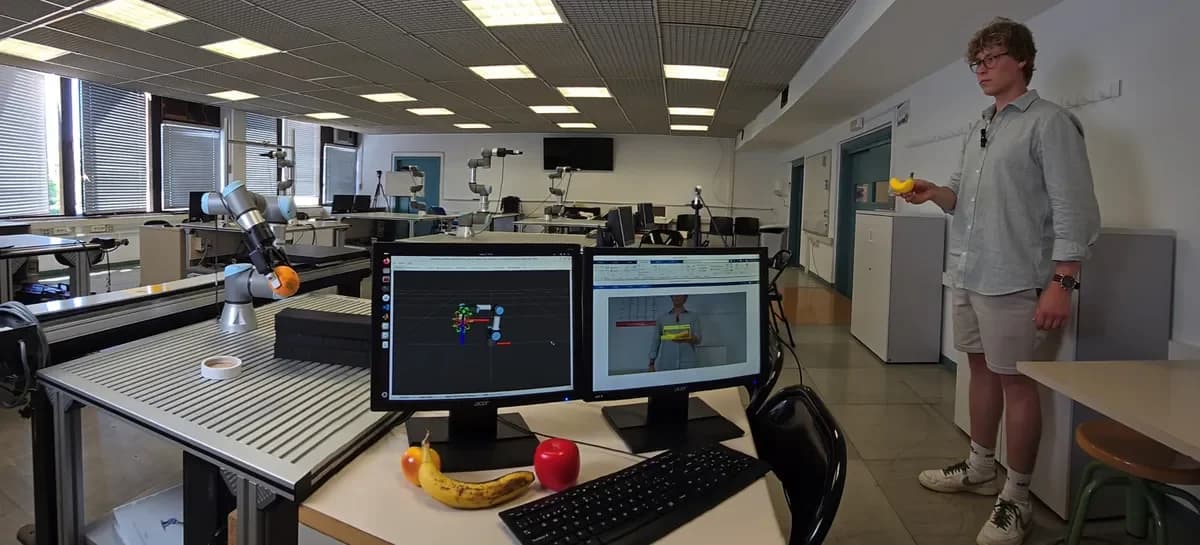
Manufacturers now have another option to consider: physical AI, where AI is connected to machines that sense and act in the physical world.
For industrial automation, this matters because some of the hardest remaining applications are hard precisely because the physical world varies. Parts move. Materials deform. Product mixes change. What the robot encounters on cycle 500 may be different from what it encountered on cycle one.
Universal Robots' Gen 7 platform has been developed for this increasingly software- and AI-driven automation environment. The important question for a manufacturer, however, is less about the technology itself. It is where greater perception, adaptability and software capability can make an automation project viable.
Why variable production changes the automation decision
Traditional industrial robotics works particularly well when engineers can tightly define the process: known part, known position, known trajectory, repeat.
That model remains useful. The challenge appears when manufacturers introduce more product variants, shorter runs or processes that are inherently difficult to make uniform.
Consider three very different production problems:
- A material-handling cell has to process multiple components rather than a single known part.
- A robot encounters objects whose position cannot economically be controlled with precise fixtures.
- A manufacturer frequently changes products and needs automation equipment to remain useful after the original application changes.
In these situations, the cost of dealing with variability becomes part of the automation calculation.
This is also why flexibility should be evaluated at the application level rather than treated as an abstract benefit. A robot may be capable of many tasks, but tooling, sensing, process knowledge, safety requirements, software and integration ultimately determine whether an application can be changed economically.
Existing UR deployments illustrate how broad that application range already is. For example, the current customer case library includes Sensata Technologies using UR3e and UR7e robots for assembly and material handling, Midgard Inc. with a UR12e machine-tending application, and THEMAGIC5 using a UR3e in material removal.
That variety matters because the next step in flexible automation depends on adapting to more variation within those processes, rather than simply adding another fixed sequence.
What Physical AI means on a factory floor
Physical AI connects machine intelligence with physical action.
In manufacturing, the practical value is the potential to handle situations that are difficult to describe through a fixed set of coordinates and rules. Vision, sensing and AI software can give the automation system more information about what is happening in the process and allow software to respond to that information.
Imitation learning is one approach being explored for this purpose. Instead of describing every element of a task exclusively through conventional programming, the system can learn aspects of a physical task from demonstrations. UR’s existing content library specifically identifies imitation learning as an area being applied to physical AI in industrial environments.
That creates interesting possibilities for applications involving:
High-mix handling. A production process may need to pick or manipulate several different items rather than repeatedly handling an identical component.
Less constrained parts. Advanced perception can become useful when guaranteeing exactly the same position and orientation for every part is difficult or expensive.
Processes with inherent variability. Some materials and objects simply do not behave identically cycle after cycle.
The business case still starts with the process. If an inexpensive fixture removes the variability, conventional automation may remain the sensible answer. Physical AI becomes more interesting when removing variability through mechanical engineering is costly, restrictive or impractical.
That distinction can keep an AI project grounded.
Gen 7 and the infrastructure around an AI application
A physical AI application depends on much more than a robot’s motion.
The complete cell may involve vision, sensing, end-of-arm tooling, compute resources, software, networking and the production system surrounding the robot. The engineering question therefore becomes: how easily can those elements work together?
That provides a useful way to assess Gen 7. Rather than evaluating isolated specifications, manufacturers can look at the platform’s role in the complete automation architecture.
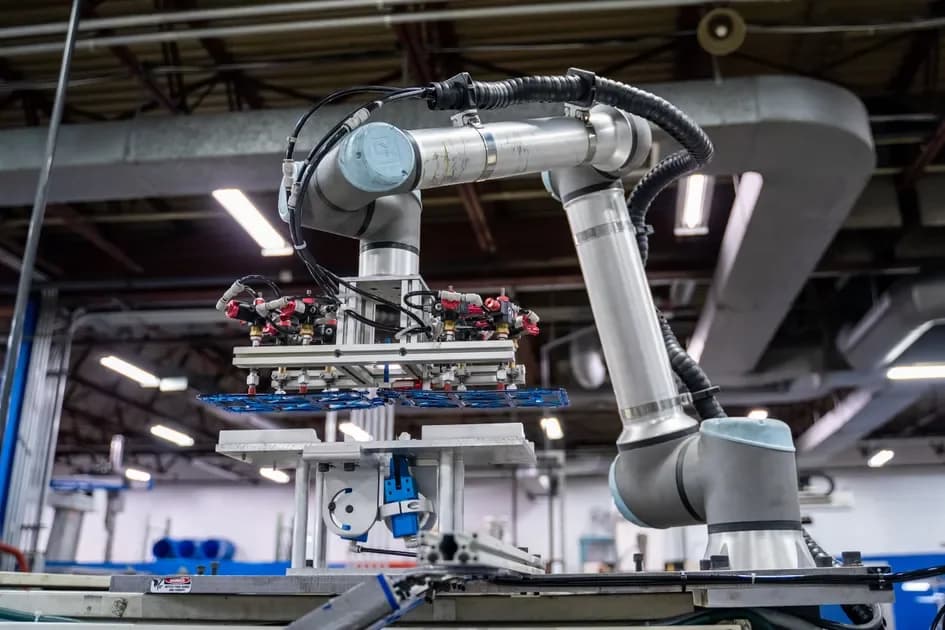
Connectivity matters because perception systems and other intelligent devices need to exchange information with the automation system. On-robot power and communications matter when cameras or sophisticated tooling sit at the end of the arm. Software matters because applications have to be deployed, maintained and changed after commissioning.
The same applies to interaction with the people running production. Engineers may build the application, but production technicians and operators will live with it. If routine adjustments repeatedly require specialist intervention, that becomes an operating cost.
PolyScope X is already part of UR’s broader Physical AI and software discussion. The existing UR content library includes material covering PolyScope X in the context of physical AI, software development and data security.
That final area deserves attention. As automation becomes more connected, IT and OT considerations move earlier into the cell-design process. Network architecture, data access and security need to be considered alongside reach, payload, cycle time and tooling.
See how the Gen 7 platform connects cameras, tooling and software in one system in the video below.
The more important ROI question: what happens when production changes?
The first automation business case usually concerns one process.
How much manual work does the application require? What does the cell cost? What production capacity will it support? What integration and maintenance resources will it consume?
Those calculations remain necessary. For flexible automation, however, there is another question worth asking:
What happens to the automation asset when this product or process changes?
A rigid system can have an attractive return while its assumptions remain valid and become expensive to modify when those assumptions change. Flexible robotics can change that calculation when hardware can economically be redeployed into another suitable process.
This doesn’t mean every robot can simply be moved from one operation to another. Tooling may change. Software needs adaptation. A new process needs validation, and safety requirements have to be assessed for the new application.
But redeployment potential has real strategic value when production mix changes frequently.
The present UR customer library shows robots being deployed across a long list of applications, including assembly, material handling, machine tending, dispensing, palletizing, finishing and welding applications. That range provides useful context for manufacturers evaluating whether a robotic asset can remain relevant beyond its initial job.
A more complete investment discussion can therefore include both application ROI and asset flexibility.
Where to start with physical AI
The best starting point is usually a production problem, not an AI project.
Walk the process and look for work where variability is creating measurable friction:
- Operators repeatedly compensate for inconsistent part locations.
- Product changeovers generate significant reprogramming or setup work.
- Manual picking remains difficult to automate because the item mix varies.
- An otherwise automatable process still depends on human visual judgement.
Then separate the sources of variability.
Some can be eliminated cheaply with conventional engineering. Some can be handled with established vision or sensing. Others may genuinely require more adaptive approaches.
That exercise prevents manufacturers from adding AI where a simpler solution will do the job. It also reveals the applications where physical AI could materially change the automation case.
Recommended webinar: Found a process worth a closer look? Watch the full recording of The robotics platform built for AI-driven manufacturing to see how Gen 7 supports physical AI applications in practice.
A practical way to assess the opportunity
Physical AI expands the range of automation problems engineers can investigate. It does not remove the fundamentals.
The process still needs a sound business case. Tooling still matters. Integration still matters. Safety, reliability, production ownership and maintainability still matter.
What changes is the boundary of what can reasonably be automated.
For manufacturers evaluating Gen 7 and physical AI, a useful question to take back to the plant floor is therefore very concrete:
Which process have we avoided automating because there is too much real-world variation?
That is where the conversation gets interesting.
Physical AI applies AI to machines that interact with the physical environment. In industrial automation, it can help a robotic system use perception and other information to deal with variation that would be difficult to accommodate through a fixed sequence alone.
Physical AI is most relevant when variability is a meaningful barrier to conventional automation, such as changing items, inconsistent positioning or processes that depend on perception. If conventional fixtures, sensing or programming can solve the problem economically, those approaches may remain the better engineering choice.
Manufacturers should assess the economics of the initial application together with integration, tooling, software, maintenance and process requirements. Where production changes frequently, the potential to reconfigure the automation asset for future suitable applications can also become part of the investment case.
Universal Robots
Universal Robots delivers industrial-grade collaborative automation built to perform, scale, and last. Combining lightweight, high-performance hardware with intuitive PolyScope software, certified safety, cybersecurity and open interfaces, Universal Robots enables manufacturers and integrators to deploy automation faster, reduce risk, and evolve toward AI-supported production—across applications, sites, and industries.
Automate with Confidence.