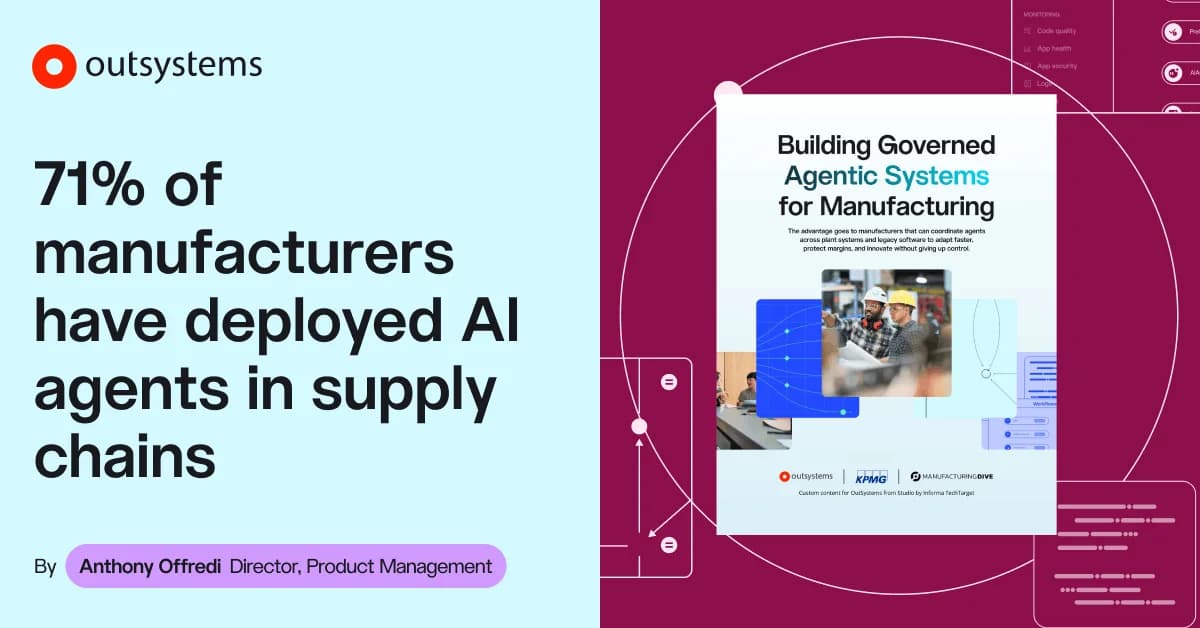
Of the 179 manufacturing respondents in a recent OutSystems and KPMG study, 50% say they plan to invest in agentic AI for application modernization and legacy migration over the next 12 months. For manufacturers, agentic AI is about connecting existing systems, production context, and people so agents can improve decisions without chasing autonomy for its own sake.
Manufacturers have been working hard to incorporate agentic AI into technology
Manufacturers have technology estates that typically feature long-lived proprietary systems and specialized equipment that can’t easily be replaced. However, the sector has seen major strides in the use of agentic systems in supply chain and logistics operations, where 71% of firms had deployed agents. Fifty-six percent said they had accelerated processes in those areas.
A manufacturer based in Penang, Malaysia shows what that looks like in practice. Using OutSystems agents, ACM built a multi-agent system that extracts material specs and pricing from technical drawings and compiles supply chain cost reports. The task used to take hours of manual work. Now it takes minutes, and ACM’s teams make faster, better-informed decisions.
The supply chain is a natural entry point for agentic AI adoption in manufacturing because it directly affects the bottom line. Moreover, years of disruption ranging from steel market volatility to the COVID-19 pandemic to continuing geopolitical tensions have effectively forced the issue.
What matters now is being able to scale realized value across plant operations without losing control. This makes governed orchestration a critical driver of continuing innovation at a time when manufacturers face rising pressure to work faster and become more adaptable.
The challenges of chained reliability
It’s rarely viable for manufacturers to treat agentic transformation as a greenfield restart. Core systems are often difficult or expensive to replace, and doing so can put plant operations on hold for unacceptably long periods. As such, manufacturers are modernizing around this constraint.
The need for interoperability only becomes more pronounced as agentic AI scales across functions. Chained workflows are a significant source of friction, with 42% of manufacturers citing reliability and error handling as a top orchestration hurdle.
For instance, an agent might appear reliable in isolation but still produce a bad result when it relies on other downstream or upstream systems such as MES, ERP, maintenance, inventory, or quality control.
The problem is compounded by the fact that manufacturing operations often span different plant vintages, acquired businesses, specialized operational technology vendors, and enterprise systems that rarely work on a single stack.
Decentralize innovation and centralize governance with an open agentic orchestration layer
Bridging those gaps requires an open agentic orchestration layer spanning all systems relevant to a given use case. In other words, a layer that supports decentralized innovation with centralized governance. This gives manufacturers the freedom to deploy new agents, models, and tools without rebuilding the governance and integration layer every time they do.
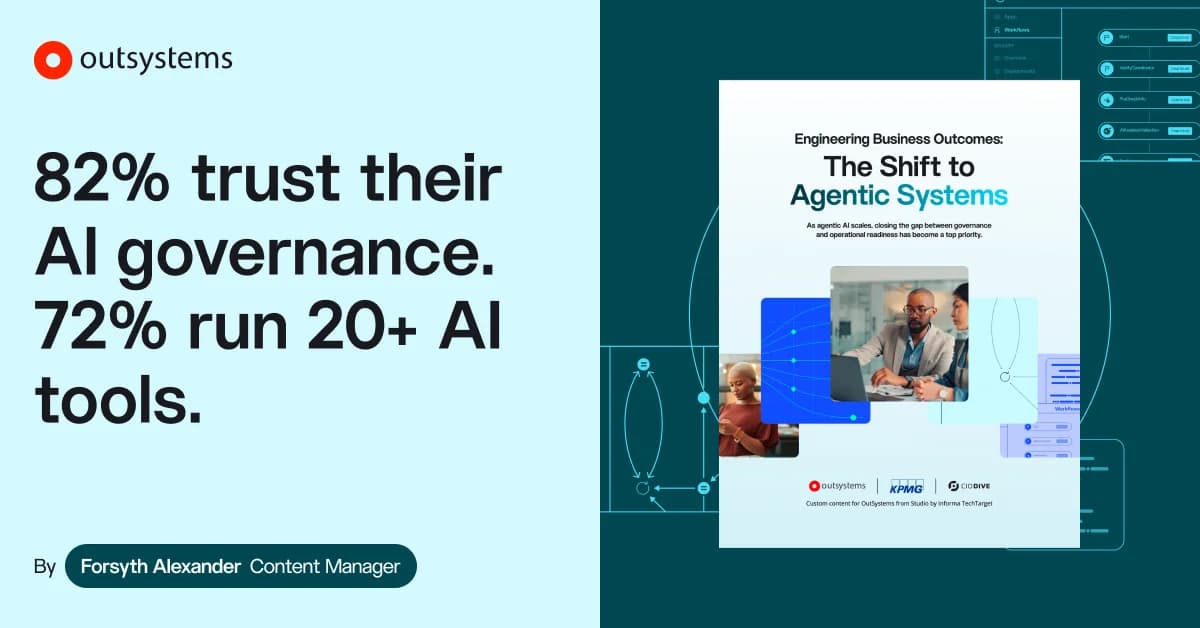
Indeed, 65% of respondents rated the ability to use multiple models and vendors in parallel as “very or extremely important.” Meanwhile, about two-thirds reported using more than 20 distinct AI tools, models, or vendor platforms.
Most manufacturers want agents to reduce the cognitive load on operators, QA, maintenance, and safety teams. The goal is to automate while ensuring people are ultimately responsible for exceptions of consequence. The manufacturers that scale agentic AI successfully will be those that turn isolated gains into a reliable operational-intelligence layer spanning systems, workflows, and people.
Want more insights?
Read the full Building Governed Agentic Systems for Manufacturing report to find out more about how manufacturers are operationalizing AI.
Anthony Offredi leads the strategy, definition, and prioritization of manufacturing solutions built on the OutSystems platform, driving the vision for how AI, modern workflows, and agentic systems engineering can transform manufacturing operations. Previously, he was an industry advisor for Quickbase, served in Afghanistan, and held management positions at Amazon, Jeep, and Ford.
See all posts from this author