For years, the process has been broken for the parties involved. Recently, insurers have been experimenting with AI to remove friction. What they’ve found are packages that offer AI, which are often difficult to customize and don’t feed into a single audit trail. Or their in-house solutions don’t get past the pilot stage.
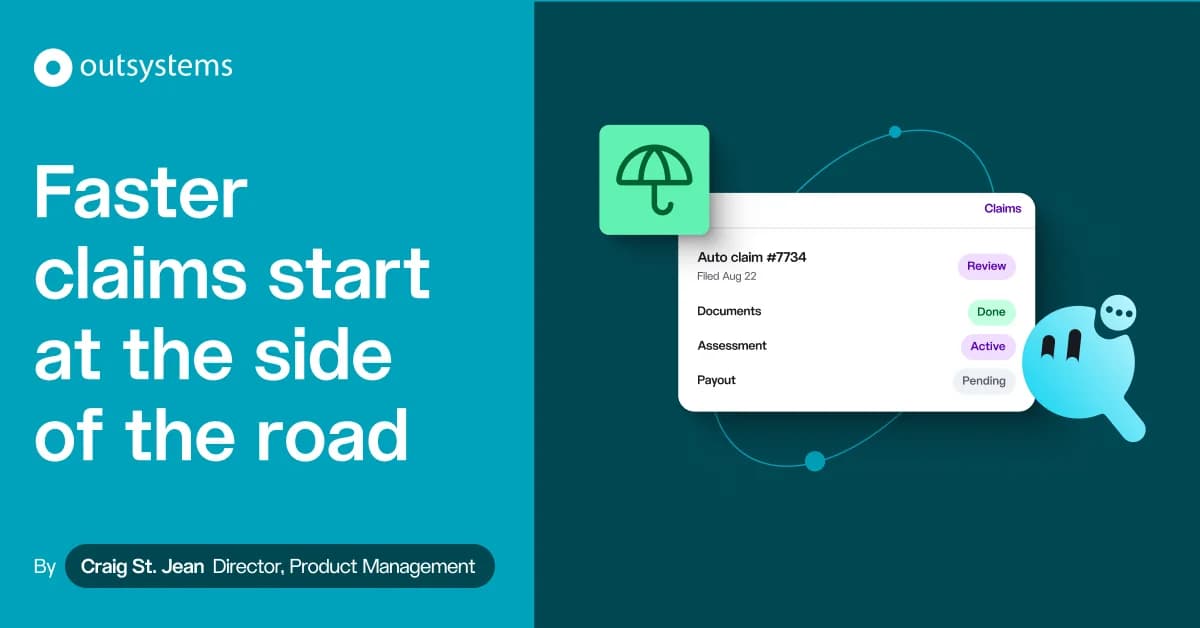
But that’s in the past. As part of our prebuilt Agentic Industry Solutions, OutSystems has redesigned the First Notice of Loss so policyholders get immediate feedback while they report the loss. And adjusters start with the facts on file.
Here’s a closer look at the first notice of loss (FNOL) opportunities and how the solution helps.
The AI opportunity hinges on integrating with legacy systems and moving pilots into production
Insurers understand that the best opportunity to keep a customer lies in the claims process. Their customers strongly support digital or conversational AI intake when it eliminates repetitive forms, phone trees, and long hold times. In addition, Deloitte reports that 76% of surveyed insurance executives expect AI to deliver better customer engagement in the next three years. The question is how.
Ever since agentic AI took over the tech scene three years ago, the tools available for developing agents have multiplied. Overall, the pilots built with these tools performed well as proof of concepts, up until someone wanted to integrate them with legacy systems or run them in production. Yet, in the State of AI Development in Insurance study from OutSystems, 35% of insurance IT leaders say AI projects have not started because they take too long. What are the blockers? According to 42% of the insurers surveyed, they’re legacy systems and scattered data.
These blockers should not stand in the way of insurers who want to use what they already have to provide policyholders what they want. They just need a governed, prebuilt solution that works with their specific legacy systems and agentic needs based on an understanding of the industry. This solution should also allow for customization when needed.
Delivering a solution insurers need based on years of understanding what they want
Insurance companies that see the claim as their best chance to keep a customer can make that happen with OutSystems. We have years of experience helping insurers streamline and smooth FNOL and claims processes.
For example, American Integrity built an online first notice of loss portal on OutSystems in eight weeks. AXA built a self-service portal where more than 3,000 brokers track claim status, covering 260,000 claims a year. And Van Ameyde built a claims platform that cut the time to resolve a claim by 30%.
Now, OutSystems has taken what we learned in working with these insurers and many more to create the Agentic First Notice of Loss solution. Part of Agentic Industry Solutions for insurance, it ships with the customer mobile app, the AI agents, and integration points to your policy system, claims system, and service partners. Your team starts from a working solution and adapts it, instead of building from scratch.
What is the Agentic First Notice of Loss Solution?
This prebuilt agentic system includes the customer mobile app, the agents, the workflow, the data model (based on ACORD), and the integration points to your policy and claims systems. OutSystems builds, supports, and updates it.
Fixed workflow rules decide when an agent acts on its own and when it waits for a person. Every agent action is recorded, so you have records you can show an examiner.
Agents ship with a suite of evaluations that were used to select the default model for their tasks. Your team can rerun them at any time, with any model, to test the agents and their prompts.
Your team can change any part of the Agentic First Notice of Loss solution, from rules to screens to agents, with OutSystems tools or other AI coding. It connects to the policy and claims systems you already run through their APIs.
AI agents only collect, check, record information, and arrange services the policy already includes. Every decision regarding coverage, liability, pricing, and claims payment remains entirely with your human adjusters and existing workflows. The OutSystems platform also has built-in agent guardrails, such as personal information exposure, so private data is redacted before it reaches the AI models.
Putting the policyholder first in the claims journey
Let’s return to the stranded driver for a demonstration of what Agentic First Notice of Loss can help you put into action, without replacing your current claims systems. The driver who had an accident opens your company’s mobile app, and AI agents guide them through reporting the loss, capturing the statement, the other driver’s details, and photos while the facts are fresh.
When the policy includes roadside assistance, AI agents book a tow through your roadside provider, such as such as Honk, while the driver is still at the scene, and they follow its status in the app. Then, the AI agents assemble the claim file and open the claim in your system. Your adjusters make every coverage, liability, and payment decision, in the workflows they already use.
The driver has a satisfying claims experience and is less likely to consider moving to another insurer. And your team is freed from repeat calls and tasks to focus on what makes your company unique.
See Agentic First Notice of Loss in action
Bring your current first notice of loss flow to a 30-minute demo. We'll show you how AI agents can improve this experience for your team and your customers. And be sure to check out the First Notice of Loss and Industry Solutions for Insurance pages.
Craig St. Jean is Director, Product Management, BFSI Solutions at OutSystems. During his two decades of experience, he has honed the art of building robust software solutions and excelled in devising strategies and architectural frameworks that directly contribute to business success. His comprehensive understanding of high-code environments, coupled with a deep insight into dynamic low-code platforms as well as a strong insurance and financial services background uniquely positions him to design adaptable and future-proof solutions that align with the evolving needs of modern enterprises.
See all posts from this author