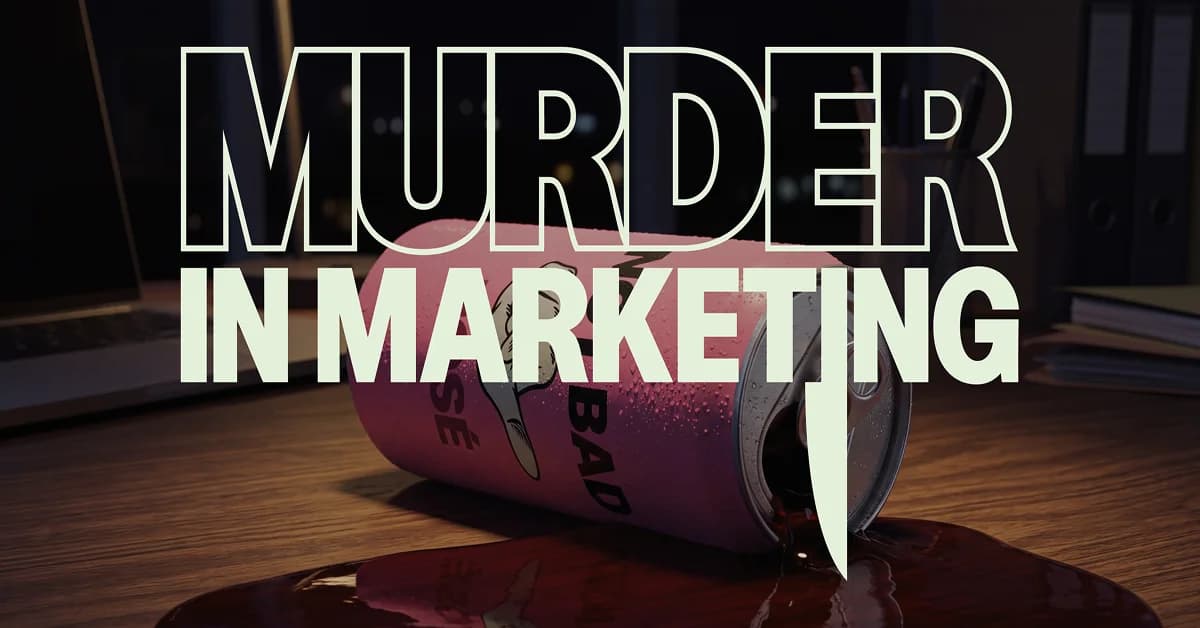
At Opticon in New York on Sept. 1, 2026, I sat in the audience at the Javits Center with more than a thousand customers and partners as two actors walked onstage with Optimizely's Dan Reid and Julianne DeVincenzo. The trailer rolled for a murder mystery, and while people were laughing and having fun, you could almost hear the question forming: What is this, and who approved it?
Two people did: Tara Corey, our SVP of Marketing, and Shafqat Islam, our president. Murder in Marketing, a 36-episode vertical dark comedy shot in Los Angeles with professional actors, premieres Friday, Oct. 30, 2026, and I called each of them separately to ask whether someone should have stopped it. Neither did, and when I spoke to them, I found they agreed on more than I expected.
The room in New York
Back at the Opticon general session in New York, Tara was sitting next to Shaf. She says the actors were "a bit unhinged onstage, which was way outside of my comfort zone," and a little outside Shaf's too. He thought the audience hadn’t been given enough context to understand what it was watching. Some almost thought the trailer was AI-generated, he says, calling it "a badge of honor." At Opticon London, they set it up better.
Tara: "Don't get it"
Tara had asked the same question when Julianne first pitched the murder mystery. "Don't get it. How can we do this?"
It didn't take her long to come around. She isn't a fan of out-of-home ads, which come up constantly in leadership discussions because they're hard to measure and not fully targeted. For her, the comparison was straightforward: "If I'm going to spend so much money on a billboard, I'd rather put money on this."
She also saw something different in the idea. It was "clever, different, still tied to marketing," she says. "Why not do it? Test it." Optimizely’s recent rebrand helped too: marketing leaders kept calling B2B "boring," and everyone's content looked the same.
She's candid about what made it possible. Shaf is "willing to take risks," she said, and without another senior leader's buy-in she "probably wouldn't have had individually the confidence to go forward."
Tara Corey
SVP, Marketing, Optimizely
Shaf: "The more improbable, the more interested I am"
Years ago, Shaf met the founder of Caspian Studios, who had made a Webby-winning murder-mystery podcast called Murder in HR and wanted to try one for marketing. Shaf was in, but the timing never worked out. When Julianne joined, he introduced them, and the podcast idea eventually became a microdrama.
Shaf sees conventional B2B marketing as boring and noisy, and it scales one webinar at a time. A series, he argues, can reach millions. "The biggest risk is to be ignorable." The timing helps, too: he calls micro-drama "probably one of the fastest-growing formats of media consumption in the world." A Crocs microdrama on ReelShort drew nearly 10 million views, according to Marketing Dive, which also names Dr Pepper and P&G. All of them sell to consumers, not to marketers.
He had another concern: whether the marketing team would dismiss it as “one of Shaf’s crazy ideas” and let it die slowly. Instead, he says, "everyone embraced it right away." Tara had leaned on his backing to move the idea forward, while he had been wondering whether her team would get behind it.
What if nobody watches?
Digiday put the challenge plainly in September 2026: brands have solved the attention problem with microdramas, but not ROI.
"This is not a pipeline activity or purpose," Tara said. The aim is for people to see Optimizely as an AI platform, not just an A/B testing company or a CMS. Shaf plans to measure views and engagement first, then non-branded search, and later traffic and pipeline. "Not everything is directly measurable."
What happens if the series doesn’t go viral? "To me, it's not a failure. It's a learning." "We're an experimentation company," he says, and the series was made on a shoestring budget even though it looks like millions.
Tara’s 2027 plan also tests bolder content against the safer, more familiar formats. But she’s setting a high bar for this particular project. She guessed Shaf would call a non-viral result a flop, but he didn't. “If it just does okay, I'd say that's a failure. It has to be great”, she says.
She's upfront about the nerves ("I'm nervous") but believes the project would have been “worth the risk and investment” even if it flopped. She also paused other creative projects so the team doesn’t lose “sight of some of the fundamentals.” "We're trying to strike the right balance without limiting creativity."
Tara Corey
SVP, Marketing, Optimizely
Shafqat Islam
President, Optimizely
The president hasn't read the script
The answer I keep coming back to is Shaf's. He approved the series without reading the script, and that was on purpose. He gave the team creative freedom and stayed hands-off "so I can get the full experience as well," which means the president will find out who killed the CEO of a non-alcoholic wine startup at the same time as everyone else.
Tara keeps the stakes simple: "Literally, nobody's dying. It's a success or a failure." The CEO in the series would beg to differ, but now the audience gets to decide which. Watch the series on YouTube and pick your suspect.