An International Criminal Court judge woke up one morning and found that services he used every day no longer worked for him.
In August 2025, the United States placed sanctions on him. Almost overnight, Airbnb, PayPal, and other online services closed his accounts. A hotel booking in France, made through a US travel platform, was canceled within hours. The judge later described the experience as “civil death.”
Why did this happen? US sanctions prohibit American companies from providing services to a sanctioned person. If your essential services come from providers under US jurisdiction, decisions made there can reach you, wherever you live.
From one person to a whole union
The situation with the judge demonstrated the vulnerability of depending on foreign technology. The concern goes beyond who owns or operates the infrastructure and services: it’s also about who controls access to the systems and the data they hold. Laws and sanctions imposed in another part of the world could disrupt access to critical services and information, with devastating consequences. Imagine a hospital in Italy suddenly unable to access patient records or the system it relies on to schedule appointments. Or picture a bank in Bulgaria unable to retrieve customer data or process loan applications. A decision made far away, for reasons that have nothing to do with them, can cut off organizations and citizens from services and information they depend on.
The judge’s case was a wake-up call across Europe. The International Criminal Court moved away from a major US software provider to an open-source alternative. A German state took steps to protect civil society from the effects of US financial sanctions. As European Commission President Ursula von der Leyen said, “We cannot afford to depend on others for the technologies that keep our hospitals running, our energy grids stable, and our services secure.”
In June 2026, the Commission presented its Technological Sovereignty Package, with proposals on cloud, AI, chips, and open source. The legislation is still under negotiation. Even so, digital sovereignty is now a business requirement for many EU organizations.
More sovereign control, without more complexity
The shift is already happening. In a 2025 Gartner survey, 61% of Western European CIOs and IT leaders said geopolitics will increase their reliance on local or regional cloud providers. In that same survey, Gartner predicts that by 2030, over 75% of enterprises outside the US will have a digital sovereignty strategy.
The pressure is strongest in government and the public sector. It’s also felt across regulated industries and providers of critical infrastructure, where regulation and customer expectations can limit the use of non-EU cloud services. The proposed Cloud and AI Development Act would establish an EU-wide framework for assessing cloud sovereignty and introduce additional sovereignty requirements for public procurement.
At the same time, these organizations must modernize. Many run their most important services on legacy systems that are hard to change and even harder to move. They also want to integrate AI into systems that contain sensitive data. They need more control over where their systems run and who manages them. But they can’t afford to slow down delivery or build a cloud operations team of their own.
What sovereignty means
That need for control has a name. Digital Sovereignty is the ability of an organization or country to keep control over its digital assets. Governments need this control to protect public interests, and regulated businesses like banks and insurers need it for their own operations. That control has four dimensions:
- Data sovereignty is about where data lives, both when it’s stored and when it moves.
- Infrastructure sovereignty is about who owns and controls the platform underneath.
- AI sovereignty covers the models an organization uses and the content they generate.
- Operational sovereignty is about who is allowed to access and run the systems.
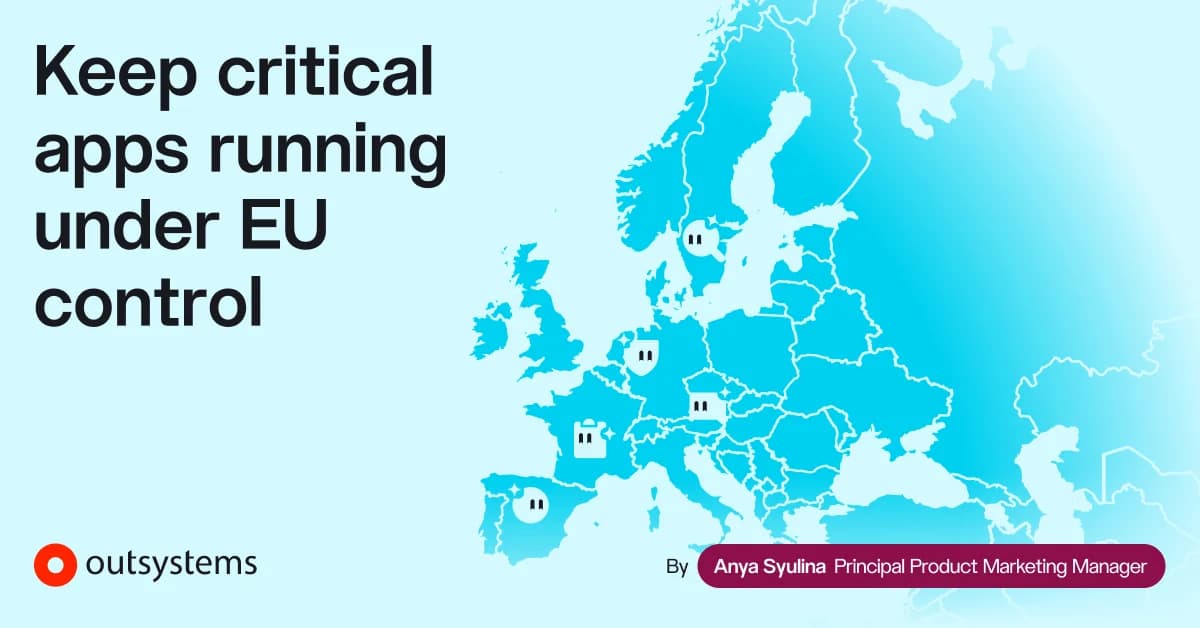
Today, we’re announcing the general availability of the OutSystems EU Sovereign Cloud. We built it in partnership with STACKIT, the sovereign cloud infrastructure operated by Schwarz Digits, and valantic, a digital transformation consultancy.
With the EU Sovereign Cloud, organizations can modernize legacy systems and build custom apps and AI agents under EU control. Applications run on dedicated, EU-owned infrastructure in a fully managed cloud.
Each partner has a clearly defined role in delivering and operating the service.
- OutSystems owns the platform and product, including platform management and the product roadmap.
- operates the sovereign runtime, implementing the sovereign boundary and managing day-to-day operations, monitoring, alerting, and escalation.
- provides and secures the EU-hosted underlying infrastructure, including compute, storage, Kubernetes, databases, observability, and identity services, with EU data residency.
Together, we deliver a fully managed, EU-owned cloud foundation that helps customers modernize critical systems and build AI agents while focusing on innovation rather than managing the underlying infrastructure.
Sovereign by design and ready for AI
The EU Sovereign Cloud addresses all four dimensions of sovereignty, from data to operations.
- Data: Apps data stays in the EU, including backups and metadata. Encryption keys are held in the EU.
- Infrastructure: Apps run on dedicated, single-tenant infrastructure owned by STACKIT, a European company.
- AI: AI agents run in the EU. The platform is open to any AI, so customers decide which models to use.
- Operations: EU-based staff operate the sovereign runtime and resolve every support ticket in the EU.
Together, these guarantees reduce exposure to foreign jurisdiction and to sanctions that could force a provider to withdraw service. If the geopolitical situation changes, critical apps keep running.
They also remove a common barrier to AI. Many European organizations have AI pilots that never reach production because of sensitive data and uncertainty about where that data goes. With the EU Sovereign Cloud, teams can use OutSystems Agent Experience and OutSystems Agents to build and run AI agents and custom apps on one platform. They get the governance and auditability that regulators in Europe expect. Because the platform is fully managed, IT teams spend their time on delivery. They can modernize the systems their business depends on and add AI where it creates value.
Prepare before you need it
The judge had no warning. Your organization can prepare now, before a sovereignty requirement or a geopolitical shock forces a fast decision.
Anna is a product marketing leader at OutSystems, turning customer insight into products that organizations want. Over the past 10+ years, she's launched and scaled multiple products and startups, working with global brands to sharpen their growth strategies. Now she brings that same instinct for insight and execution to helping enterprises adopt AI and agentic development.
See all posts from this author