Radar systems have traditionally faced a straightforward engineering tradeoff: Better performance requires more hardware, more power, and more money. But emerging applications including drones, autonomous vehicles, and distributed sensing networks require capable radar on platforms where space, weight, battery power, and computing resources are limited. These needs are driving researchers at HRL Laboratories, an IBM company, to rethink how radar systems are designed.
Enter low-SWaP radar. SWaP stands for size, weight, and power, although cost is increasingly treated as a central constraint. The goal of low-SWaP radar, beyond making a system smaller, is to preserve as much of its useful capability as possible while shrinking the hardware, reducing its energy demands, and dramatically lowering its cost. For HRL lab leader Seong-Hwoon Kim and his colleagues, the target is radar systems costing in the tens of thousands of dollars range rather than hundreds of thousands or even millions. “For this industry, that cost difference is a paradigm shift,” he said.
Achieving that goal means rethinking radar as an integrated system, including the semiconductor devices producing and receiving radio-frequency signals as well as the algorithms interpreting those signals in real time.
What does a radar actually measure?
The word “radar” is an acronym for radio detection and ranging. At its simplest, radar works by transmitting radio-frequency (RF) signals and examining what comes back after those signals encounter objects in the environment and return to a sensing antenna. Based on how the returning pulse’s phase and amplitude differ from what was transmitted, information about nearby objects can be interpreted. The Doppler shift of a returning pulse describes how its wavelength is stretched or compressed based on whether an object of interest is moving farther or closer from the radar source. This information contributes to the overall picture provided by radar equipment.
Unlike a camera, a radar sensor doesn't produce an immediately recognizable picture. Instead, engineers design a radar system's operating mode and its waveform, determining how its RF signal is conditioned and transmitted so that useful information — like how far away an object is and how fast it is moving — can be extracted when the signal bounces back to the source. A radar mode is a particular way of operating the radar, with its waveform and other parameters configured for a specific sensing task. Frequency and modulation can be selected for a particular application, but the radar's hardware must also be capable of supporting that mode. Designing increasingly specialized hardware around increasingly sophisticated modes is one reason high-performance radar systems can become so expensive.
Kim’s team approaches that problem through co-design, considering the waveform, hardware, and signal-processing software together rather than treating each as a separate engineering problem.
“I’m a strong believer that software and algorithms will make excellent sensors even smarter,” he said. “But if you can make the excellent sensor a little bit smarter, then work on the hardware in conjunction with the software, now you've got something that will really work.”
Getting more from commercial hardware
One of the keys to lowering radar’s cost is avoiding custom hardware when existing components can do much of the job. Commercial off-the-shelf, or COTS, electronics offer enormous economies of scale. But components designed for mass markets don’t necessarily support everything a specialized radar requires, according to Kim.
He described his team’s approach as “customized off the shelf.” Instead of developing every component from scratch, researchers can start with comparatively inexpensive commercial components, modify them where necessary, and add surrounding electronics or software to give them capabilities their original designers hadn’t anticipated.
The important point is to avoid customizing away the economic advantage.
“If you buy a $50 chip, you don’t want to make that chip cost you $5,000,” Kim said. “You want to just add some more capability to it,” while keeping it close to that original cost category.
That philosophy extends throughout low-SWaP design: Spend resources where they materially improve performance, rather than optimizing every component to its theoretical limit.
Bringing intelligence to the edge
Radar’s SWaP problem doesn’t end with the RF hardware. The sensor also needs enough computing power to turn the signals it receives into useful information, increasingly in real time.
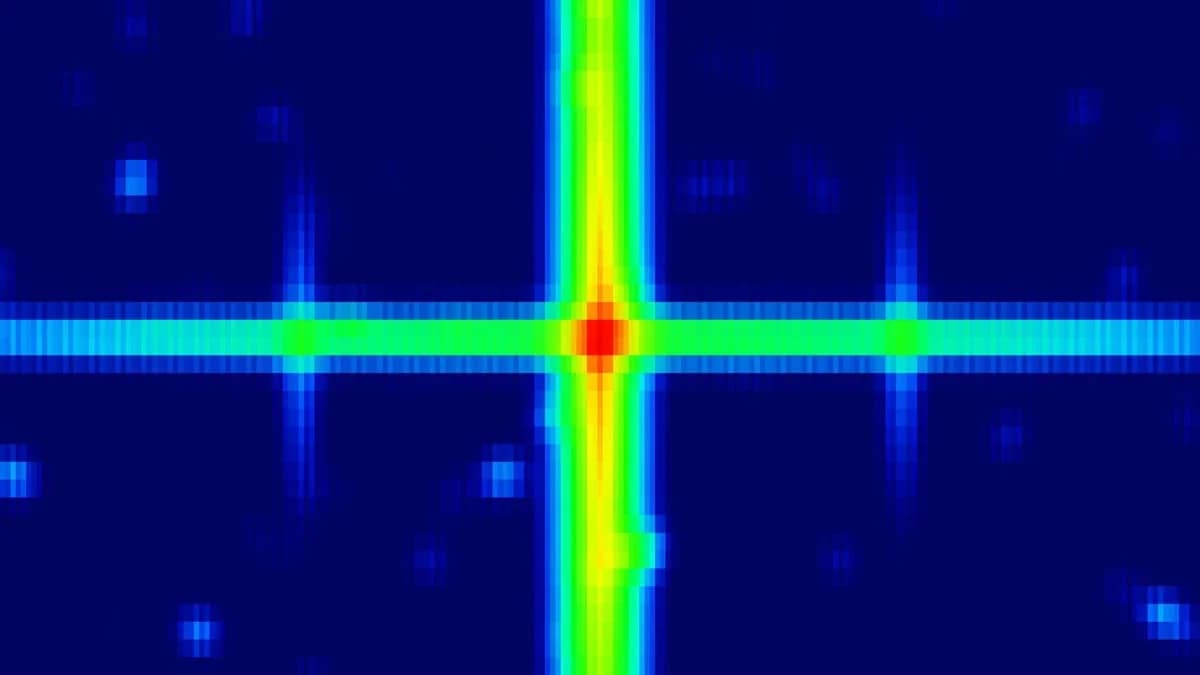
A basic radar data product is a range-Doppler map. One dimension contains information about an object’s range from the sensor, while another captures its relative motion via the Doppler effect. The result can help determine where something is and how quickly it is moving relative to the radar. But interpreting a range-Doppler map is very different from picking out a recognizable object in a photograph. A stronger signal isn’t necessarily a more important signal. Useful information may emerge from patterns across the data.
Kim and his colleagues are exploring how machine learning can act as a first-line filter for that information directly at the edge. Depending on the scene, Kim estimates that 80% to 90% of radar data may ultimately be irrelevant to the higher-level task. If an efficient machine-learning model can identify the potentially useful portion earlier, the rest of the computing system has much less information to process.
The approach isn’t about putting the largest possible AI model onto a radar. Rather, it’s the opposite: finding efficient algorithms running on efficient hardware that can perform a tightly defined task within severe power and computing constraints.
Co-designing AI with radar
Applying AI to radar creates another challenge: Radar data is highly specialized.
A machine-learning researcher working with photographs knows intuitively what an image of a face, vehicle, or building represents. It’s easy to annotate data for model training in that case. A radar return, on the other hand, is an electrical representation of the environment. Understanding it requires knowing something about how the waveform was generated, how the radar operates, and how the returning signal was processed.
Kim’s team therefore wants machine-learning researchers to understand radar waveform and mode design while radar engineers understand what the algorithms need from the hardware. That creates a feedback loop in which algorithm requirements can influence hardware design and knowledge of the sensor can influence how machine learning systems interpret its output.
That loop could become an important source of innovation, according to Kim. Rather than simply giving an AI system a collection of labeled radar data and asking it to discover patterns, researchers can incorporate knowledge of how those measurements were created in the first place. The aim is both better results and systems that can be deployed more quickly. Building efficiency into the RF hardware
Ultimately, low-SWaP radar is constrained by physics. A sensor on a battery-powered platform like a self-driving car or a drone has a finite energy budget, meaning improvements in software can’t compensate indefinitely for inefficient electronics. That makes semiconductor technology another important part of the equation. Expertise in designing and fabricating efficient RF devices is one way to make the necessary tradeoffs closer to the fundamental hardware level rather than adding more hardware around an inefficient component, said Kim.
One important technology is gallium nitride, or GaN, a semiconductor used in radar and other high-performance RF systems. Kim and his colleagues work on GaN devices and fabrication, and their foundry also makes the technology available to other organizations in the U.S. defense industrial base.
That semiconductor expertise complements the broader low-SWaP philosophy: Optimize the technology stack as a system, including the underlying devices as well as RF components, signal processing, and software.
What’s next for low-SWaP radar?
The next step may be pushing the same approach into still higher frequencies.
Kim’s team is investigating high-millimeter-wave devices, an area with relevance beyond radar to emerging communications technologies such as 5G and 6G. HRL researchers are now examining how technologies developed in that frequency range could support a new generation of low-cost, high-millimeter-wave radars.
Ultimately, low-SWaP radar is less about miniaturizing a conventional radar than it is about deciding what capability actually needs to live inside the sensor and designing the entire system accordingly. That could make sophisticated sensing practical on platforms where the cost, weight, or energy demands of conventional systems have made it difficult before.
And increasingly, the determining factor won’t be any one breakthrough component. It will be how effectively the hardware, RF electronics, sensing modes, and intelligent software are designed to work together.