On 29 November, Yuchen Jin, posting about Databricks' AI Gateway, argued that Google's comeback with Gemini 4 Neon should remind buyers not to "lock your token spend into a single AI provider for years." The numbers he attached are the part worth keeping: more than 30% of tokens on that gateway go to open models, 71% of active enterprises use two or more model providers, and 31% use four or more. Those are not survey responses. They track a dataset published on 16 November as the Databricks AI Index, covering 10,000+ companies and 20 July through 7 November 2026 — the same dataset in which single-provider reliance falls from about 64% in July to 28% by 2 November. The model that made the argument concrete is Gemini 4 Neon, and the reason it lands as arithmetic rather than principle is Gemini 4 Carbon.
Neon is a mid-tier variant adapted from Gemini 4 Carbon, released on 18 November at $3 per million input tokens and $15 per million output, with a 1M-token context window. What it demonstrates is how quickly the answer to "which model is the cheap one" changes. On 1 December, two days after Jin's post, Gemini 4 Carbon's introductory price doubles from $2/$10 to $4/$20. The model that undercut Neon in November becomes the more expensive of the two in December, and neither model changed at all.
That is the lock-in problem stated as arithmetic rather than principle. A procurement decision made in November — standardise on the cheaper Gemini 4 tier, sign an annual commitment, build the prompts around it — is made against a price list that expires in 48 hours. The model choice is durable; the number that justified it is not.
Where Neon sits in the Gemini 4 ladder
Google's own model card is unusually direct about the family geometry. Gemini 4 Neon "is adapted from Gemini 4 Carbon," and the card defers architecture, training data, hardware and acceptable-use details to Carbon's documentation. It places Neon between the long-horizon Carbon and the faster Hydrogen, with the phrase that "Neon balances depth and efficiency." The 1M-token context window is shared with its siblings; Neon's default synchronous output is 64K tokens, extendable to 1M through background long decode.
The independent scores are good, not transformative. Artificial Analysis puts Gemini 4 Neon at 62 on Intelligence Index v5.0.2 when run at xhigh effort, sixth of 95 models on the board as of 29 November. The same page reads 60 at high effort, 55 at medium and 44 at low — an 18-point spread wide enough that any single score describes effort as much as capability. Google's launch post quotes 61 at xhigh, which is the sort of one-point discrepancy that appears when a vendor quotes a score before the index is re-run. Either number supports the same reading: Neon is a strong mid-tier model whose position depends heavily on how much reasoning you pay for.
None of that is a comeback in the technical sense. The comeback framing is about reputation and attention — Google shipping a model that developers are talking about again, after a stretch in which the same gateway data showed Anthropic's share of proprietary-model tokens rising to 68.8%, with Claude Opus 5.5 alone taking 37.9%. Neon did not reset the capability frontier. It reset the conversation, which is why it became the example in an argument about procurement.
The number that matters is 28%
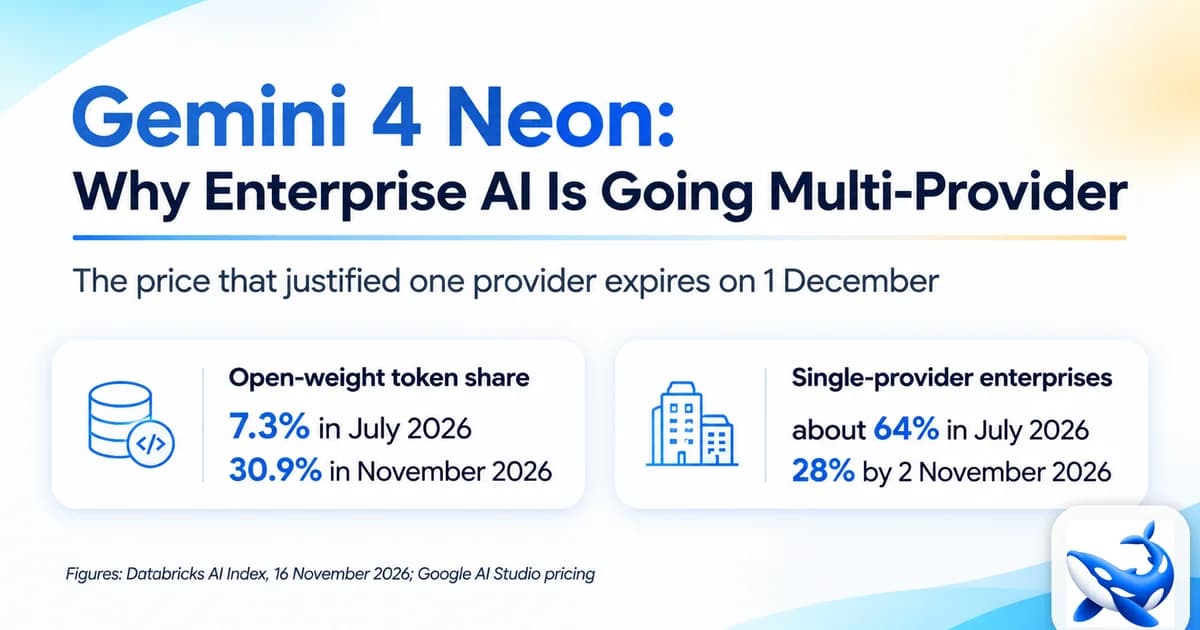
The Databricks AI Index is an unusually useful public snapshot of what enterprises actually call, because it measures tokens through a gateway rather than intentions in a survey. Two of its findings matter here. First, open-weight models went from 7.3% of tokens in July to 30.9% in November — more than quadrupling in under four months. Second, the share of enterprises relying on a single model provider fell from roughly 64% in July to 28% by the week of 2 November.
Jin's post puts the complement at 71% using two or more providers, and adds a 31% four-or-more figure that the published index does not break out. The one-point gap from the index's own 72% is small enough to be a different cut of the same week, but it is worth saying plainly: the 71% and 31% numbers come from his post, while the 64%-to-28% comparison is in the Databricks write-up itself. The direction is the same either way.
The caveats are real. This is Databricks' own customer base, not a random sample of the market; spending is estimated from public list prices; and the coding benchmarks in the same report use Databricks' private codebase with hidden tests. A company that has already bought an enterprise gateway is predisposed to multi-model routing. What the data shows is that the behaviour is now normal among a large, sophisticated population — not that every buyer has adopted it.
It also shows that multi-provider is not the same as diversified. In the same sample where 72% of enterprises used two or more providers, one vendor still held roughly two-thirds of proprietary-model tokens. Enterprises are adding a second and third provider at the edges — for cost, for failure modes, for a specific workload — while volume stays concentrated. That is a hedge, not a portfolio.
The price ladder moves under you
Google's AI Studio pricing page is the cleanest illustration of why a fixed model choice ages badly. Neon carries one rate with no end date. Carbon carries an introductory rate that expires on 30 November, and the page states the replacement explicitly.
• Standard — Gemini 4 Neon $3.00 input / $15.00 output per million tokens; Gemini 4 Carbon $2.00 / $10.00 through 30 November, then $4.00 / $20.00 from 1 December.
• Cached input — Neon $0.15; Carbon $0.10 through 30 November, then $0.20.
• Batch and Flex — Neon $1.50 / $7.50; Carbon $1.00 / $5.00 through 30 November, then $2.00 / $10.00.
• Priority — Neon $5.40 / $27.00; Carbon $3.60 / $18.00 through 30 November, then $7.20 / $36.00.
Run the arithmetic on a modest workload — 40 million input tokens and 8 million output tokens a month. On Carbon's introductory rate that is $160. On Neon it is $240, a 50% premium that made Neon look like the expensive choice in every comparison published since 18 November. From 1 December, Carbon costs $320 and Neon is the cheaper model by $80 a month. The ranking flips, and Carbon ends up 33% more expensive than Neon on the same two products, with no announcement beyond a line on a pricing page.
Price per token is not cost per task, though, and the Databricks report has the better cautionary tale. On its coding benchmark, Gemini 3.8 Flash had a low token price but needed 140 turns per task, ending at $11.97 per task. GPT-6 Luna finished at $0.05 per task; Claude Opus 5.5 at $1.62 with an 89.1% task success rate. A model with a low sticker price can still be the expensive choice if it needs 140 turns to finish. The only number that survives a price change is cost per completed task on your own workload — which is exactly the number a single-provider commitment prevents you from measuring against an alternative.
Why routing is the cheaper hedge
The practical alternative to picking a winner is not signing two contracts and hoping. It is moving the model choice out of the application and into a layer that can change without a deploy. That is the narrow, unglamorous case for a router: the prompt schema and the evaluation harness stay fixed while the model behind them is a configuration value.
OrcaRouter exposes 214 models through one API, with provider list price passed through at 0% markup, automatic failover across providers, and a routing DSL for sending different workloads to different models. The markup point matters more after a date like 1 December: when a provider changes a rate, the change appears at the same price on our side, with no renegotiation and no second invoice to reconcile. The catalogue currently carries Gemini 4 Carbon and Gemini 4 Argon; Gemini 4 Neon is not on it as of 29 November. That gap is its own argument — any fixed menu lags the market, including ours, and the hedge is the interface that lets the menu change underneath you.
For a team trying an unproven model, failover is the other half. You can put a new release on a slice of traffic and let the router fall back to a model you have already measured, rather than betting a production path on launch-week benchmarks. That is a cheaper experiment than a second vendor contract, and it produces the cost-per-task number that the pricing page cannot give you.
Where the multi-provider case breaks
The hedge has costs, and they are easy to underestimate. Every additional provider means another rate limit, another failure mode, another data-processing agreement, and another set of model-specific quirks in prompts and tool calls. Evaluation is not free: the reason most teams default to one model is that measuring cost per task across five is real engineering work. Multi-provider also raises latency variance, because the fallback path is rarely as fast as the primary.
There are workloads where concentration wins. A single high-volume workload with heavy prompt caching can beat a diversified setup on price, because the cache discount is deep and the operational simplicity is worth something. A regulated deployment may have exactly one approved provider. And as the Databricks data shows, running four providers does not prevent one of them from carrying most of your tokens.
The argument is not that every team should run four providers tomorrow. It is that the cost of keeping the option open has fallen far enough that a multi-year single-provider commitment needs a better justification than a November price list. The default should be reversible; the exception should be argued.
What to watch in December
Three dates and one number. On 1 December, check whether Carbon's rate actually doubles; if Google extends the introductory price, the ladder argument weakens and Neon's premium looks more durable. On the next Artificial Analysis index version, check whether Neon's 62 at xhigh moves — v5.0.2 is the current board, and a rebase has moved scores by several points before. In the next Databricks AI Index, watch whether open-weight share holds above 30.9% and whether single-provider reliance stays under 30%; one month is a data point, two is a trend. The number to watch alongside them is Anthropic's proprietary-token share, still 68.8% in the November cut: if multi-provider adoption keeps rising while that share does not fall, enterprises are hedging without diversifying.
None of this requires a prediction about which lab wins. It requires only the observation that, inside eleven days, a new mid-tier model entered the benchmark board, reset the conversation about which lab is ahead, and is about to become the cheaper option in its own family. Gemini 4 Neon is a strong model with a published price. The reason it matters is that the model that was cheaper last week will not be the cheaper one next week — and the architecture that treats that as normal costs less than the contract that pretends otherwise.