Microsoft Security Copilot is the easiest security purchase to justify and the hardest to cost. It lands inside licences enterprises already hold, reads telemetry they already collect, and bills in a unit that does not convert cleanly into investigations. Ahrefs put the term at 1,400 monthly searches and KD 46 on 27 November 2026 — roughly the number of people trying to work out whether that is a good deal.
What the product is, stripped of the launch copy
Security Copilot went generally available on 1 April 2024, announced 13 March 2024. It is a natural-language layer over Microsoft's security estate, not a detection engine.
You reach it through the standalone portal or embedded panels in Defender XDR, Sentinel, Entra, Intune and Purview. Agents — Microsoft-built, partner-built through the Security Store, or custom — sit on top.
It reasons and orchestrates. The alerts, identities and policies come from products you already run, and so does their bill.
What it collects, and what it can reach
In a Microsoft shop the reach is wide: Defender XDR incidents, Sentinel logs, Entra sign-in and Conditional Access state, Intune policy state, Purview DLP and insider-risk alerts. ServiceNow and Jamf are the named third-party examples (Microsoft Learn, read 27 November 2026).
Reach is not authority. Each agent runs under an identity an administrator assigns — a dedicated Entra Agent ID, or an existing account that inherits that person's access. The second turns a triage bot into a privileged insider.
The SCU bill, and the two ways to pay
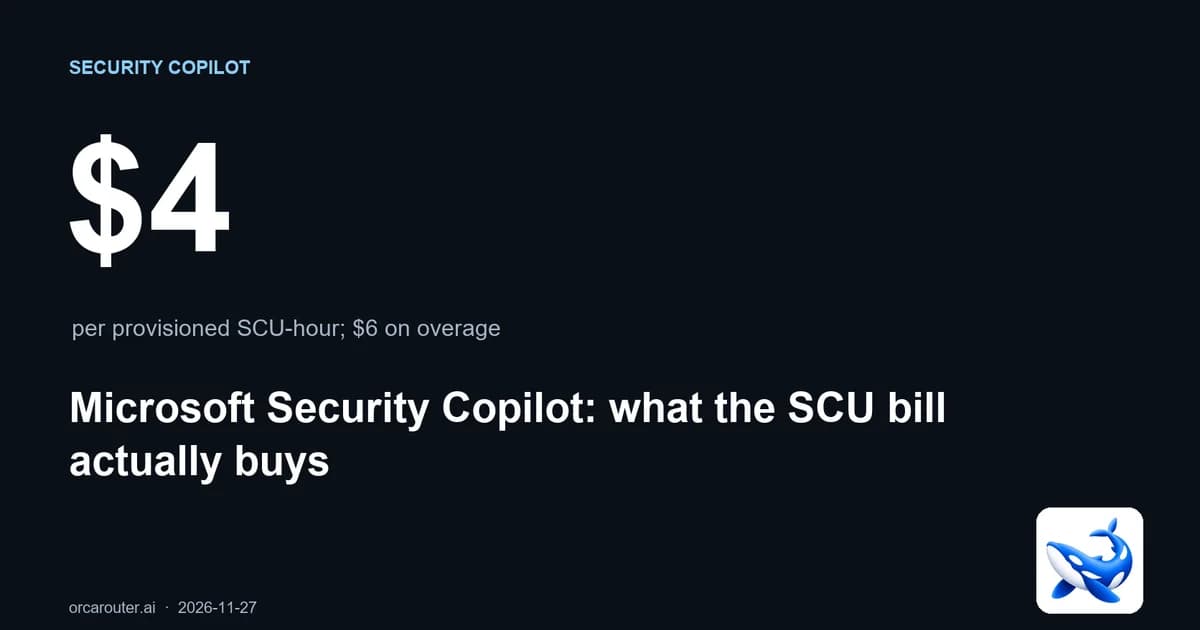
Microsoft's pricing page lists US$4 per provisioned SCU-hour and US$6 per overage SCU-hour (read 27 November 2026; list rates move with contract and date).
Provisioned capacity bills in clock-hour blocks with a one-hour minimum; unused units expire, so 09:05 and 09:45 units are both billed in the 09:00 block. One SCU running continuously is 730 hours a month, about $2,920 at list.
The licence changes the maths. Microsoft 365 E5 and E7 tenants get 400 SCUs a month per 1,000 paid licences, capped at 10,000: 400 seats means 160, 4,000 seats means 1,600. The allocation resets monthly, does not roll over, and per the inclusion FAQ (updated 19 June 2026) usage beyond it is set to be throttled rather than billed, with a $6-per-SCU top-up described as coming later.
Outside the pool even for E5: Sentinel data lake compute and storage, Logic Apps, and partner agent licences.
For an E5 shop this is a configuration decision, not a procurement one. The question is which agents spend the 160 units, and what stops them at month end.
What it will do without you
The Phishing Triage Agent evaluates user-reported email, returns a verdict with reasoning, and takes analyst feedback. Microsoft's application card marks the Security Alert Triage Agent — which extends this to some identity and cloud-container alerts — as Preview (updated 9 October 2026).
The Conditional Access Optimization Agent audits policy against Zero Trust baselines and recommends changes. Intune's Policy Configuration Agent drafts policy from plain language; its Change Review Agent flags risk. Purview's data-security agents remain labelled preview.
None acts first and asks later. Microsoft's wording is that agents "may also perform scoped actions within configured permissions when prompted, which require an appropriate user or administrator approval," and that its designs minimize irreversible actions. Analysts get a node map that is a summary, not a decision-level record.
Agents are not switched on by inclusion; you deploy them. And Security Copilot is not offered in GCC, GCC High, DoD or Azure Government clouds.
It decides what an alert probably is; a person decides what happens to an account.
Where the numbers come from
Microsoft publishes strong outcomes: 78% faster triage of user-reported phishing and 77% more accurate verdicts, 204% more missing baseline policies found by the Conditional Access agent, and a 30% cut in mean time to resolution (adoption page, read 27 November 2026).
All vendor-published, from Microsoft-selected customers, with no external reproduction.
The operational gap is worse. Microsoft's developer cost page (updated 28 April 2026) says creating and publishing an agent consumes no SCUs and testing always does, then stops. It publishes no SCUs per phishing investigation, so a buyer cannot compute an alert class's cost from documentation — only from a pilot.
What the data cannot tell you is whether the agent's false negatives resemble the ones your analysts catch, at your alert mix, in your tenant.
Against standalone agentic SOC products
The standalone category sells an analyst, not a platform. Dropzone AI is the reference: vendor-neutral across SIEM, EDR, identity and cloud, and quote-only — its pricing page on 25 November 2026 offers no figures, only "unlimited investigations under a fair-use cap."
If a third of your signal comes from CrowdStrike or an on-prem SIEM, Copilot reaches it through a plugin or partner agent, at less depth.
The split: if most telemetry sits in Defender and Sentinel and you hold E5, Copilot's marginal cost is inside the licence and the work is configuration. If you are multi-vendor or not on E5, a standalone analyst is a new contract but does not require moving telemetry. Sentinel ingestion and retention sit outside the SCU line and are usually larger.
OrcaCyber is the model layer under this stack. OrcaCyber Flash 1.0 and MiMo V2.6 Flash both sit at $0.80 per million input tokens and $1.60 per million output, both carry a 1M-token context window, and both run through OrcaRouter's single API key. Access is provisioned for vetted security engagements with a passkey, which keeps frontier-grade offensive capability in the hands of teams authorised to use it. If you would rather buy capacity on a flat plan than pay per token, OrcaPod meters in agent-hours and locks the price for twelve months.
What to write into the pilot plan
Run the agents in observe mode for two weeks before any closes an alert. Record disagreements by alert class and use that as the adoption boundary, not the vendor's percentage.
Cap overage at a number finance approved, provision for the baseline rather than the peak, and check the usage dashboard weekly. The included pool is a monthly bucket; the failure mode is a quiet throttle in week three.
Then write down which alert classes may close without a human, which identity each agent runs as, and who is paged when a verdict is wrong. If one is blank, the agent is not ready.
Sources: Microsoft Security Copilot pricing page and inclusion FAQ (read 27 November 2026); Microsoft Learn capacity, agents application card (9 October 2026) and developer cost pages (28 April 2026); Microsoft Security Blog, 13 March 2024; Microsoft adoption hub agent studies (read 27 November 2026); Dropzone AI pricing page, 25 November 2026; Ahrefs keyword data, 27 November 2026. Vendor figures are self-reported and not independently reproduced.