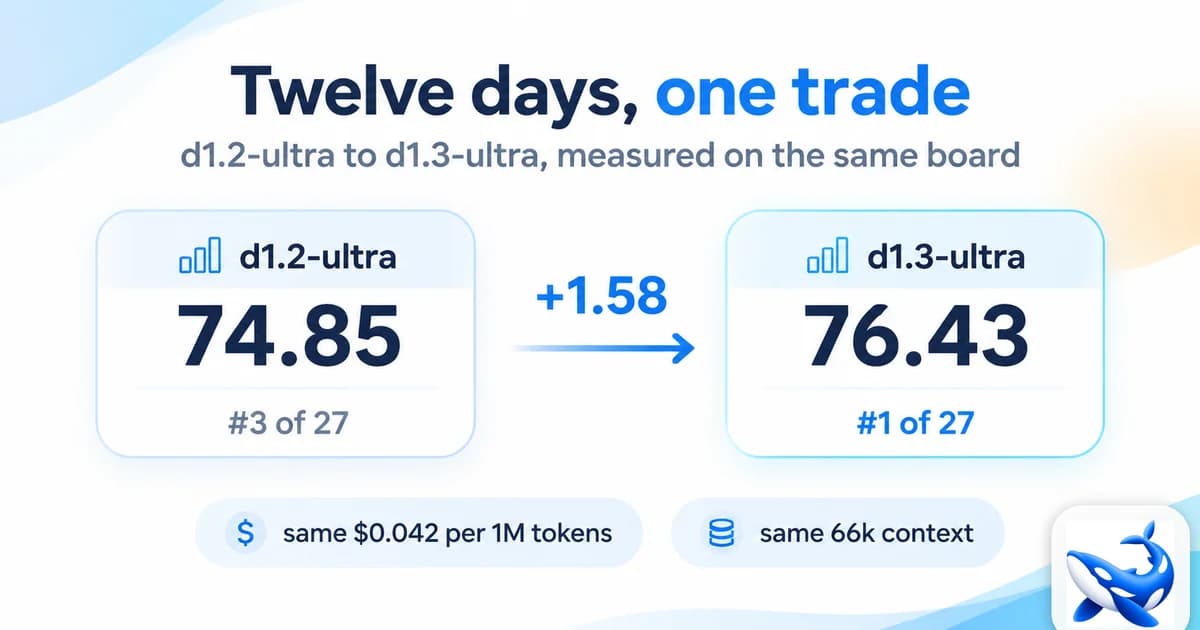
The upgrade from Liquid AI d1.2-ultra to Liquid AI d1.3-ultra costs nothing. Both are $0.042 per million input tokens, both carry a 66k-token context window, both return calibrated probabilities instead of generated tokens, and the only change on the wire is the model id. For that, Artificial Analysis measures a composite gain of 1.58 points — 76.43 against 74.85 on Decision Index v2.1 — and an accuracy-index gain of 2.72 points, 64.28 against 61.56. If the question is simply "should I move?", the answer is yes, and you can move this afternoon.
The interesting question is what you give up. Two of the six components went backwards, one of them on the exact behaviour that made the previous model attractive to risk-averse pipelines: d1.3-ultra is less likely to abstain when it does not know something. It is also no longer first by default — a 31-billion-parameter model from Base Labs now sits between the two Liquid generations on the board — so "upgrade to stay on top" is not the reason to move. The reason is documents and knowledge, and the cost is a little calibration on the edges.
Two rows, one instrument, twelve days
This comparison is cleaner than most upgrade decisions because both rows were produced by the same organisation, on the same version of the same board, within twelve days of each other. d1.2-ultra shipped on 16 November 2026 and d1.3-ultra on 28 November 2026. Artificial Analysis tested both itself; neither number is a vendor claim, and neither depends on an index revision that moved the goalposts between releases. That matters because the October launch of d1-ultra was measured against a board published before the model existed, and the comparison was not checkable in the same way.
Twelve days is also the story. Liquid shipped a new Ultra two weeks after the last one, with the same price and the same context, which is less a generational release than a checkpoint promotion. The board also times it at 191 ms per task against 218 ms for d1.2-ultra, so the upgrade is about 12% faster. The composite moved 1.58 points; the previous gap, from d1-ultra to d1.2-ultra, was 4.27 points over a month. If you are scheduling upgrades, the cadence now matters as much as the delta: anything you build against a specific component's behaviour has a two-week half-life.
The component ledger
Six evaluations, unequal weights, and a different shape in each one. Read the rows rather than the composite, because the composite is the only number that hides the trade.
• AA-Paperclip, 30% of the index — d1.3-ultra 77.23 vs d1.2-ultra 75.81, with 70.73% of documents fully correct against 67.67%. The heaviest component improves by 1.4 points and three points of all-pass rate. This is the row that justifies the upgrade for extraction work.
• AA-Omniscience-Decision, 15% — 66.25 vs 60.80 on the decision score, and 34.8% vs 23.6% raw accuracy. The largest gain anywhere on the board, and the one that changes what the model is for: the previous Ultra was a document engine with weak world knowledge; this one is closer to competent on both.
• HLE-MultiChoice, 15% — 48.34 vs 46.36 on the decision score, 5.5% vs 2.36% raw accuracy. Better on the hardest knowledge set by every headline measure except one, below.
• When2Call, 10% — 97.01 vs 96.49, with 96.7% vs 96.11% accuracy. A small gain in the field's strongest suit; Bison 31B still leads at 98.43.
• EvalSafe-O*NET, 15% — 89.67 vs 89.53. Flat. Both are now behind Bison 31B at 93.48 and Jev 1.14 at 91.14.
• AA-Symmetry, 15% — 86.17 vs 86.34, a 0.17-point regression, while the stricter all-pass rate rose from 56.67% to 60.83%. The score says slightly less consistent; the all-pass rate says more questions survive every paraphrase. The two measures disagree, and the disagreement is small enough that neither should drive a migration.
The knowledge gain is also a guessing gain
The HLE row contains the trade in a single pair of numbers. d1.2-ultra answered 2.36% of HLE-MultiChoice correctly and abstained on enough of the rest to post a 76.06% non-hallucination rate. d1.3-ultra answers 5.5% correctly and its non-hallucination rate falls to 70.06%. On omniscience the same pattern appears: accuracy rises from 23.6% to 34.8%, non-hallucination falls from 83.77% to 81.29%.
That is not a scandal. A model that answers more questions will, unless it becomes perfectly accurate, also produce more confident wrong answers; the calibration-weighted score is designed to price that in, and the composite still rises. But the operational consequence is concrete. If your pipeline routes low-confidence answers to a human, d1.3-ultra will send fewer cases to review and get more of them right; if your pipeline treats the model's "I don't know" as a safety interlock, the interlock now trips less often. The second case is the one to test before switching, because the aggregate score will not show it.
The model that actually specialises in abstention is Bison 31B: 0.59% raw HLE accuracy and a 99.01% non-hallucination rate on the same set. It is 0.55 points behind d1.3-ultra overall and ahead of d1.2-ultra by 1.03. If your requirement is "decline unless certain", neither Liquid Ultra is the right instrument, and the upgrade question is moot.
Migration is a model id, not a project
The endpoint, the request shape and the three question types are unchanged. A noul question still returns a probability, a choice question still returns a distribution over labels, and a score question still returns a position on a scale. Nothing in the integration changes except the model name, which is why the switch is cheap and why it is easy to do without measuring.
Two documentation gaps are worth checking before you flip the id. Liquid's docs still list d1.2-ultra as the most capable decision model and do not yet have a d1.3-ultra page; they list d1.1, d1-ultra and d1 as deprecated, but not the model you are leaving. And the input modalities are stated differently in the two places that describe the family: Artificial Analysis' summary lists text and image input for d1.3-ultra, its specification panel also shows document and audio icons, and Liquid's d1.2-ultra page lists audio too. If you send audio today, confirm it still works rather than assuming the modality carried over.
The billing rule is the other thing to verify in writing. d1.2 introduced per-request billing for images: text and pictures are charged once and each additional question adds only its own text. Under d1-ultra, every question was billed as a prompt including all images, so ten questions over one photograph paid for the photograph ten times. If d1.3-ultra keeps the d1.2 rule, a multi-question request costs what it costs today. If it reverted, the same request costs roughly nine times more at an identical sticker price. The launch material does not say, and this is a larger sum than 1.58 index points.
What a switch actually costs you
On Liquid's own API the migration is free. It is not free in the rest of your stack if the decision call shares a key with other models. d1.3-ultra is available through Liquid's own API and several third-party platforms; it is not in OrcaRouter's catalogue, so it cannot sit behind the same key as the 200-plus models we route, and it does not inherit our automatic failover or our pass-through pricing. Those apply to the models we carry — for decision work, Jev 1.14, which is on the same board at 66.23 and still leads EvalSafe-O*NET at 91.14. Budget d1.3-ultra as a separate integration with its own rate card, not as a model id on an existing router bill.
The practical test is a replay, not a benchmark. Take a few hundred requests your current pipeline has already labelled, run them through both models, and compare three things: the answers that changed, the cases where d1.2-ultra abstained and d1.3-ultra did not, and the cost per request including images. The first tells you whether documents improved on your data; the second tells you whether the safety interlock moved; the third catches a billing change that no launch post mentions.
My reading: switch if the job is extraction, classification or document decisions at volume, because the 30%-weighted component improved and the knowledge gain is real. Test first if the job is gating, escalation or anything where a confident wrong answer costs more than a deferral, because that is the one behaviour that got measurably worse. And do not switch for the ranking: d1.2-ultra was first of 24 twelve days ago and is third of 27 today, which says more about how fast this board is filling than about either model.