Purple AI has sat inside SentinelOne's Singularity console since April 2024, when it shipped as a natural-language layer over the data lake: ask a question, get a PowerQuery and a summary. What changed on June 17, 2026 is who starts the investigation. Since then the product starts one itself, which SentinelOne calls zero-click.
When an alert crosses a threshold the customer set, Purple AI gathers evidence from endpoint, identity, cloud and third-party telemetry, rebuilds the chain and returns a verdict with an audit trail. How far it may go is configurable, down to suggesting rather than acting.
What the triage automates
The 2024 product was read-only: it wrote queries and left the clicking to a person. October 2024 added Auto-Alert Triage, which scores an alert against anonymised similar alerts from other customers, and Auto-Investigations, which ran the steps and saved the findings. June 2026 joined both into one automatic path with a credit meter underneath.
The work removed is volume sorting, deduplication, enrichment, a first-pass verdict on shapes the platform has seen ten thousand times. Whether it can do that is settled. Where the boundary sits is not.
The boundary is business context
An agent reads telemetry. It does not know that finance runs a script at 02:00, that a penetration test was booked for this week, or that the contractor in the alert was hired on Monday and given those credentials deliberately. None of that is in the logs.
The split shows in the arithmetic. In a Microsoft randomised trial on phishing triage, cited by RiskInsight in November 2026, roughly 83% of the time saved came from reports classified as benign. The model is fast at clearing the many, and the many are not where an intrusion hides.
The hard case is the expensive one: isolating a production database, disabling an account that owns a deployment pipeline, closing an alert that turns out to be an insider. SentinelOne concedes the boundary by leaving it to the buyer, who pre-sets where the AI acts and where it waits for sign-off.
Nobody publishes the calibration
A verdict carries a confidence score, and autonomy rests on it meaning something. RiskInsight and Wavestone assessed five agentic SOC products against 26 criteria in November 2026; none publishes calibration of its confidence against analyst verdicts. A score works only if verdicts marked 90% are right nine times in ten.
SentinelOne's June 2026 launch release has no accuracy figure, no false-positive rate and no time-to-verdict, only minutes against hours. The August 2026 follow-up is concrete on volume and silent on quality: more than 8,500 critical autonomous investigations a day and more than a third of the eligible customer base. Both vendor-reported.
How the credits work
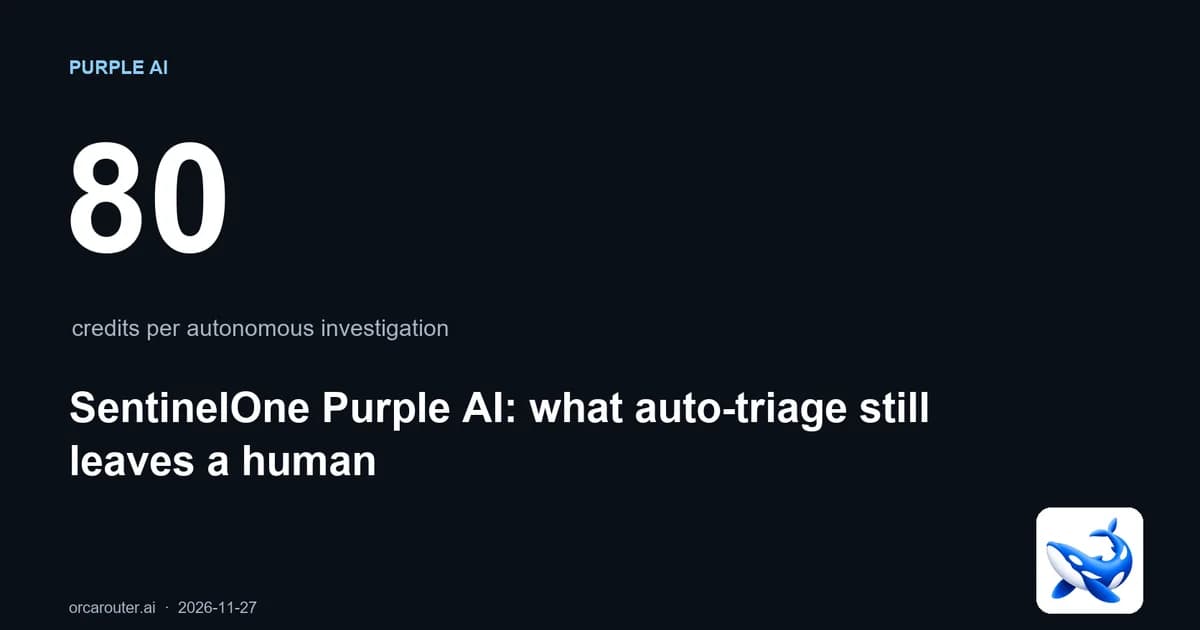
One agentic investigation costs 80 credits, deducted on completion rather than on start, per the console documentation. Credits sell in 100-credit packs with a 15-pack minimum, so the smallest purchase is 1,500 credits, or 18 investigations. Sizing is multiplication: monthly investigations × 80 × months of term.
At zero balance automatic investigations stop immediately; the documentation says there is no grace period. On-demand billing, settled in 10-credit increments monthly in arrears, has to be switched on before you need it. Credits also must be allocated from the top-level scope down through account and site, and a site holding none runs nothing.
They do not reset monthly: they expire at the earlier of twelve months after purchase or contract end, and any balance is forfeited. Buying requires Singularity Complete, and credits are unavailable in Flex, GovCloud and to MSSPs. Purple AI SOC Analyst closes to new customers on October 31, 2026.
The price is still the missing number
No per-credit price is published. The trial ran free until September 6, 2026 per the console documentation, or August 15 per SiliconANGLE; afterwards credits come through partners, direct billing or ecommerce at the local price book. A Licenseware teardown puts Purple AI in more than half of licences sold in SentinelOne's fiscal Q4 2026.
The only budget line before a quote is in credits. A site generating 600 alerts a month, all routed through investigation, buys 48,000 credits a month. That figure follows alert volume, not headcount.
What the data cannot tell a buyer
Three things: whether the verdicts are right often enough for the autonomy you chose, because no calibration exists; what the credits cost, because no price is published; and whether the saving survives a bad week, because every published volume counts investigations started, not investigations that changed an outcome.
One failure mode gets less airtime. An agent that reads attacker-controlled text can be steered by it: a non-peer-reviewed May 2026 preprint found injected instructions could conceal 68% of malicious logs from an unprotected analysis agent. SentinelOne's answer is governance, pre-set boundaries and an override, which is right and still a design claim.
OrcaCyber is the model layer under this stack. OrcaCyber Flash 1.0 and MiMo V2.6 Flash both sit at $0.80 per million input tokens and $1.60 per million output, both carry a 1M-token context window, and both run through OrcaRouter's single API key. Access is provisioned for vetted security engagements with a passkey, which keeps frontier-grade offensive capability in the hands of teams authorised to use it. If you would rather buy capacity on a flat plan than pay per token, OrcaPod meters in agent-hours and locks the price for twelve months.
What to test while the trial credits last
The pilot question is not whether Purple AI writes a good report; the evidence chain makes that easy to check and it will look competent. It is what happens to the alerts it calls benign. Take a month your team already closed, run it through, and read only the disagreements.
Then check the mechanics: where the allocation sits, who can raise the on-demand limit, what happens at zero balance, and what an autonomous containment costs when the verdict was wrong. SentinelOne will say it stops threats at machine speed. The question worth asking is what your organisation does at human speed when it stops the wrong one.
Sources: SentinelOne press releases of April 9, 2024, October 16, 2024, June 17, 2026 and August 3, 2026; Singularity Credits console documentation (2026); SiliconANGLE, June 17, 2026; RiskInsight/Wavestone agentic SOC analysis, November 2026, citing a Microsoft randomised phishing-triage trial; Licenseware licensing teardown, 2026; a May 2026 non-peer-reviewed preprint on prompt injection in analysis agents. Volume and adoption figures are vendor-reported; per-credit pricing is not public.