Arendalsuka 2026
What happens when patients can access the world's medical knowledge in just a few clicks? Key takeaways from Arendalsuka's debate on AI in healthcare.
When patients gain instant access to the world's medical knowledge base, it does more than transform the patient’s role. It challenges the very foundation on which today's health and social care services are built. For healthcare leaders and professionals, this creates a new strategic reality: knowledge is no longer a scarce resource, and patient expectations are increasingly shaped by digital services that are faster, more accurate, and more accessible than many public systems. The question is not whether this change is coming, but how healthcare services can lead it and remain relevant in a new reality.
Artificial intelligence is transforming healthcare at a pace few could have imagined just a few years ago. Patients now arrive at appointments with AI-generated analyses, diagnostic suggestions, and higher expectations regarding both accessibility and quality. At the same time, new technologies offer opportunities for better insights, more personalized care, and smarter use of scarce healthcare resources.
During Arendalsuka, Norway’s largest annual political and civic festival, EHIN, Norway’s leading e-health conference and network for digital health, and Tieto Caretech brought together a panel of leading voices from healthcare administration, municipal healthcare, general practice, and patient advocacy organizations to discuss the growing role of AI in patients own diagnostics, trust in new technologies, and the future of healthcare services.
The panel consisted of:
- Ellen Rønning-Arnesen, State Secretary, Ministry of Health and Care Services
- Johnny Advocaat, Director of Quality, Innovation and Digitalization, Oslo municipality
- Torgeir Hoff Skavøy, Chair, Norwegian Association of General Practice
- Sara Underland Gjelsvik, Head of Public Affairs and Policy, Norwegian Cancer Society
- Hanne Støre Valeur, Country Manager Norway, Tieto Caretech
The discussion was moderated by EHINs CEO Nard Schreurs.
Knowledge is no longer healthcare's scarce resource
Just a few years ago, medical knowledge was largely reserved for healthcare professionals. The internet made information more accessible, but generative AI has accelerated the development dramatically. Whereas patients previously relied on healthcare professionals to understand symptoms and potential diagnoses, they can now receive answers from advanced language models within seconds.
This development challenges traditional roles and changes the dynamics between patients and healthcare providers.
"We are in a situation where patients have access to increasingly powerful tools and more information than ever before. This challenges both the patient role and the way healthcare services are organized," said the moderator Schreurs.
No longer future scenarios
Hanne Støre Valeur described how developments in artificial intelligence are no longer future scenarios, but situations are already unfolding today. At the same time, she emphasized that access to data is essential for realizing the full potential of the technology.
As an example, she shared the story of a colleague and parent who used AI to better understand a complex medical condition affecting his child after healthcare providers had been unable to identify the cause over time. Although he had access to advanced AI tools, he did not have access to the necessary healthcare data, which remained fragmented across different systems within the healthcare sector.
"Patients already have access to the tools. The question is how we connect healthcare data and analytical tools in ways that create value for both patients and healthcare services," said Valeur.
She stressed that the future of healthcare must be built on a combination of accessible health data, responsible use of technology, and solutions designed around patient needs.
From diagnosing to de-diagnosing
For general practitioners, the shift is already visible.
Torgeir Hoff Skavøy explained that many patients now arrive at consultations with diagnostic suggestions and extensive analyses they have carried out themselves.
"Patients often arrive feeling fully assessed, at least in their own view. Sometimes it almost feels as though we need to de-diagnose more than we diagnose," he said.
At the same time, he believes AI can be a valuable tool when used appropriately.
"We need to be open to patients bringing valuable insights, but the information must be interpreted within the proper medical context."
A new kind of dialogue between citizens and healthcare services
Johnny Advocaat from Oslo municipality described how some citizens are already requesting access to extensive health and sensor data to analyze their own health situations or those of family members.
In his view, this signals a new normal.
"We will increasingly encounter citizens who are far better informed than before. We must be willing to sit on the same side of the table and understand the insights they bring," he said.
Advocaat also warned that healthcare services cannot afford to ignore the trend.
"If we move too slowly, we risk citizens gaining access to better tools outside the official healthcare system than those available to healthcare professionals."
Trust will be the decisive factor
Trust emerged as a central theme throughout the debate.
How much error is society willing to accept when AI is used in diagnostics, decision support, and patient follow-up?
State Secretary Ellen Rønning-Arnesen argued that the discussion should not be framed as technology versus people.
"People make mistakes today. Technology will also make mistakes. The question is which mistakes we are willing to accept, how we manage them, and how we ensure safety and trust throughout the entire development process," she said.
She also stressed that healthcare services must demonstrate an ability to adopt new solutions if the public is to maintain trust in public healthcare systems.
AI must help address workforce challenges
A significant part of the discussion focused on future workforce challenges.
In the coming years, Norway will require more health and care services while access to healthcare professionals becomes increasingly limited.
Technology must therefore do more than improve quality. It must also help free up capacity.
"The goal is not fewer healthcare services. The goal is to deliver healthcare differently, enabling healthcare professionals to spend more time on the human interactions where they make the greatest difference," said Rønning-Arnesen.
The risk of greater inequality
The panel also highlighted a less discussed aspect of AI development: the risk of increasing inequality.
Some citizens will have both the skills and resources needed to make use of advanced AI tools, while others may be left behind.
Sara Underland Gjelsvik of the Norwegian Cancer Society emphasized the importance of maintaining an equality perspective.
"We must ensure that technology benefits everyone and is built on data that represents the entire population, not just selected groups," she said.
The doctor of the future works alongside AI
Despite differing perspectives, the panel agreed on one key point: AI will not replace healthcare professionals. However, their roles will evolve.
In the healthcare system of the future, physicians, nurses, and other healthcare professionals will increasingly act as advisors, guides, and decision-support partners for patients who themselves have access to growing amounts of information.
As Hanne Støre Valeur summarized:
"The real value emerges when the patient, the healthcare professional, and the 'third expert' - AI - all have access to the same knowledge and can use it together. But that requires equal access to the third expert."
The road ahead
Technology is no longer the question. It is already here. The challenge now is to build the infrastructure, data foundation, and trust required to ensure artificial intelligence can be used safely, responsibly, and in ways that create real value.
For healthcare systems, the future is not simply about more technology. It is about better collaboration between people and technology - for the benefit of citizens.
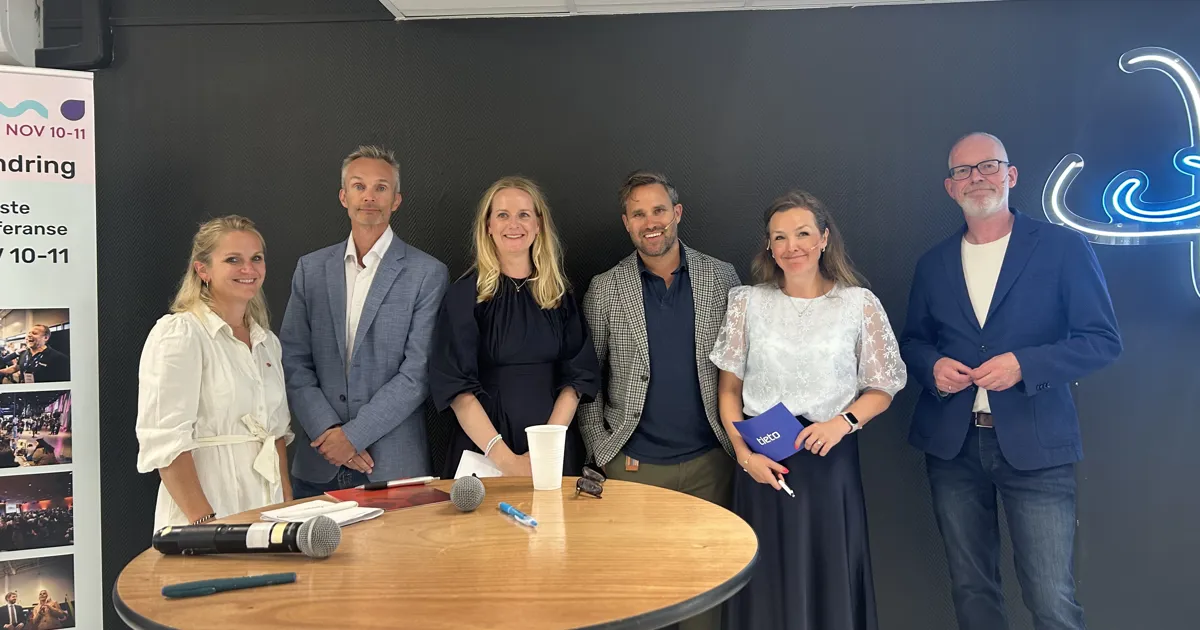
Image from the panel discussion at Arendalsuka 2026. From left: Ellen Rønning-Arnesen, Torgeir Hoff Skavøy, Sara Underland Gjelsvik, Johnny Advocaat, Hanne Støre Valeur, Nard Schreurs