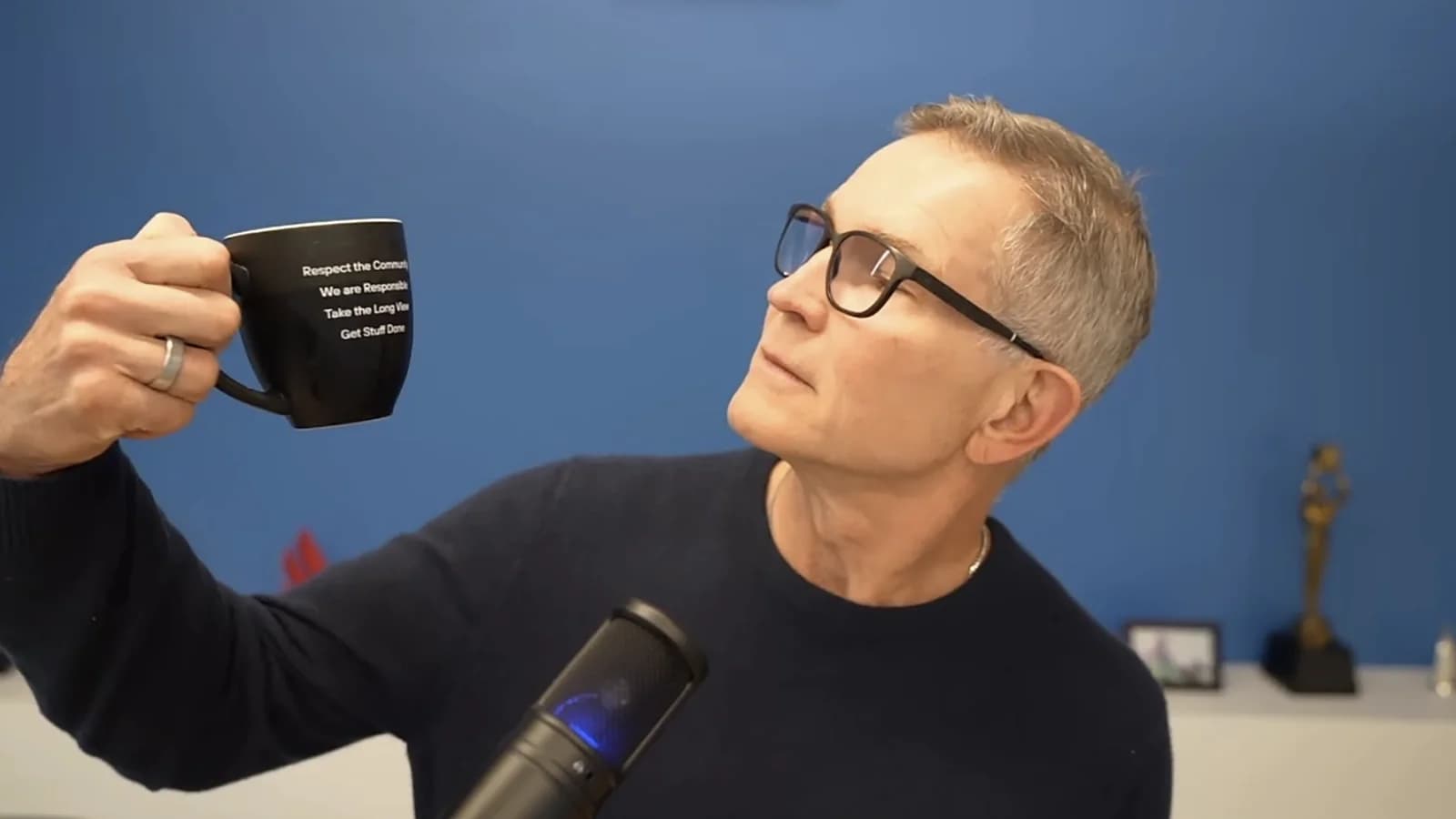
In October, Roblox Founder and CEO David Baszucki sat down with Bloxz of Bloxy News for a candid interview, answering questions Bloxz selected from the community. While there was an issue with the recording, we are sharing the transcript and some screenshots from the conversation. With Bloxz’s permission, below is the transcript.
Bloxz: Hello, Robloxians and welcome back to Bloxy News. I’m your host, Bloxz, and in this episode, I have a very special guest, who some of you may know. Please welcome the founder and CEO of Roblox, David Baszucki.
David: Hey, it’s great to be here. Thanks for having me on.
Bloxz: Thank you. Before we dive into it, let’s just talk a little bit about where you came from, your origin story. You were born in Canada, right? And then you grew up in Minnesota?
David: I was born in Canada, started growing up in Canada, moved to Minnesota in about sixth grade, went to middle school and high school there, and had a wonderful youth in the prairies of Minnesota, outside of Minneapolis.
Bloxz: Awesome. And then you also studied electrical engineering and computer science at Stanford, right?
David: I did. That’s exactly right.
Bloxz: Some people may not know this, but before Roblox—back in the late 1980s—you and your brother actually founded a company called Knowledge Revolution, where you made a program called Interactive Physics.
David: Yes. Back then, good UIs were coming along, windowed operating systems. When we surveyed the educational software market, what we saw was that the vast majority of educational software was, in a way, like pre-scripted stuff where you would move a few sliders or do a few things.
My brother Greg and I, and Erik Cassel, we were all creators when we were young and making models and stuff, so we were thinking, why would you use pre-scripted physics? Why wouldn’t you have a physics lab on the computer where you could build any experiment and watch it and measure it and play with it?
So that was the idea for Interactive Physics. We built it on the Mac. It won a bunch of awards, MacUser Editors’ Choice Award, and something really interesting happened. We would go to schools and watch all the young people playing with Interactive Physics and doing their physics homework and modeling physics experiments and balls and pendulums and springs and all of that. But universally, we found them using it to actually build stuff.
They weren’t building the physics experiment. They were building cars crashing into bricks and things falling down, and in a way that formed some of the original ideas for Roblox.
Bloxz: Awesome. So after the Knowledge Revolution days, you obviously started work on Roblox. Do you want to take us through like the early days, like back in 2006 where it was just the four of you sitting in that office in Menlo Park? What was that like?
David: So what happened with Knowledge Revolution is we got all of this feedback from all of the people playing with Interactive Physics, and we also had our own vision about immersive 3D and the holodeck and Snow Crash and all that sci-fi stuff. And we knew that all of the people who were building on Interactive Physics, they wanted 3D, they wanted in the cloud, they wanted multiplayer. They wanted avatar-based worlds, all of that.
So we set out to build Roblox with that vision—very early on, we had a business plan. We actually had a business plan slide, if you can believe it, that we should frame and put on the wall somewhere because it said, look at all these emerging trends. We saw social networking starting to pop up with social graphs; we saw UGC platforms for video, like YouTube, starting to pop up. We had online gaming starting to get, you know, more and more prevalent, multiplayer-type stuff. We had communication platforms, and we thought, right in the middle of all of this was this new category—call it immersive human co-experience, call it the holodeck, all of that. That slide was really the genesis of the very first Roblox.
Some fun things along the way: Erik and I tried to release, arguably really early, we tried to get something out that we hoped would go viral that was not multiplayer, that was more of an early puzzle game. It was still UGC—everyone making their puzzles with a physics engine. But it didn’t go viral, and so we had to go, “Oh my gosh, we have to go to the complete vision multiplayer, avatar, in the cloud UGC.”
The second release was Roblox, and we released not just Roblox, and not just people playing in classic Crossroads to test the engine—but when we released Roblox Studio, we knew on that day, we'’e gonna see virality. It was a really special day for us.
Bloxz: Yeah, so I’d say that second option was definitely the right move.
David: Yeah.
Bloxz: OK, so fast-forwarding a bit, we recently just celebrated 20 years of Roblox. Do you have any favorite memories over the last two decades you want to share?
David: I feel we’re all very fortunate because in addition to all of the hard work, and all of the ups and downs and hard challenges, there are just so many amazing moments.
That first day with Roblox Studio, we weren’t quite sure, right? John Shedletsky was building Chaos Canyon, we were experimenting, we were all using Roblox Studio. We already had a small multiplayer group that we knew were online every day in the afternoon, but when we launched Roblox Studio and allowed people to start creating, we saw within those first hours more and more and more interesting creativity, and that was a very special moment.
Then it was a very special moment when we introduced Robux and the economy. This was a really big Board-level discussion, and it seems hard to believe, but at the time we were very concerned that adding economy and revenue might take away some of the passion and fun of all of the hobbyists who were creating on Roblox.
So we discussed that a lot, but we talked a lot about the notion that we’re gonna see full-time creators, we’re gonna see groups of creators that can make a living on the platform, and we’re going to see better creations possibly when people can make a living building on it.*
So when we introduced the creator economy, a couple of things had been happening. For those of you that remember Builders Club, that was a very primitive starting point. But that really wasn’t the substantial economy we needed for people to make a living.
In a way, we were both reacting to Builders Club getting a little old-fashioned as well as leaning into our innovation, but we built the whole system. We built Robux, we built the ability for creators to have items in their games for sale for Robux. We built the ability for creator Developer Exchange (DevEx) and for creators to cash out. We built one of the sorts we had on the homepage at that time, which was just top places where Robux were being spent, and that created a viral loop on that first day as well. Within hours of introducing the creator economy and DevEx, all kinds of interesting games were starting to add Robux to the economy. We had that same feeling … this is going to be amazing.
And I would say, whether it’s Roblox, RDC, or the very first BLOXcon we had, every one of those has been an emotional high. It gets better every year when we see the creative power that comes together in that room. I love having my Q&A, which is, you know, everyone in that room asking edgy questions. Which we love. Over the years, seeing the creative power of our creator community and seeing it evolve with the platform to the point now where I feel, when we do our developer conference, the creators we have in that room are arguably relative to all of the CEOs of the gaming companies out there, the creators I see in that room are absolutely mind-boggling, so that’s another high for me.
Bloxz: Awesome. All right, kind of staying on the topic of the last 20 years. We’ve seen a lot of different changes. We’ve seen new styles of games, new types of avatars, better tools for development. Where do you think Roblox will be in the next 20 years?
David: What’s fun about Roblox is it’s not finished. And what’s fun about Roblox, and what makes my job super-interesting, is there’s a lot of fun things to think about.
So first, we’ve talked about the global gaming market and wanting to get to 10% and beyond. We'’e not there, right? You can do the math—in a $200 billion gaming market, what’s running on Roblox is in the 3.5% to 4% zone, roughly.
The second thing that’s really exciting about what we’re working on is under the covers of Roblox. I believe that the way we’re serving games and creating games is really the future. We’re seeing right now, just in the midst of AI, reverse engineering, reverse compiling, the traditional notion of a fat binary, with all the content embedded and the difficulty in updating and running that across multiple devices around the world. That I think is more and more going to move toward what the Roblox architecture is, which is cloud-based multidevice, 3D streaming, instant join, single-build mobile, PC, tablet, computer, you name it, and a bunch of that other functionality.
The fun thing is, since the very first BLOXcon, we’ve always said, “Look, the endgame here is infinite scale and multiplayer with photorealism. And I do think, over the next 20 years, we’re going to see that come to fruition with all the tech we’re building. So, in the movie industry, in the TV industry, we’ve gone from black-and-white, no audio, to 4K 60Hz video. I think we’re going to see that kind of stuff with Roblox over the next 20 years.
Bloxz: So you mentioned RDC just now. We got a first look at the Roblox Card and the Roblox Wallet, which is going to be replacing the existing DevEx program next year. It’s a big change to how creators earn money on the platform. Are you able to go into a little bit more detail on how this is going to work next year?
David: I would say, this is getting to be a bigger and bigger economy. We’re moving north of $1.5 billion to creators every year. We think transparency and liquidity are important for creators, and we want it to be very easy to have their earnings flow through.
So what we’re doing with the Roblox Card and Wallet, I would say, is just the first step toward more financial liquidity and transparency for creators. There’s a lot more potentially to come, down that alley.
For many young people, learning how to manage money with Robux is actually going to be more and more someone’s first exposure to financial literacy, even if they’re getting, you know, 100 Robux here and there. Learning how to spend and how to figure that out, I think, has a lot of future promise for us. So, stay tuned on the Roblox economy. Stay tuned on the Roblox Card. We have more fun to come.
Bloxz: Awesome. And then one more thing on RDC this year: We also got to look at stand-alone games and listings on the App Store. So does this mean I can publish a Roblox game to Steam or Epic Games and launch it straight from those storefronts, or how does that work?
David: I think this is really interesting, and I want to compliment all the creators over the last 10 to 12 years who’ve been pinging and asking about it and following on what we said about the Roblox architecture. Cloud-based, constantly able to update, multidevice, single build, instant join, no download, and more and more things coming to support higher and higher quality.
A lot of creators have been asking, “If I build an iOS app, could I have my game be both on an iOS app as well as in the Roblox app at the same time? Could people co-play between those? If I wanted, in my creator console, to download a PC executable that uses the same Roblox tech and the same Roblox Cloud, could I do that?” We more and more think yes, and I think we have the first release of this coming. We’re not gonna say the date on it, but stay tuned on this.
We actually think the technology behind Roblox is so substantial for the future of gaming that we want to support it both in our app as well as in Roblox Everywhere.
Bloxz: Awesome. All right, let’s jump into a couple edgier questions. I know you wanted a couple of those.
David: OK, yeah, those are the kind we like and the kind we like to answer at RDC. So let’s see what we got here.
Bloxz: All right, so there’s been a lot of talk about attracting older audiences to Roblox. However, the algorithm seems to push games that are intended for younger audiences to everyone regardless of whether they’re 8 years old or 28 years old, and I know you recently introduced the Standout Games sort on the homepage, but some say that isn’t enough. Are there any changes we can expect soon to give more exposure to higher quality games and help attract older audiences?
David: Yeah, so I want to compliment our discovery team. More and more, we’re directly measuring increases in retention and monetization in a more appropriately aligned and personalized way—and at the same time making sure we comply with privacy requirements.
I shared something really interesting at RDC—we can see more and more in our discovery algorithm the difference in the type of things an older player might want to see versus a younger person, and our algorithm is more and more picking that up.
One of the things you’ll see us constantly roll through is improvements in cold start as well as what you see if you’re older or younger, and we can see the data, we can see how we’re getting better at matching younger people with what they play and older people with what they play.
So, the needle is moving on this already, it will get better and better over time, and I think ultimately, when you go to our homepage, what you’ll see is just going to be what is exactly right for you.
Bloxz: Awesome. All right.
David: Oh, and I have one other fun discovery comment. I think we’ve all seen this just in the last month or two or three: AI acceleration—there’s a lot of it going on. MCP usage in Roblox Studio is going up. People are using a lot of AI to complement their work, and so it brings forward the concern all of us have around AI slop, and it brings up the question: Are there people just setting up automated farms to AI-slop hundreds of Roblox games?
The good news is our discovery team is open to the challenge. The way we have to build discovery is in a realm where there are 100 times more games published per day or per hour than there currently are. We have to be the best at finding the truly authentic, unique, new, interesting content, which I believe is always going to incorporate human spark and human ingenuity as part of it. So we’re really building a future-forward resilient look for our discovery algorithm.
Bloxz: All right, awesome. Moving on. With all kinds of audiences and ages on Roblox, safety is a very important factor when it comes to running a platform as big as Roblox. However, there does seem to be a little bit—every once in a while—some discrepancies and false actions taken against some users or creators that might be innocent. What are you doing to continue to improve safety in moderation, and do you think we’ll ever be able to see exactly how the moderation works for transparency?
David: I love the notion of transparency. We have a principle inside the company that we don’t shadow ban, and we want as much transparency as possible. We’ve also had the principle for discovery: As much as possible, we’d like to make the algorithm transparent and show what we’re weighting and stuff so people can see that.
So I think you’re onto something, which is, the future of these types of things is absolute transparency. Our policies are pretty transparent right now, and I would highlight behind the scenes, we do watch the metrics—what percent of accounts are banned, how accurate are all of those—and those numbers keep getting better and better. So I know there could be a vibe out there, but we do watch those metrics, and our goal is absolute perfection.
Of course, no one can be perfect, but that is the goal we strive to get to. I’m very optimistic about AI in that regard. We have over 400 models running. We have all of our own models for text, for voice, for all of these types of safety things. And what’s really been fun is some of the innovations we’ve made over the last year, whether it’s age checks or Roblox Kids or Select.
I won’t name the companies, but a lot of the innovations we’ve made over the last year or two are now starting to be picked up by other big-name companies, almost as a response in a way. So, you know, our vision on safety is to go beyond what’s required by law, go to our own responsibility for the community, and build what we think is right. It’s getting better and better all of the time, and I think we’ll never stop.
Bloxz: Awesome. All right. What are some challenges you face when it comes to being the CEO of a company as big as Roblox? Like, how do you manage a healthy work-life balance?
David: Super-important, right? I feel being a CEO is almost like being an athlete in a way. You’re not necessarily running a 100-meter dash, but your brain has to be functioning at peak performance, and I would also say, part of being a CEO is being in a mental mindset where one is in an optimistic creative mode as opposed to a defensive tactical mode. One of our values is, oh … look, it’s here.
Bloxz: Oh, there it is right there.
David: Yeah, sorry, I just thought of that. So one of the things that’s made Roblox successful is this value of Take the Long View. We don’t want to stop doing that. So, lifestyle for a CEO, all of this stuff—diet, sleep, exercise—how you balance your life is critically important for me, and it’s well reflected within the company as well.
We do a lot of stuff within Roblox as far as optimal-performance-health-type things, whether they’re DEXA scans or glucose monitors or how we label our food—we really run the whole company as a performance-health place to work.
Bloxz: Yeah, I took a visit to Roblox headquarters during RDC this year, and I could tell the food was definitely on the healthier side of things.
David: The food—we label all of our snacks, whether or not they’re whole foods, whether or not they’re good energy. It’s almost educational as you pick your snacks. Our cafeteria doesn’t use seed oils, it uses what we would consider healthier oils. I just had a friend who joined Roblox a couple weeks ago, and they pulled me aside and said, yeah, the food’s ridonkulous.
Bloxz: Awesome. All right, so you spend a lot of time at Roblox, obviously, but what do you do outside of Roblox? Like what does a day in the life of David Baszucki look like?
David: OK, I’ll give you today. Today, I probably woke up at 4:45 a.m., did some email, went online, went and did a workout at 6:30 to 7, rolled into the office; I have a calendar all set up. By midmorning, I’ve already met with some of our key engineering leaders. We’re planning a lot of interesting accelerations on our game engine, so we’re starting to set up meetings for that. Then I’m going to hop in a car, go have a lunch meeting with another CEO, come back, and work.
I’ll probably go till 6:00 p.m. here, go home, eat. You know, hang out, do some hobby stuff. Probably go online 7:00 to 8:30. At 8:30, I’ll put on my blue-light-blocking glasses so that I’m no longer seeing blue light—they’re like red glasses. From 8:30 to 9:00 or 9:30 p.m., I’ll wind down reading or socializing, and then I’ll hit the sack.
Bloxz: All right. You got it all planned. I’m gonna read you a quote real quick that you said in a blog post back in 2012: “We have a big vision. The future of ROBLOX is an online world where many physical phenomena are simulated. Ultimately, wind will blow small parts around, metal wires will conduct electricity, lasers will cause wooden parts to burst into flame, magnets will attract parts made of iron, and water will freeze, flow and vaporize. This is not a world that will be composed only of blocks.”
Do you think you’ve successfully achieved this vision 14 years later, or do you think there’s still more work to be done?
David: There’s obviously more work to be done, right? Here’s the challenge, and the exciting part of all of this is how much, both local and cloud compute, is going to be available. How far can we simulate physical reality with the given compute? The more we have, the more we can simulate physical reality.
When we started Roblox 20 years ago, we had the vision of, if we could have a million times the compute or 1 trillion times the compute, we would simulate the Roblox world at the atomic level, and we would from first principles get the water flowing and the wind blowing and all of that, at that level. We just don’t have that compute power, but I’m really optimistic about the power we’re starting to see, both server side with compute power, as well as video client side with AI accelerated, and the demo we gave at RDC recently about Roblox Reality highlights that that compute power is going to be distributed.
We’re going to want more compute power so we can simulate, you know, 10,000 avatars all in a medieval battle with that networked castle, falling apart. That’s been a dream since we started. But some of the other physics stuff, like raindrops and water reflection and water pooling, we’re starting to see the local AI models be able to handle that. And so I’m optimistic we’re gonna stay on track.
We want to simulate all aspects of reality. Part of what made Roblox successful and helped it grow is it’s easier to build a 3D environment where the car has wheels, and if the wheel falls off, the car does weird stuff automatically, than to have a fully scripted car and try to capture and code what happens. So, the more physical reality, the more fun, the easier it is to build, and we won’t stop.
Bloxz: All right, awesome. This is the last main question, and then we’ll move on to some community questions if we have additional time. You’ve been the CEO since Roblox started basically in 2006. How long do you plan to stay the CEO for? Do you plan to ride it out as long as possible? What’s the move, do you think?
David: Yeah, it’s, it’s fun to think about work, and there’s various types of work. Some of us get fortunate in our job to have a job that is almost like being an inventor, and I think running Roblox arguably is one of the most interesting and creatively rewarding jobs in the world. So I don’t have any plans to stop.
It’s so interesting. Imagine some of what sound like the funnest jobs in the world, right? You’re running Disney and we’re about ready to build the Magic Kingdom, or, you know, we’re running Apple and we’re about ready to ship the Macintosh. That’s a bit what my job feels like.
Bloxz: All right, we’re gonna move on to some community questions real quick. I got a few for you. I actually got over 1,000 questions submitted. Obviously I can’t go through all 1,000, but…
David: Oh! Shoutout to the community. Thank you.
Bloxz: So first one comes from Roblox user IcyTea. They asked, “Will we as players and developers be able to curate our Roblox profile to showcase what we want? Whether that’s items we own, experiences we want to showcase, a community we’re a part of, UGC we made, etc.” More of a profile customization.
David: I think you’re seeing a trend towards that, right? We’re already starting to do 3D backgrounds. We’re also starting frames and things like that, so we do want more customization. We realize how personal everyone’s profile is, so I think you’ll see more along that trend.
Bloxz: Awesome. All right, the next one comes from a user by the name of Dro: “What does the future of Roblox Studio look like? Will it eventually compete with other engines like Unity and Unreal Engine?”
Bloxz: All right. The next question comes from Roblox user andrew9126: “How do you plan to balance the competitive side of Roblox events while maintaining the fun, more laid-back ones as well? How’s 2027 and beyond looking for the future of Roblox events?”
Bloxz: I appreciate it. All right. And that’s that.