Here’s what a typical Monday report looks like for enterprise optimization teams:
- 16 tests running across nine markets
- 38,000 new session recordings.
- 1,200 survey responses and fresh heatmaps for every campaign
Somewhere in the sea of data is an insight that nobody has spotted yet: Checkout completion has dropped by 5% for returning visitors.
But finding this insight means picking which recordings to watch, which segments to dig into, and which of the other 20 open questions to keep aside.
By the time someone notices it, the dip has cost the company weeks of revenue.
That’s what data overload looks like. Teams today have more visibility into the customer journey than ever before. Yet, the more there is to look at, the harder it gets to notice what matters.
And with traffic getting scarcer and more expensive, every missed signal costs more.
The problem is that there’s a lot of data out there. Every martech vendor and every business has plenty of data. But a lot of that data isn’t being used to make the right business decisions. Often, it’s used to build a report for executives that says, ‘This happened,’ but it isn’t actively used to improve experiences. Of course, it feeds back into your experiences later, but by then you’ve lost a lot of opportunities.
The problem is that there’s a lot of data out there. Every martech vendor and every business has plenty of data. But a lot of that data isn’t being used to make the right business decisions. Often, it’s used to build a report for executives that says, ‘This happened,’ but it isn’t actively used to improve experiences. Of course, it feeds back into your experiences later, but by then you’ve lost a lot of opportunities.
Wingz, the intelligence optimization layer within Wingify, is built exactly for this. It reads the signals across all your data, brings the ones that matter to the surface, and helps your team act on them while they still count.
What causes data overload in enterprise optimization programs?
In Oracle’s Decision Dilemma study, 72% of business leaders said the sheer volume of data, combined with their lack of trust in it, had stopped them from deciding at all.
Teams are so overwhelmed with data that the sheer volume of evidence outgrows their ability to turn it into a meaningful decision.
Although data overload has always been a challenge for enterprise teams, it becomes more evident as they try to build and scale their optimization efforts.
Here are some key reasons why this happens.
The signals hiding in plain sight
Same data, different stories
Insights with nowhere to go
More data, limited hands
The signals hiding in plain sight
Analytics shows where visitors drop off, session recordings show how they behave, and user feedback hints at why. However, the insight worth acting on usually appears only when you read them together.
Connecting these dots is a ton of manual work, and at enterprise scale, nobody has those hours. So teams just watch a few dozen recordings out of thousands and look where they already suspect trouble.
The cost is the friction nobody knows exists. While you optimize the problems you can see, the bigger one often sits somewhere you never looked.
Same data, different stories
In large organizations, data ownership is often split across teams. Product owns the analytics tool, marketing owns campaign reporting, UX owns research, and each team defines success a little differently.
And when the evidence conflicts, seniority tends to fill the gap.
Shantelle Lai, Optimization Manager at Woolworths Group, points out that even senior leaders fall into their own biases, and that decisions should rest on understanding customers at scale.
Without that shared understanding, decisions slow down, trust in the numbers wears thin, and the loudest opinion often wins.
Insights with nowhere to go
A dashboard can tell a team that mobile drop-off rose 12% on the product page. It can’t tell you why, what to change, or whether that fix matters more than the six other issues flagged the same week.
Without a clear way to rank opportunities by likely impact, teams either chase whatever surfaced most recently or keep analyzing in search of certainty.
Gladwin Ngo, VP of Growth at Crimson Education, describes the trap well.
“Overthinking and over-analyzing can lead to procrastination, causing you to miss out on valuable opportunities to test, learn, and adapt.”
The result is a growing backlog of known issues that nobody acts on, while each one continues to impact key business metrics.
Teams sit on behavioral data, analytics, and clickstream, and they know what users are doing, where, and how. Then they stop turning insights into action and start drowning in observation.
Teams sit on behavioral data, analytics, and clickstream, and they know what users are doing, where, and how. Then they stop turning insights into action and start drowning in observation.
More data, limited hands
Every new market, product line, and channel multiplies the pages, segments, and journeys worth studying.
However, teams rarely grow at the same pace. So, skilled analysts spend much of the week on recurring work such as test debriefs and stakeholder summaries.
That leaves little room for the strategic thinking only they can do. It also means knowledge and learnings live in slide decks and in people’s heads, and when someone moves to a new role, the context behind years of tests leaves with them.
Wingz is the agentic intelligence layer at the heart of Wingify. It works where your experiments, audiences, metrics, and behavioral data already live, so you never have to export your data and explain your business before it can help.
Rather than sitting on top of the platform, Wingz runs across the entire relevance loop.
It helps you understand what visitors are doing, decide what’s worth changing, act on it, and then measure and learn from the result. Every outcome shapes what Wingz suggests next, so each decision is a little sharper than the last.
The same signals can also shape what individual visitors see in the moment, so the loop improves the experience as well as the program behind it.
You can work with Wingz in plain language through Wingz Chat, hand recurring analysis to Wingz Agents, and automate multi-step processes with Wingz Workflows. Here’s how that plays out against each data overload challenge.
Look closer, across the whole journey
Imagine a teammate who has watched every one of the 38,000 recordings you’ve registered. That’s the starting point with Wingz.
Ask it where visitors are dropping off in checkout, and it reads your funnel data, session recordings, and heatmaps together, finds the step where people leave, and shows you what they were doing just before.
Agents can review recordings in bulk for rage clicks, dead clicks, hesitation, and scroll fatigue, so the patterns hiding in the thousands of sessions nobody had time to watch finally come to the surface.
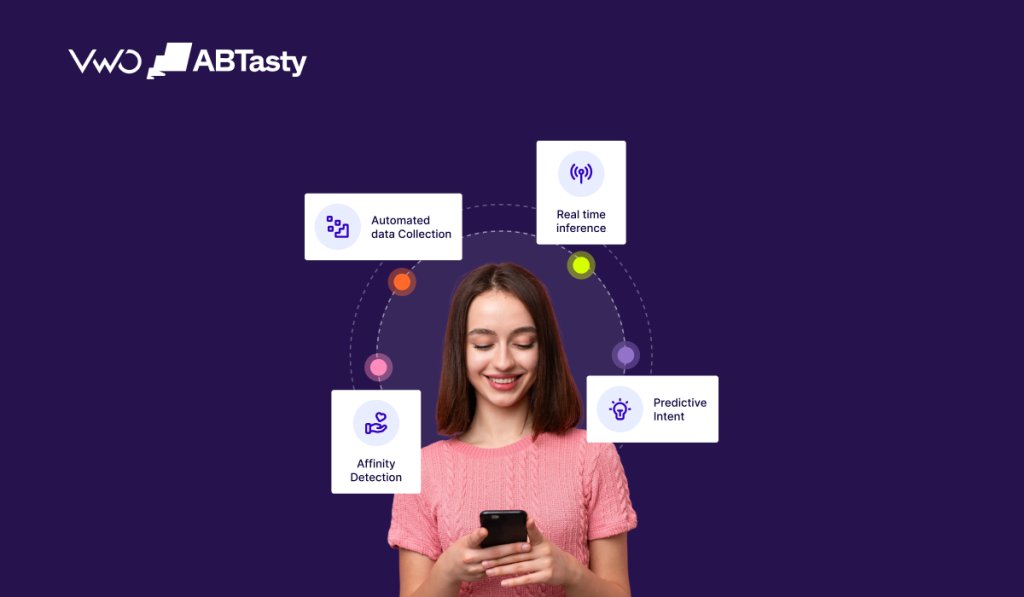
Wingz also interprets what those signals mean. It reads hesitation, affinity for a product category, or likelihood to convert for every visitor, including anonymous ones.
And it keeps looking in the background, so the next drop in checkout is recorded in this week’s priorities instead of next quarter’s backlog.
One bird’s-eye view for every team
Because Wingz draws on the same underlying data everywhere you use it, an insight from a heatmap carries into a hypothesis, an audience, and a rollout without anyone re-explaining the context at each handoff.
Also, every hypothesis Wingz produces shows its reasoning, and every action is logged. You can reference a specific campaign by name and ask why it underperformed, or attach a product brief and ask whether a campaign’s results match its stated objectives.
The conversation shifts from which dashboard is right to whether the evidence is strong enough to act on.
Wingz can also summarize every running campaign in one view or produce a summary that answers a leadership question directly, so product, marketing, and UX all start from the same picture.
Wingz has been instrumental in surfacing pain points that would have otherwise been difficult to spot manually. The AI-powered summaries on one of our key pages revealed that users were mistaking certain elements for buttons and repeatedly clicking on non-responsive areas. We promptly added redirection logic to those elements. Wingz helped us turn a lengthy review into a quick, targeted fix.
Wingz has been instrumental in surfacing pain points that would have otherwise been difficult to spot manually. The AI-powered summaries on one of our key pages revealed that users were mistaking certain elements for buttons and repeatedly clicking on non-responsive areas. We promptly added redirection logic to those elements. Wingz helped us turn a lengthy review into a quick, targeted fix.
From “what happened” to “what’s next”
Wingz goes beyond describing what happened. It suggests likely causes, turns them into testable hypotheses, and bases every recommendation on what has worked in your own past tests, not generic best practice.
Acting on an idea also happens in the same conversation. You can describe a change in plain language, attach a Figma design, or click an element on the page, and Wingz builds the variation for you.
Before launch, it can review a draft campaign’s metrics, targeting, and traffic split to catch setup issues that would otherwise surface once the test has gone live.
More room for the work you want to do
Wingz Agents take on the repeatable analysis tasks that eat into an analyst’s week.
You configure each agent once with a goal and instructions, and it owns that task end to end, works inside your guardrails, and brings its evidence back to Wingz Chat.
You can start with built-in agents or build your own around how a specific program runs, which completely changes how the whole team works.
Junior team members can pull insights instantly, and senior leaders get concise summaries that let them steer the program without digging through reports.
Every result feeds the next recommendation, so what your program learns stays with the organization as people grow into new roles.
Moreover, you remain in the pilot’s seat throughout the whole thing. By default, Wingz suggests a change and waits for your go-ahead before anything goes live.
Once its recommendations have earned your trust, you can decide how much it can handle on its own. Even then, it works within the guardrails you set.
Pro Tip!
Set up a Wingz Workflow that runs every Monday morning, so your team starts each week with a clear list of priorities, not a pile of dashboards. One agent reviews campaign performance by segment, another scans session recordings for friction on the same pages, and a third combines both into a short report emailed to your stakeholders.
See further and act sooner with confidence and clarity
Enterprise brands already collect the evidence they need to grow. The real gap is how quickly that evidence turns into a decision, and closing it pays off well beyond any single fix.
Friction caught in the week it appears stops leaking revenue, so revenue per visitor holds up across the site.
Analysts who spend less time assembling reports get that time back for the work only people can do, like shaping strategies and deciding where the program should head next.
And because every test builds on the last, hypotheses get sharper and learning compounds across markets and teams.
That’s what growth without the guesswork looks like at an enterprise scale.
Although many AI agents or LLMs can help with this, Wingz works differently because it sits at the center of everything Wingify does and offers. It brings intelligence across the entire Wingify ecosystem, rather than functioning as a standalone AI tool.
While plenty of platforms can make decisions with AI, Wingz helps you prove which ones were right, and that proof is what lets your team act decisively.
Schedule a demo to see how Wingz can run the whole optimization loop for you.
Frequently asked questions
Q1. What are the signs that an optimization team is facing data overload?
The clearest sign is a growing gap between what the team knows and what it acts on. While reports continue to pile up, very few of them lead to actual tests. Different teams bring conflicting numbers to the same review, and analysts spend more time preparing reports than finding opportunities. If known issues sit in a backlog for weeks, data overload is likely slowing your program down.
Q2. How do you prioritize optimization opportunities when there’s too much data?
Rank each opportunity by how many visitors it affects, how close it sits to key metrics like revenue, and how reliable and strong the evidence is. Opportunities that combine several signals, such as a funnel drop lining up with frustrated behavior in recordings, usually deserve attention first. Grounding priorities in your own past test results also helps teams focus on ideas with the best chance of moving the needle.
Q3. Does collecting less data solve data overload?
Not on its own. Although cutting back on the data you collect can reduce clutter, it also risks losing the very signals that explain what’s going wrong. The real gap often lies in how quickly the team can connect data points, find what matters, and turn it into a decision.
Q4. How can AI help reduce data overload?
AI can do the work that’s hardest to do manually at scale. For instance, Wingz can track analytics, session recordings, heatmaps, and feedback together, spot the patterns that matter, and rank what to act on first. It also goes a step further by suggesting likely causes and testable hypotheses, building variations, and learning from every result, so your team spends less time sifting through data and more time making decisions.
.png)