Key takeaways
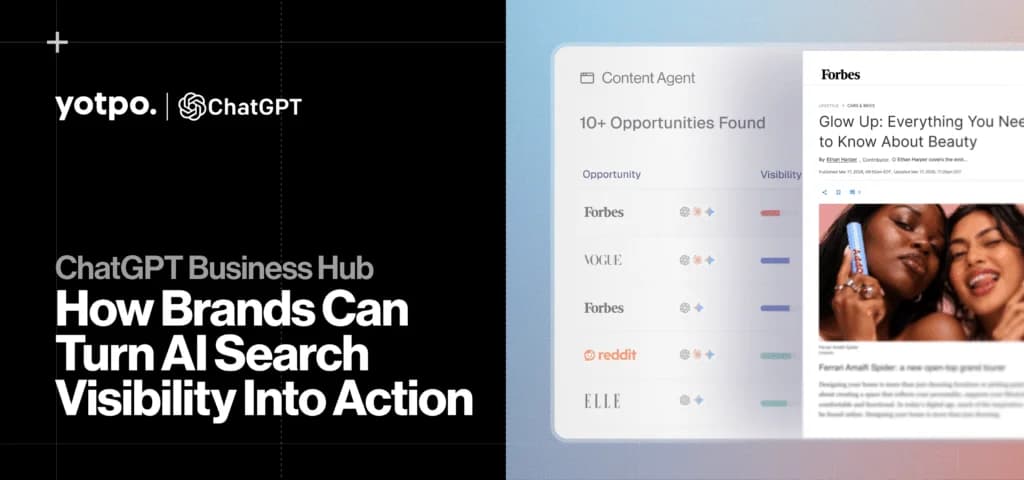
- ChatGPT Business Hub lets eligible brands claim their business, manage their information and product data, and see how shoppers engage with them in ChatGPT.
- Yotpo Discover fills that gap by tracking specific shopping questions across AI engines, measuring brand and product visibility, identifying competitors and recommending actions.
- Business Hub helps validate which topics shoppers are asking about, while Discover lets brands track and prepare for topics before demand peaks, including seasonal ones.
- Used together, the two tools help brands connect AI visibility improvements to real ChatGPT references and clicks, bringing them closer to proving ROI from AI search.
- Detailed, review-informed product content gives shoppers and AI engines more useful information to work with.
More shoppers than ever now use AI to discover products, compare options and decide what to buy. So when someone asks ChatGPT to recommend a product in your category, does your brand make that list? And if it doesn’t, do you know why?
The problem is that until recently, brands had little to no insight into how shoppers are seeing them inside AI engines like ChatGPT. But now, OpenAI’s ChatGPT Business Hub gives brands a way to claim their business, manage key information and see how people engage with them in ChatGPT.
While this is a meaningful step forward, it only covers part of the picture. Business Hub shows where a brand appears, but a full AI search strategy also has to account for where a brand isn’t showing up, which competitors are recommended when they’re not, and what they can do about it.
Now let’s look at what Business Hub offers and how brands can use it alongside AI search optimization tools like Yotpo Discover to act on what they learn.
What is ChatGPT Business Hub?
ChatGPT Business Hub is OpenAI’s platform that allows businesses to see and manage their presence in ChatGPT.
After claiming their business and completing verification, eligible brands can:
- Manage business information: keep descriptions, contact details and business policies up to date.
- Connect product information: share current product details, pricing and availability through supported feeds.
- Understand visibility: see aggregate website references, website clicks and the discovery topics associated with their business.
- Engage interested shoppers: eligible businesses can create a Business Agent to answer questions about their offerings.
For ecommerce brands, the Insights dashboard stands out. It’s first-party data from OpenAI on how shoppers are actually encountering a brand in ChatGPT, including the broad topics where its website is referenced.
A skincare brand might learn that it appears in conversations about moisturizers for sensitive skin. And while that confirms where the brand already has a presence, it says nothing about the relevant conversations where the brand is absent.
Understanding AI visibility is different from improving it
Business Hub’s Insights dashboard reports aggregate activity over the past 28 days: website references, clicks and broad discovery topics. For online businesses, a reported mention means ChatGPT referenced the business’s website, but it may not capture every conversation where someone saw the brand’s name.It also doesn’t show the exact prompts people entered or the competitors who were recommended instead.
Knowing that your brand comes up in conversations about running shoes is great, but it won’t tell you whether you’re recommended for “best running shoes for wide feet” or “comfortable running shoes for beginners,” and it won’t show you who shows up when you don’t.
Yotpo Discover is built for that gap. Discover tracks a defined set of relevant shopping questions, measures brand and product visibility, identifies competing brands and recommends actions to close gaps.
Discover and Business Hub work well side by side because each answers a different question. Business Hub reports on activity from real ChatGPT conversations, while Discover gives you structured monitoring of the specific prompts and AI answers that matter to your business.
How to use Business Hub and Discover together
First you should start with what you already know, find what you’re missing, then make optimization an ongoing process.
1. Use Business Hub to validate the topics you track
Review the discovery topics in Business Hub. Which product categories or themes are associated with your business? Are there topics you expected to see that aren’t there?
This makes Business Hub a useful check on your Discover setup. It shows which topics shoppers are actually asking ChatGPT about and gives you a better sense of the demand behind the prompts you track in Discover.
From there, you can get more specific. A beauty brand that shows up around “sensitive skin” might track questions like:
- “What’s the best fragrance-free moisturizer for sensitive skin?”
- “Which skincare brands are good for easily irritated skin?”
Discover monitors questions like these across supported AI engines, so you’re working from concrete shopping questions rather than broad topic categories alone.
2. Find the questions your competitors are winning
Some of the biggest opportunities in AI search are the questions where your brand doesn’t yet appear.
If a shopper asks an AI assistant for a recommendation in your category and your brand isn’t mentioned, but three of your competitors are. Why them? Maybe their content is more specific and relevant, maybe they explain product benefits more clearly, or they have third-party sources that back them up.
Discover helps teams find the questions where competing brands appear, reviews the answers and supporting sources to spot ways to help strengthen their own presence. This is especially valuable when the brands showing up in AI answers aren’t the competitors you usually keep an eye on.
Pair Eyewear used Discover to see which shopping questions it was missing from and which brands were showing up instead. Acting on those gaps lifted its unbranded mention rate by 38%, meaning Pair now appears far more often in AI answers to questions that don’t mention a brand by name
3. Turn visibility gaps into better content
A gap is only useful if you know how to close it.
Say a footwear brand learns that it rarely appears in AI answers about walking shoes for people who spend long hours on their feet. Instead of publishing more general footwear content, the team can focus on what those shoppers need to know. Are they worried about cushioning, fit, support or durability? Does the brand’s existing content answer those questions clearly? Are customers already discussing these benefits in reviews?
Discover helps identify which content opportunities are worth pursuing and create assets informed by product information and real shopper feedback. That could mean stronger product descriptions, more useful buying guides, answers to common questions, and content built on what customers say about a product.
The aim is to make the information shoppers need easier to find and understand, rather than to publish more for its own sake.
Footwear brand Aetrex uses Discover to decide which content to create and where it will have the most impact. The results show up in AI answers. Aetrex increased its owned AI citation share by 24%, so AI engines now cite Aetrex’s own site more often when answering relevant questions, and it holds the #1 product placement in 62% of tracked AI answers.
Why authentic customer content matters in AI search
AI search optimization goes well beyond adding keywords to a page. Detailed product questions call for specific answers: how a product performs, who it suits and what customers experience using it.
Compare a product description that calls a shoe “comfortable” with customer reviews describing how it feels after a full day of walking, whether it runs true to size and how much support it gives. The reviews give shoppers (and AI) far more to go on.
Because Discover can draw on Yotpo reviews and commerce data where available, it connects AI visibility opportunities to the language and experiences of real shoppers. More complete, relevant and credible product information is a solid foundation for both traditional search and AI-driven discovery.
4. Measure progress and connect it to revenue
AI search isn’t a one-time project. Shopper questions change, competitors publish new content, products evolve and AI systems give different answers over time, so measurement has to be continuous.
That’s where these two tools really complement each other. Discover shows how your brand and products perform against a consistent set of tracked questions, including how visibility changes after you make improvements. Business Hub shows whether those improvements carry through to real ChatGPT activity.
Together, they bring brands a step closer to proving ROI from AI search. Say a footwear brand starts the fall with zero mentions on boot-related prompts. After acting on Discover’s recommendations, those mentions start to grow. When winter arrives and shoppers start asking about boots, Business Hub shows that visibility as real references and clicks from ChatGPT conversations, which is actual demand that can turn into purchases.
Don’t expect the numbers in the two tools to match. Business Hub reflects qualifying activity from real ChatGPT conversations, while Discover measures responses to selected prompts. They use different methods, and each is valuable for what it reveals.
Is ChatGPT Business Hub enough for AI search optimization?
Business Hub is a strong starting point, and eligible brands should use it. Claiming your profile, keeping your information accurate and reviewing your insights are practical first steps for managing your presence in ChatGPT.
An AI search strategy needs to go further, because most shoppers don’t start with a brand name. They ask about problems, needs, preferences and comparisons, and ChatGPT isn’t the only place they ask.
Understanding how your brand performs across those questions, which competitors appear and where your content can improve takes a more detailed approach. Business Hub tells you where you stand, and Discover helps you improve your position.
Neither tool can guarantee that an AI engine will recommend your brand. Used together, they give ecommerce teams a better-informed way to approach a channel that’s quickly becoming central to how customers discover and evaluate products.
Want to see where your brand stands in AI search? Explore how Yotpo Discover helps ecommerce brands track AI visibility, understand competitors and turn insights into action.
Explore Yotpo Discover
FAQs
What is ChatGPT Business Hub? ChatGPT Business Hub is OpenAI’s platform for businesses to see and manage their presence in ChatGPT. After claiming and verifying their business, eligible brands can update business information, connect product feeds, view visibility insights and create a Business Agent to answer shopper questions.
What data does ChatGPT Business Hub show? The Insights dashboard reports aggregate activity over the past 28 days, including website references, website clicks and the broad discovery topics associated with a business. For online businesses, a reported mention means ChatGPT referenced the brand’s website.
Does ChatGPT Business Hub show which prompts mention my brand? No. Business Hub shows broad discovery topics, not the exact prompts shoppers entered. It also doesn’t show which competitors were recommended when your brand wasn’t. Tools like Yotpo Discover track specific shopping questions and the brands that appear in AI answers to them.
How is Yotpo Discover different from ChatGPT Business Hub? Business Hub reports on activity from real ChatGPT conversations. Discover monitors a defined set of shopping questions across supported AI engines, measures brand and product visibility, identifies competing brands and recommends content to close visibility gaps.
If a topic shows low activity in Business Hub, should I stop tracking it? Not necessarily. Low or zero activity can reflect seasonality rather than a lack of importance. A footwear brand may see little boot-related activity in early fall, but tracking those prompts in Discover and acting early helps the brand become discoverable before winter demand arrives.
Why don’t the numbers in Business Hub and Discover match? They measure different things. Business Hub reflects qualifying activity from real ChatGPT conversations, while Discover measures AI responses to a selected set of tracked prompts. Each is useful for what it reveals.
How can brands measure ROI from AI search? Brands can use Discover to track how visibility on specific prompts improves after making changes, then use Business Hub to see whether that visibility shows up as real references and clicks in ChatGPT, which represent demand that can lead to purchases.
Can any tool guarantee my brand will be recommended in ChatGPT? No. Neither Business Hub nor Discover can guarantee AI recommendations. Accurate business information, ongoing visibility tracking and detailed, credible product content give brands a stronger foundation for AI-driven discovery.