When an engineer investigates a production failure, the trail can run from an alert to a log, through several services, and back to an error that first appeared months ago. Following that trail gets harder when the telemetry behind it must stay on-premises, separate from the tools the team uses to understand the rest of its environment.
For banks, hospital networks, and other organizations with strict data policies, where observability data is stored is often non-negotiable. Public cloud storage may not be an option, and employing SaaS is simply a no-go.
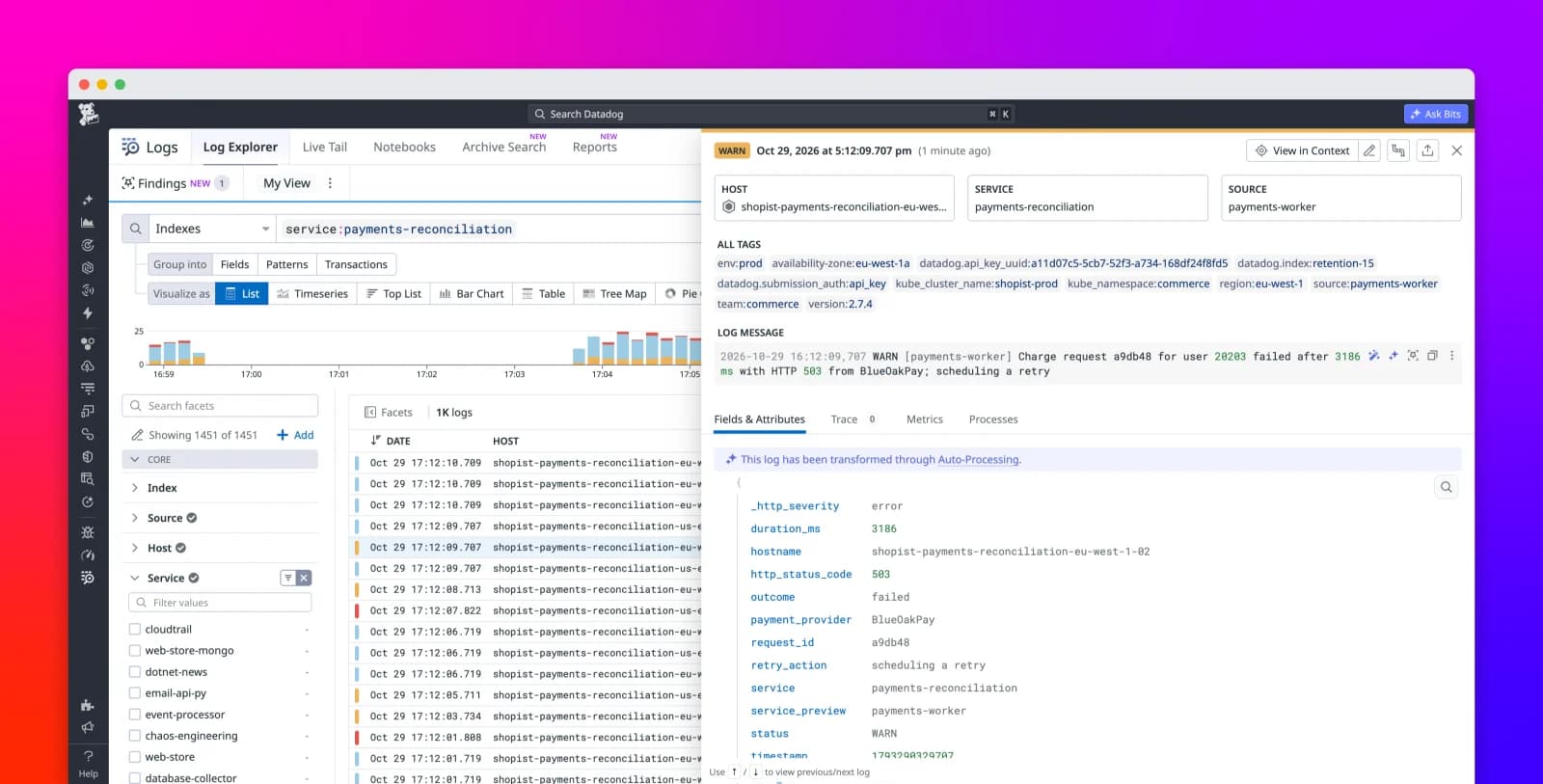
To address this need, Datadog has certified MinIO AIStor as an on-premises foundation for Datadog Bring Your Own Cloud (BYOC). Datadog provides monitoring and investigation capabilities to data stored on infrastructure you control, while MinIO AIStor securely provides the on-premises object storage for your telemetry. You can search these on-premises logs in Datadog, use them in dashboards and monitors, and draw on them through Bits AI and the Datadog MCP Server.
How Datadog BYOC and MinIO AIStor work together
Datadog BYOC for Logs runs indexing and search in your Kubernetes cluster, while MinIO AIStor provides the object storage on your own servers. The two communicate through AIStor’s S3-compatible API, connecting Datadog BYOC’s query engine directly to the data stored in your environment.
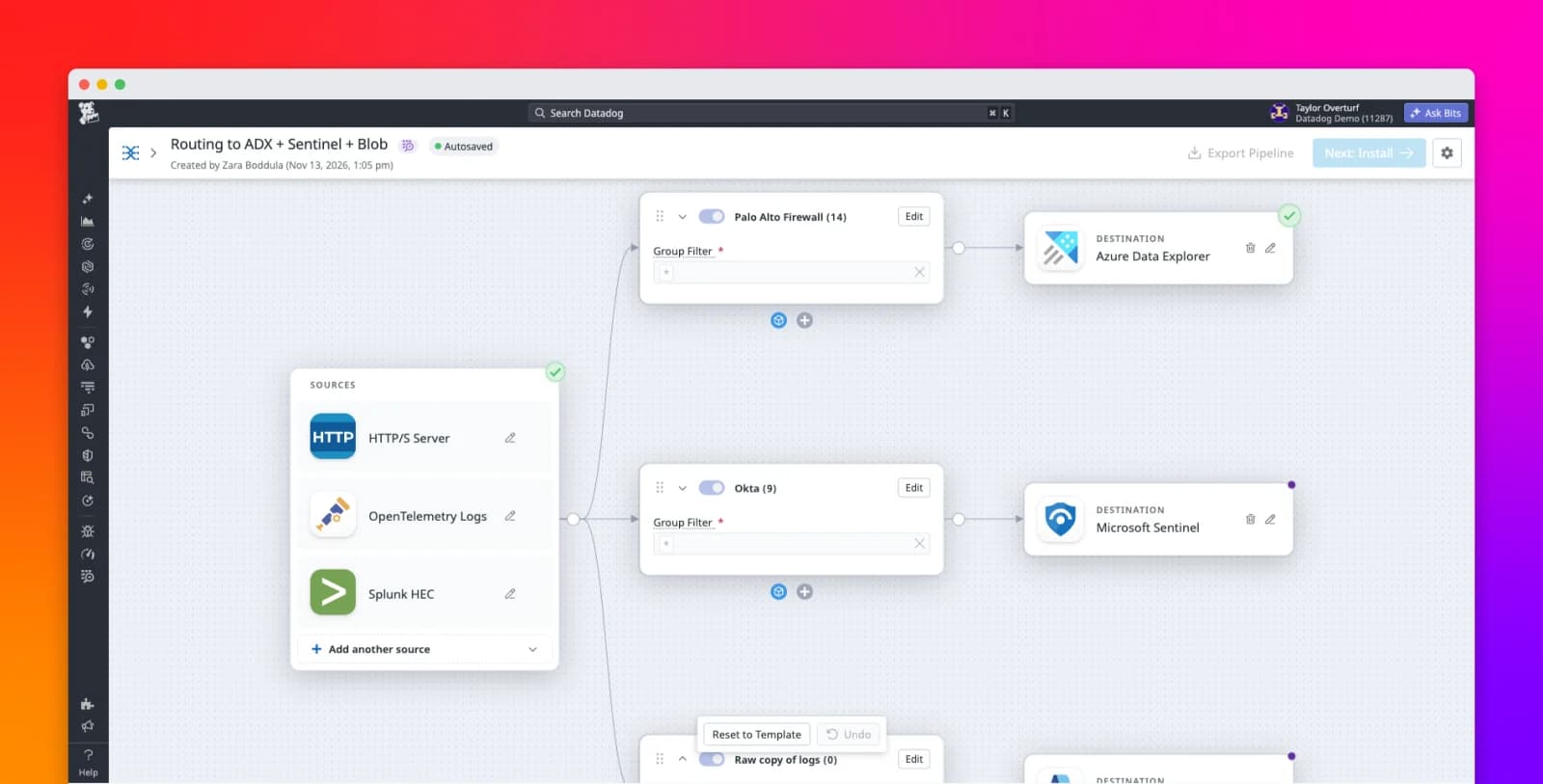
Datadog BYOC consists of Datadog Observability Pipelines (OP) and the BYOC engine, where OP provides the ingestion layer. OP’s workers collect and process logs from your applications and infrastructure within your environment, then pass them to Datadog BYOC indexers. The indexers organize those logs into searchable files and write them to an AIStor bucket. As data arrives, background compaction merges smaller files, while a PostgreSQL metastore tracks the index metadata needed to locate them.
Keeping the searchable dataset in AIStor enables storage to grow independently from the compute needed to use it. You can add indexing capacity as ingestion increases, search capacity as engineers and Bits AI run more investigations, and AIStor capacity as your retained history grows. As that history expands, AIStor’s erasure coding provides redundancy without requiring multiple complete copies of every object, and transparent object tiering allows you to better balance performance. Both strategies help make longer retention practical within your storage budget.
Keep control of how your data is accessed
The locally stored telemetry in AIStor provides the evidence that engineers using Datadog and Bits AI draw on during investigations. Whether an engineer searches in Log Explorer or uses Bits AI to query logs while investigating a failure, Datadog BYOC searchers execute the query within your infrastructure and retrieve the relevant data from AIStor. The searchers receive these queries through a TLS-encrypted outbound connection that they initiate and authenticate by using your Datadog API key. This means your deployment can serve searches without opening inbound ports or exposing a public endpoint.
The same connection carries matching results back to Datadog. For Log Explorer searches, results pass through Datadog’s services to be rendered in your browser without being stored or cached in Datadog. The indexed log dataset remains in MinIO AIStor throughout its retention period. That on-prem storage plus no server-side caching approach allows the dataset to comply with strict data privacy and residency regulations.
Beyond this separation of storage and access, you can also configure Datadog’s powerful RBAC controls to determine who can query your data and what appears in notifications. Datadog support access can be restricted to require your explicit written consent before employees access your account or query your BYOC data. For alerting workflows, disabling log samples and excluding log fields from notification templates prevent those notifications from carrying log content to destinations outside the BYOC cluster.
Unlock observability with data you control
Datadog BYOC offers a way for organizations to move forward with observability data that must remain on-premises. Datadog BYOC currently supports logs, with trace and metric support coming soon, so you can build toward a connected view of your systems with more of the underlying data stored under your control.
Start with a service that your team finds difficult to troubleshoot and the questions they wish they could answer about the service’s past behavior. Contact your Datadog account team to explore that workload, review the data flow and upcoming telemetry support, and plan a deployment around your retention and query needs. You can also read theDatadog BYOC documentation to learn how the architecture works.
If you’re new to Datadog, get started with a 14-day free trial.