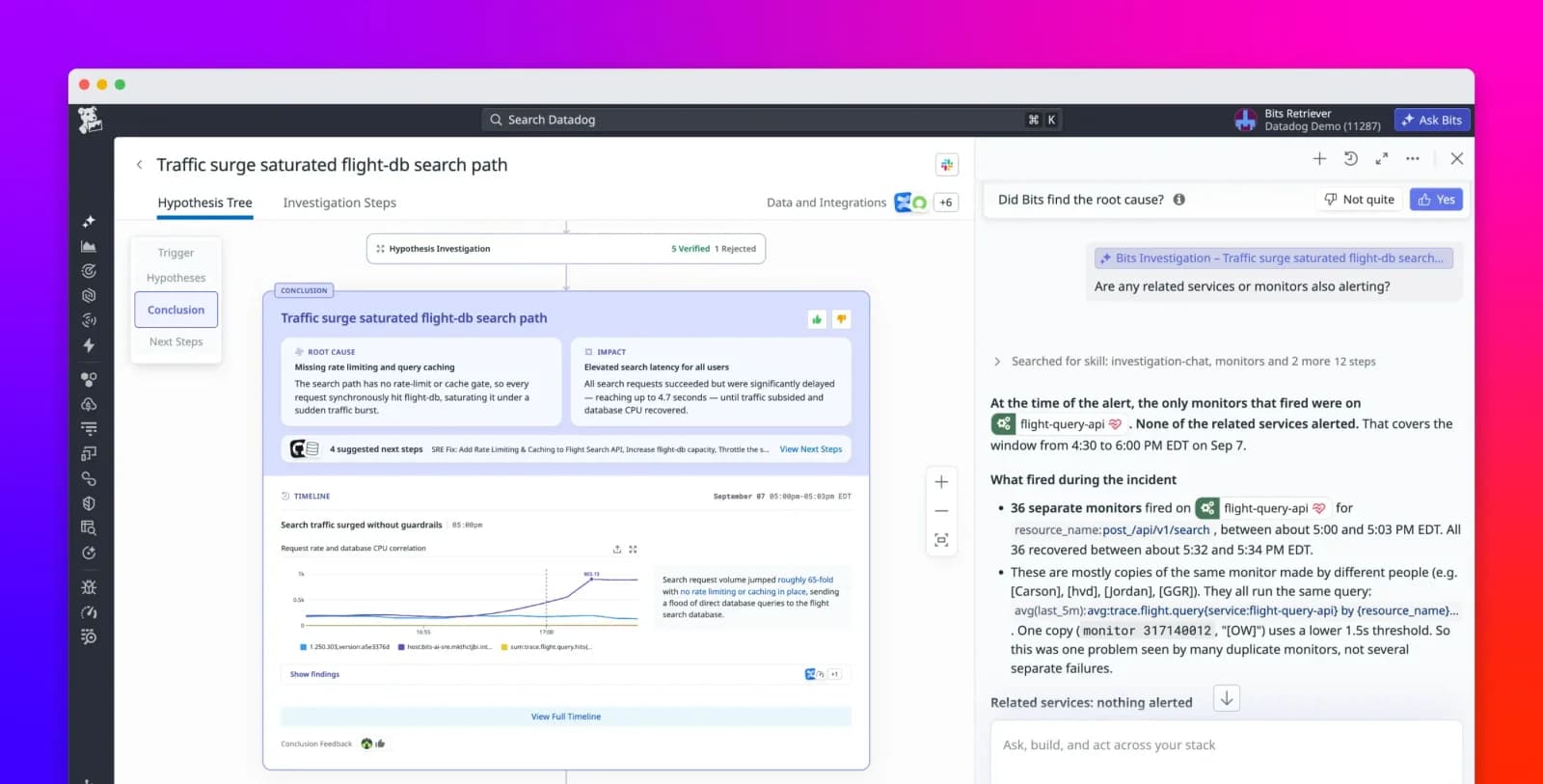
When we launched Bits Investigation in December 2025, our goal was to give teams an always-on agent that could investigate every alert and reduce mean time to resolve (MTTR). Since then, we’ve focused on making Bits faster, more cost effective, and even more accurate.
At launch, the average investigation cost $25 and took 11 minutes. As of October 2026, Bits Investigation has:
- An 84% lower average cost per investigation, down to about $4.
An 84% lower average cost per investigation, down to about $4.
- An 82% shorter average investigation time, down to about 2 minutes.
An 82% shorter average investigation time, down to about 2 minutes.
- A 44% higher investigation quality score on our internal benchmark, compared to our March 2026 release.
A 44% higher investigation quality score on our internal benchmark, compared to our March 2026 release.
This post explores how Bits Investigation was built, the latest improvements to its investigations, and how these changes help teams resolve production issues faster.
Where we started: Building Bits
The first generation of Bits Investigation used a coordinated system of agents to investigate production issues. When presented with an incident, Bits agents first gathered relevant context, then ran an initial investigation using targeted telemetry queries. Based on those findings, the agents iteratively generated and tested root-cause hypotheses. The agents then expanded promising hypotheses into more specific hypotheses until they arrived at a probable root cause.
This approach established the foundation for autonomous investigations grounded in evidence from customers’ environments. However, the orchestration layer for the initial Bits Investigation was complex, as it required dedicated phases and tools for context retrieval, hypothesis generation, and testing.
As models and agent architectures evolved, we later introduced a new generation of the Bits agent built around a simpler ReAct architecture. In this framework, each agent reasons about the evidence, chooses a tool, and uses the results to decide what to investigate next. Newer models and better tools helped the agents adapt as they uncovered information, while expanded access to Datadog data sources gave them more context.
Altogether, this flexible structure reduced the average investigation cost to about $6.50.
Where we are now: Faster, more efficient investigations
The latest updates to Bits Investigation combine newer models, improved model routing, and better tools. With code execution through the Datadog MCP Server, Bits can write and run code to query multiple data sources, correlate findings, and summarize the evidence in a single tool call. Processing data before returning it to the model reduces the context Bits needs to handle and the back-and-forth required to investigate an issue. A simpler agent architecture also makes it easier to use the frontier model best suited to each task.
Together, these changes help Bits gather evidence efficiently and test hypotheses for deeper root cause analysis. For on-call engineers, that means less time gathering evidence and more time acting on findings.
Bits Investigation now costs about $4 per investigation and completes its analyses in about 2 minutes on average, helping engineers reach a diagnosis sooner.
Alongside these efficiency gains, Bits achieves a 44% higher investigation quality score than our March release, according to our internal investigation benchmarks. To assess the quality of Bits’s findings, we continuously compare them with the known root causes of past incidents. Together, faster results, lower costs, and improved investigation quality make Bits a more effective first responder for production alerts.
Where we’re going: Specialization through post-training
Looking ahead, we’re building on this progress with Scout, Datadog’s model designed for site reliability engineering (SRE) investigations. We’ve trained Scout on a wide range of failures using an in-house reinforcement learning system. Customized training improves investigation quality and reduces inference costs, allowing Scout to match leading models on investigation tasks at a lower inference cost. We plan to extend this targeted approach to autonomous remediation, helping teams move from identifying root causes to restoring service faster.
Experience an enhanced Bits
Flexible agentic architecture, rigorous evaluation, specialized training, and more diverse knowledge sources have led to a more effective Bits Investigation. As we explore the future of Bits, our in-house Scout model has shown that customized training can yield better performance and lower costs.
To start using Bits Investigation in your environment, explore the documentation.
If you’re not yet a Datadog customer, sign up for a free trial today.