Overview
When it comes to making real progress in sustainability, Coralie Bertrand is a firm believer in every mill doing its part – even if that may seem small in the bigger sustainability picture.
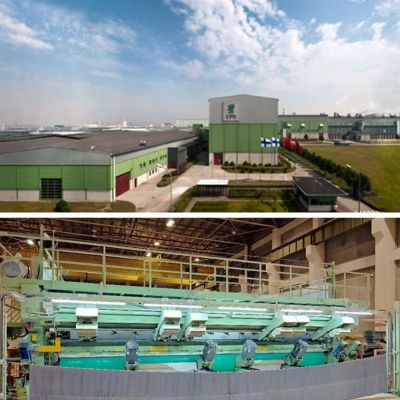
Located in the north of France, the Rethel mill that Coralie manages manufactures paper-based products from 100% recycled material. As such, one of their most important tasks is sorting the raw material that comes in so that it is free from any non-paper or board material.
“To make good paper out of the waste it’s really important that we separate the items that we cannot process and that includes the plastics,” she explains. “And because we don’t have a way to recycle the plastics in our town, or in the mill, these plastics were originally going to landfill.”
"It’s important to work in your surroundings to find local solutions, and even though there is always a cost, there is also support if you can show that there could be a more sustainable way to do things."
Coralie Bertrand, Site Director, Smurfit Westrock
For about three years Coralie and her colleagues worked on finding a practical solution.
“I am proud to say that in 2023, we found that solution with another mill from our company in Germany, which is not too far from Rethel,” she says. “We send our plastic rejects to the border and then they bring in their dedicated incinerator where they produce their own steam, and the energy helps to produce paper at their plant. For us, it means we prevent about 90% of the plastic rejects that come to our mill from going to landfill. This is an example of what we can do at our local level that can make a sustainable difference. The German mill was looking for raw materials for their incinerator, and I was looking for a greener exit for my plastics – it was a win win.”
That’s not to say the process was easy – as getting approval to move rejected waste across European borders is met with tight regulation – but Coralie and her colleagues persevered in the name of progress and got the required documentation.
The next challenge they are working to overcome is reducing the amount of natural gas the mill uses. They’ve already made some headway with the use of biogas but Coralie is looking at internal and external solutions to substitute natural gas.
“We are going to implement a heat exchanger to reduce the gas consumption because this is our biggest challenge. We’ve worked in the last 2 years on improving the biogas production thanks to a wastewater treatment plan, which now substitutes between 6 to 10% of natural gas,” she explains. “But the next step, which the company is supporting us on, is in optimizing the processes of heat and cooling, so the heat exchanger is for that.”
Coralie is even working with a local gas supplier to do research on how to recover hot water and reuse it so that it saves on fresh water and gas consumption.
“It’s important to work in your surroundings to find local solutions, and even though there is always a cost, there is also support if you can show that there could be a more sustainable way to do things,” says Coralie. “Which is why even if the project is small, it has value. If we add up all these small projects around the world, it brings real value to the company group in supporting those larger sustainability goals. And that brings value to the world.”