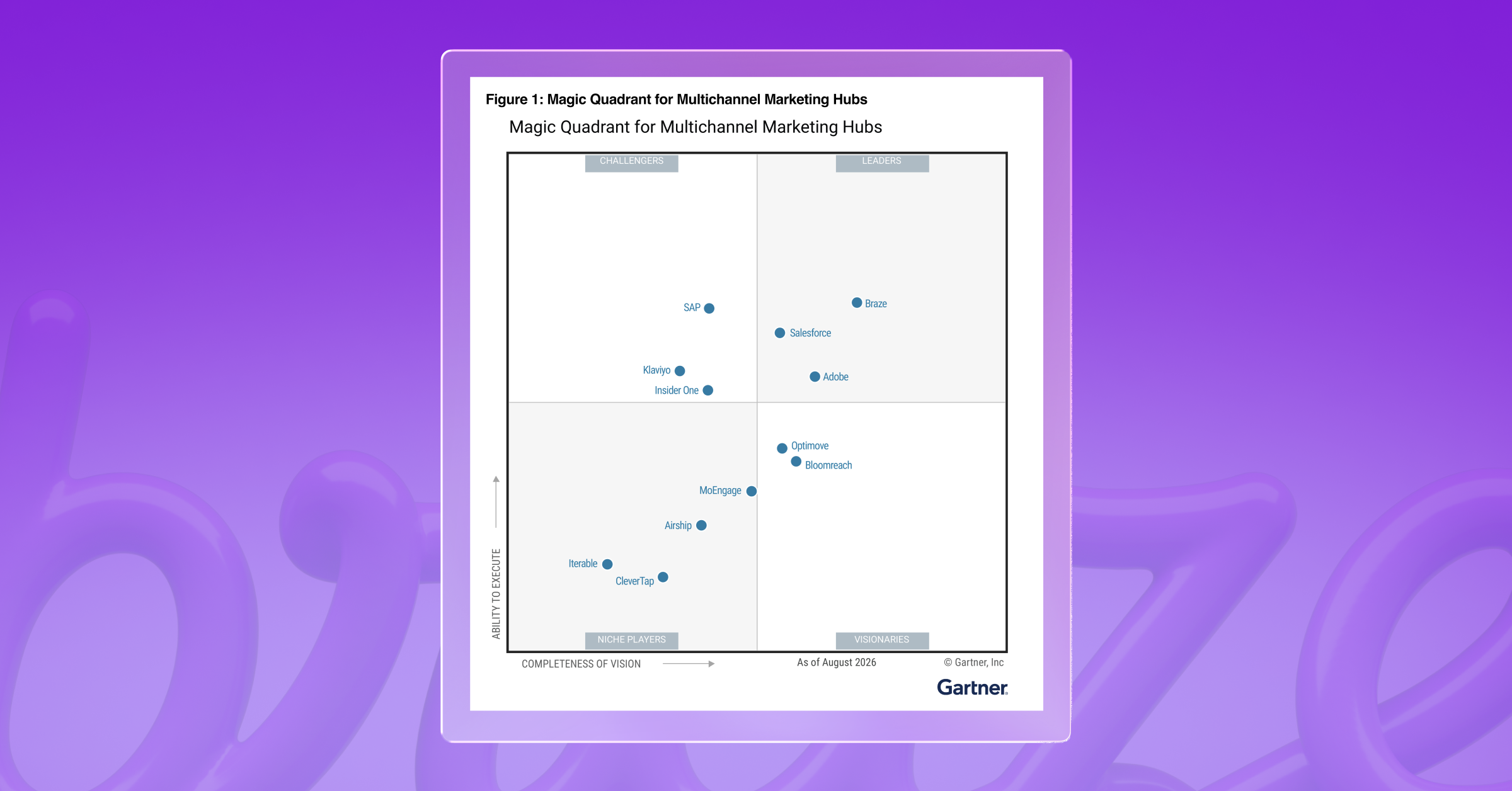
We've ranked eight Iterable alternatives and Braze scored the highest, followed by Bloomreach and Salesforce Marketing Cloud Engagement in joint second, then CleverTap, Adobe Journey Optimizer, MoEngage, Klaviyo, and Customer.io.
Which is best for you is a different question, and it depends on your business rather than on a feature list. Braze suits teams whose journeys react to behavior as it happens. CleverTap and MoEngage are built around the mobile app. Bloomreach pairs messaging with product discovery, which fits commerce brands. Klaviyo and Customer.io publish their pricing and can be set up without a procurement cycle. Salesforce and Adobe ask for the IT resourcing to run a multi-product stack.
This is a Braze article, so we ranked them on how directly each replaces what Iterable does rather than on our own opinion, using third-party reviews and rankings. We'd still recommend checking this list against Iterable's own documentation.
TL;DR
- Teams leave Iterable over the same handful of things: audiences that refresh at send time, holdouts limited to individual experiments, no drop-off reporting across a sequence you define.
- Evaluate any alternative on six questions: how segments refresh, channel and mobile depth, what's included versus separately contracted, experimentation and measurement, warehouse ingestion and export, and migration effort.
- We ranked eight platforms against those criteria, using independent reviews and third-party sources rather than our own opinion. Braze came out top, with Bloomreach and Salesforce Marketing Cloud Engagement joint second.
- Size and program shape decide the shortlist more than the ranking does. Braze, Salesforce, and Adobe suit enterprises; Bloomreach, CleverTap, and MoEngage the mid-market; Klaviyo and Customer.io startups.
- Migration cost turns largely on templates. Adobe is the only platform here whose templating language matches Iterable's, so templates carry across rather than being rebuilt.
Why teams look for Iterable alternatives
Some teams are evaluating a move. Others are shortlisting Iterable for the first time and want to know where it fits before they commit. Either way, the same reasons come up for wanting to compare alternatives.
Several of Iterable's most useful capabilities sit outside the base platform
Catalog, Data Sync, Embedded Messaging, WhatsApp Messaging, and Predictive Goals all need a conversation with your customer success manager if you want to add it to your plan. That list covers your product data, your warehouse connection, two channels, and the predictive AI. With no published tier list, there's no way to know which of them your plan includes until you ask.
Iterable reports on campaigns and journeys, not on custom event sequences
If you're looking for funnel reports, here's what Iterable has instead. Reports cover metrics for selected campaigns and journeys over a date range, and can be exported to CSV. Campaign Analytics tracks delivery, engagement, and conversions per campaign, Experiment Analytics covers variant and holdout performance, and Messaging Insights reviews aggregate campaign performance to identify trends.
Between them you can follow an audience from delivery through to a tracked conversion, but there's no report that takes a sequence of events you define and shows where people drop off at each step.
Iterable has holdout groups, but not a global control group
Holdouts sit inside an experiment, on blast campaigns, with a size and attribution window you set, and you can create one per experiment. This is great for measuring one goal over a single send, like whether an abandoned cart email drove more purchases, or whether people would have bought anyway. What the documentation doesn't describe is a global control group, holding back a percentage of users from everything you send. This gives one untouched baseline for the whole program, so you can measure what your marketing contributed overall rather than campaign by campaign.
Iterable only publishes three mobile SDKs
If you have a mobile app, you need an SDK for the framework it's built in. Iterable publishes three — iOS, Android, and React Native — plus a Roku SDK for TV. If your app is built in another framework, you'd likely need to connect through an API, and that needs engineers to build and maintain.
Iterable's own guidance asks you to simplify as you scale
Iterable's journey optimization guide advises using static lists wherever possible, avoiding dynamic lists built from other dynamic lists, and keeping segmentation queries simple for journeys that run often, noting that complex filter logic can slow things down. Static lists don't refresh, so following that advice means trading how current your audience is for how reliably the journey runs.
Iterable doesn't publish pricing
Iterable doesn't publish a pricing page, so there's nothing on the site that says how the product is charged — no mention of whether cost scales with users, seats, or monthly active users, no tiers, and no figures. There's no free tier or self-serve signup either, so every evaluation starts with a demo. You can't work out a rough first-year figure, sanity-check a quote against anything, or compare it to another vendor on your shortlist until both have quoted. Combined with capabilities that are arranged through your CSM, you're working out what the platform costs and what it includes at the same time, in the same conversation, with the vendor.
How to evaluate an Iterable alternative
Evaluating is easier with a framework. A set of questions you can ask each vendor means you evaluate them equally, whether they're a customer engagement platform, a commerce experience platform, or a B2C CRM. It's important you know how to interpret the answers too, so that you can understand what it means for your business.
How segments refresh
Ask when an audience updates: the moment someone's data changes, on a daily schedule, or when you press send. Updating as data changes keeps one audience correct everywhere it's used, which matters when the same audience feeds several journeys.
Daily and send-time updates work fine for batch and recurring campaigns, but you're then watching two clocks — one for when the audience updates, another for when the message goes out.
Ask what happens as your queries get more complicated or your lists get bigger. If a vendor suggests keeping queries simple, or using fixed lists that don't update, check whether faster updates or larger audiences cost more or sit in a higher plan.
Channel and mobile depth
Most platforms cover a similar set of channels, so counting them tells you little. Look instead at the channels you actually plan to use. For each one, ask what kinds of messages you can send, which need a developer to change, and which a marketer can edit alone. The answer tells you how far it's a marketer-operated platform, and how much your team would be waiting on engineering.
On mobile, ask what happens inside the app: which in-app message formats work, whether there's an inbox that holds messages until someone reads them, what you can put on the lock screen, and how much you can change without shipping an app update.
Then ask which app frameworks have a published mobile SDK. If yours doesn't, your engineers would connect it through an API and maintain that themselves, which affects how much of your app's data reaches the platform and how quickly you can change what it collects.
What's included and what's separately contracted
Start with the pricing page and sketch out your first and second year. That's your total cost of ownership, and a rough shape is enough to show where costs will move. Ask what comes as standard and what's charged separately: product catalogs, moving data in and out of your warehouse, individual channels, and predictive features are the usual extras. Some are CSM-gated add-ons, switched on only after a conversation with your customer success manager. Ask how many onboarding hours the contract includes, what happens if you use them all, and whether training afterwards costs extra.
Support is a separate question from training. Ask what you get when something breaks, or when you want to build something complicated: people who will work on it with you, or documentation you work through yourself. That tells you how much technical skill you need in your own team.
Then ask what happens when you go over a usage limit, add people, or turn on a new channel. You want a platform that grows with you, so ask what each of those would cost, and whether it's something you can switch on or something that needs a new conversation. Either answer is workable as long as you know it now, rather than meeting a bigger bill later.
Book a demo, and ask to see the work your team does every week rather than a standard walkthrough — building a journey, editing a template, pulling a report. That shows who can do each job without a developer, how long a new starter takes to learn it, and how soon you could be live.
Experimentation and measurement
Start with what kinds of tests the platform supports. Most cover A/B and multivariate tests, where you split an audience and compare versions. Some also shift traffic toward the better version while the test is still running. A few use AI marketing tools that adapt the channel, timing, or offer for each person based on how they respond, so the program keeps improving without someone setting up a new test each time. Ask whether you can test a whole journey or only individual messages, and who can build one.
Next, ask how holdouts work. Most platforms let you hold a group back from a single campaign, which tells you whether that campaign worked. Some also let you hold a percentage of customers back from everything you send, permanently, giving you one untouched group to measure your whole program against. That's what you need when someone asks what marketing contributed last quarter. You can't add campaign results together to get there: the same customer appears in dozens of campaigns over a quarter, so they'd be counted every time, and each campaign's held-back group still received everything else you sent.
Then ask what the reporting shows. Can it follow a sequence of steps you define — opening an email, starting a checkout, finishing it — and show how many people drop out at each stage? Can it tie results to revenue or another target you set, rather than stopping at opens and clicks? If it can't do that step-by-step analysis itself, the work moves into a separate reporting tool, so it's worth knowing who on your team would pick it up and how often.
Warehouse ingestion, export, and latency
Most brands keep customer data across several systems rather than one, so data warehouse integration matters. How well a messaging platform connects to that setup decides how much of your data a marketer can actually use.
Ask which warehouses and other systems connect directly, how often data syncs, and who sets it up. Some platforms need an engineer to build and maintain that connection. Others handle it with reverse ETL, where a marketer picks a table in the warehouse and maps the fields into customer profiles themselves. Ask whether you can build audiences straight from warehouse data without copying it into the platform first, which saves both the wait for a sync and a second copy to keep up to date. And ask what the platform does to match records to the same person, since that decides whether you need a CDP alongside it. Ask to understand what is natively-built into the platform and what is a white labeled product from a different vendor.
Then ask about data leaving the platform. How quickly do messaging results reach your warehouse? Does the first export bring your history with it, or start from the day you switch on? If it starts from switch-on, your past reporting stays where it lives today. And is export included in the platform fee or licensed separately?
Migration effort
Platform migration happens in phases, so ask each vendor to walk you through them: which program moves first, how long both platforms run side by side, and in what order the channels switch over. Ask where the IP warm-up fits, since it runs over several weeks while the rest continues, and email can't move to full volume until it's done.
Ask what won't come with you. Profiles, attributes, subscription preferences, and consent records move without much trouble. Past behavioral data collected through a mobile SDK rarely transfers cleanly, and what each customer has already seen, read, or dismissed inside your app generally can't be rebuilt from an export. Templates are a separate job. Platforms use different code to write personalization into them, so unless your current platform and the new one use the same one, every template gets rebuilt from scratch.
Then ask who does the work: how much the vendor's team handles, how much falls to yours, whether migration support is included or quoted separately, and what a realistic timeline looks like for a program your size.
The best Iterable alternatives in 2027, ranked
We looked at eight platforms, including Braze, and ranked them by how directly each one replaces Iterable's core use case: cross-channel lifecycle orchestration. Everything here comes from the platforms' own websites and current documentation, and from the third-party sources below. Scores are out of 16, across two things: capability and third-party standing. Bloomreach and Salesforce Marketing Cloud Engagement are level on both, so they share second place and there is no third. CleverTap, Adobe Journey Optimizer, and MoEngage all scored 9 in total, and are ranked fourth, fifth, and sixth on their capability scores of 8, 7, and 6.
Capability: what the platform can do. Scored out of 12. Six criteria worth up to two points each: how segments refresh, channel and mobile depth, what's included in the platform fee and what's contracted separately, experimentation and measurement, warehouse ingestion and export, and migration effort. A capability that exists but is capped, reserved for a higher tier, or only available as a paid add-on scores one rather than two.
Third-party standing: what others say. Scored out of 4. We started with nine sources and narrowed them to four on credibility and recency: the 2026 Gartner® Magic Quadrant™ for Multichannel Marketing Hubs, Gartner® Peer Insights™, G2, and Maestra, the last three all listing Iterable alternatives directly. None of the four is published by Braze, Iterable, or any of the platforms ranked here.
Scores were checked in September 2026, and platforms in this category ship changes often, so anything decision-critical is worth confirming against current documentation.
How the eight Iterable competitors scored
Rank
Platform
Best for
1st
Braze
Cross-channel lifecycle programs that react to behavior as it happens
Joint 2nd
Bloomreach
Mid-market commerce
Joint 2nd
Salesforce Marketing Cloud Engagement
Large enterprises with dedicated IT resourcing
4th
CleverTap
Mobile-first consumer apps
5th
Adobe Journey Optimizer
Enterprises already built on Adobe
6th
MoEngage
Mid-market brands with a mobile-first program
7th
Klaviyo
Small commerce teams running email and SMS
8th
Customer.io
Product-led teams comfortable with event data
Braze: best Iterable alternative
Braze is the closest alternative to Iterable, and the highest scoring platform in this list at 11/16. ranks it first and names it the best overall alternative to Iterable, and places it second of ten. Gartner® named Braze a Leader in the 2026 Magic Quadrant for Multichannel Marketing Hubs, and placing Braze highest in Completeness of Vision and Ability to Execute.
Braze is a customer engagement platform and data freshness is an area of excellence. Standard segments update as customer data changes rather than rebuilding overnight, so a journey can respond to what someone did seconds ago. Segment Extensions are the exception, refreshing on a schedule you set, and they're what you need for historical purchase behavior or warehouse data.
Braze publishes ten SDKs, covering seven mobile frameworks, each in its own public repository with a working sample app. Content Cards add a permanent inbox inside the app, so content waits for the customer rather than expiring when they close it.
Braze also has global control groups, withholding between 1 and 15% of all users from everything you send (except API campaigns), with no account-size requirement to use it. That gives one untouched baseline for the entire program rather than a holdout per campaign. Funnel reports then track a sequence of events you define, over windows of 1 to 30 days, and show where people fall away.
Migration guidance is more thorough than most, documenting what moves across and what doesn't alongside dedicated tooling and onboarding services. Templates still get rebuilt, since Braze uses Liquid where Iterable uses Handlebars, but that applies to nearly every alternative on this list. Braze Operator makes some of these template transitions even easier, helping you reformat the emails to match our liquid templating language.
The pricing page sets out four editions — Go, Select, Pro, and Enterprise — and what sits in each, along with how cost is calculated: on monthly active users, plus a credit model spanning channels and AI products. No figures are published, so costing it means a sales conversation, but you can work out the shape of a contract before you have one. Channels and warehouse ingestion are included in every tier, connecting natively to the major warehouses, as are data export and reporting. Predictive AI requires Pro, advanced experimentation requires Enterprise, and BrazeAI Decisioning Studio™ sits outside the edition inclusions.
Our Braze vs. Iterable comparison has the full head-to-head.
Bloomreach: best for mid-market commerce
Bloomreach scores 10/16 and appears in three of our four third-party sources: named a Visionary in Gartner's® 2026 Magic Quadrant™ for Multichannel Marketing Hubs for the second year running, listed among , and placed fourth of ten by .
It's a commerce-led omnichannel platform rather than a messaging layer, pairing marketing automation with ecommerce search, product recommendations, and an enterprise CMS. For a retailer or a direct-to-consumer brand, that means the same system deciding what a customer sees on your product listing page also decides what lands in their inbox.
Segmentation is where it scores full marks, one of only two platforms here to do so: Bloomreach states that audiences update as data arrives rather than on an overnight cycle. Worth checking before you rely on that at scale: Scenarios cap out at 5 audience forks and 20 segments per fork, which can bind for programs with heavily branched journeys, and in-app messages are configured at the campaign level with a 30-minute SDK cache rather than as a native step inside a Scenario. Its mobile SDK coverage runs to six frameworks, App Inbox keeps messages inside the app across a customer's devices, and funnels are native, so you can see drop-off across a sequence you define without exporting the data. A/B tests are configured inside a scenario, campaign, weblayer, or experiment, with the control group being the arm of that particular test.
Bloomreach suits mid-market retailers rather than brands whose program is mostly email. Pricing isn't published. Under the packaging that took effect on May 15, 2026, channels are bought as separate app packages — Email, Mobile Messaging, Web, Mobile App, and Ad Audiences — with an Enterprise Marketing package covering all of them, and AI tools and agents extending a package rather than coming with it. Bloomreach uses Jinja where Iterable uses Handlebars, so templates get rebuilt, and the migration guidance it publishes is written for teams coming from specific platforms, so ask what exists for a move from Iterable.
Salesforce Marketing Cloud Engagement: best for large enterprises with dedicated IT resourcing
Salesforce Marketing Cloud Engagement scores 10/16. Salesforce was . Marketing Cloud also ranks notably on Gartner® Peer Insights™ and . We scored Marketing Cloud Engagement, the B2C product, which is what a team leaving Iterable would most likely land on today, and which supports the pricing and feature detail below. Ideal for large organizations with extensive IT resourcing and budgets to implement and maintain a multi-product, multi-edition Marketing Cloud footprint alongside Sales, Service, and Data Cloud.
Pricing is transparent, including at the top. The price list publishes a monthly figure for all three editions — Pro+, Corporate+, and Enterprise+ — along with the contacts and message volumes each one buys. What it also shows is how much sits above the entry edition. Pro+ comes with 15,000 contacts, no mobile app message allowance, and no Journey Builder, multi-channel journeys, path experimentation, App Inbox, or segment creation. Journey Builder is the tool for building the multi-step campaigns this comparison is about, so for most teams Corporate+ is the real starting point.
Segmentation and real-time audience updates come from Data 360, Salesforce's data platform, rather than from Engagement's own tools, and real-time segments carry limits that scheduled ones don't, including no exclusion criteria. Every edition includes an allowance of Data Cloud credits to cover it, so it isn't a separate purchase, but segmentation draws down that allowance and more credits are bought on top.
Salesforce publishes five mobile SDKs, covering Android, iOS, React Native, Flutter, and Cordova. Standard support is included in every licence, but Premier costs 30% of net license fees on top, so total cost of ownership sits above the license figure.
CleverTap: best for mobile-first consumer apps
CleverTap scores 9/16, and its capability score of 8/12 is the highest of any platform in this list. On third-party standing it appears on Gartner® Peer Insights™ as an Iterable alternative, but not in the nor the lists. CleverTap describes itself as a customer retention platform that brings app analytics and marketing together.
CleverTap publishes eight SDKs, covering iOS, Android, React Native, Flutter, Cordova, Unity, KaiOS, and web, and App Inbox saves messages to the user's device so they stay put, unlike push and in-app messages that disappear once swiped away.
On measurement it does two things Iterable doesn't. Its System Control Group holds between 2% and 5% of your entire user base back from every marketing campaign, which gives you one untouched group to measure your whole program against rather than a separate holdout per campaign. And funnels are native, tracking up to eight steps you define and showing where people fall away, with the option to drop those people straight into a campaign.
Worth flagging given how central "how fast do segments refresh" is to this whole comparison: journey entry isn't instant. A user who qualifies for a published journey is enrolled starting at midnight the following day, not the moment they qualify, and structural edits to a published journey require a new version, which splits your analytics across versions. Changing segment criteria is a clone-and-edit workflow rather than an in-place edit, and CSV-uploaded segments can't be combined with live behavioral ones.
Check the tier table carefully, because a lot sits outside the entry plan. Pricing is published for the entry tier and includes a free trial, with the higher tiers quote-only. WhatsApp and direct email are add-ons on every tier, and the predictive tools — IntelliNode, recommendations, and predictions — are absent from the entry plan.
Adobe Journey Optimizer: best for enterprises already built on Adobe
Our Braze vs. Adobe comparison covers the wider Adobe suite head-to-head.
MoEngage: best for mid-market brands with a mobile-first program
Rank
Platform
Score
1st