Announcements
Posted October 28, 2026Posted in Announcements
Harwell, Oxfordshire, 28 October 2026 – Astroscale’s UK subsidiary (Astroscale Ltd) has been awarded a £15 million contract by the UK Ministry of Defence (MoD) as Prime Contractor for LEDA, a new defence programme that builds on the company’s experience developing capabilities to understand, protect and operate in space.
The recently published UK Space Strategy identifies defence and national security as a central priority, with a focus on protecting critical space infrastructure and building a more resilient space sector. With the knowledge that satellites underpin the communications, navigation and intelligence services on which the UK relies, the strategy emphasises the capabilities needed to understand activity in orbit, respond to threats and maintain secure access to space.
As the space environment becomes increasingly complex, congested and contested, governments are investing in the capabilities needed to understand what is happening in orbit and safeguard the infrastructure that supports our way of life on Earth. The investment is underpinned by the Defence Investment Plan within which £3.2 billion has been allocated for space through 2030, with the domain being described as "the central nervous system of modern, high-intensity warfare".
The contract has been awarded to Astroscale, with BAE Systems and Open Cosmos supporting as key partners on the programme. The award builds on Astroscale’s flight-proven heritage: the ability to approach, inspect and work safely alongside other objects in orbit. Its ELSA-d mission demonstrated rendezvous and magnetic capture of a client spacecraft, while ADRAS-J approached and inspected a non-cooperative rocket body at a distance of less than 15 metres in 2024.
Astroscale’s UK team developed the ADRAS-J mission ground segment and led flight dynamics operations, including manoeuvre planning and collision risk monitoring. This experience underpins the company’s work across in-orbit servicing, debris removal and defence which includes the upcoming missions ELSA-M, set to be the world’s first active debris removal mission – with the removal of a commercial satellite – and Orpheus, which is developing sovereign UK Defence capability.
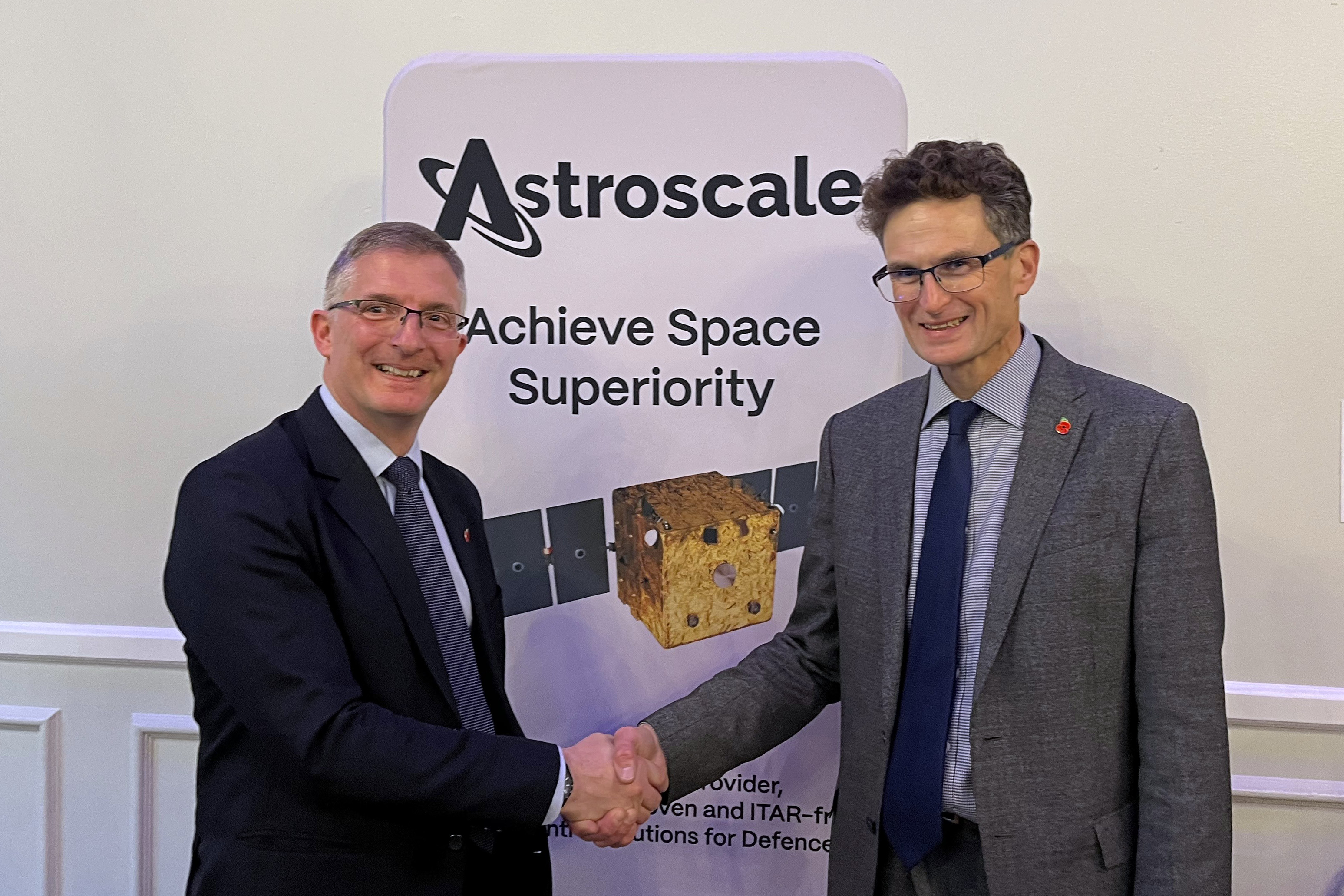
Nick Shave, UK Managing Director, Astroscale, said: “Resilience in space matters to everyone. The satellites we depend on support our armed forces, our economy and the services we use every day. Protecting that in-orbit infrastructure requires the ability to understand and operate safely in an increasingly complex environment.
“Our ambition is to be the trusted partner for Space Control. We look forward to delivering LEDA for the Ministry of Defence, supported by BAE Systems and Open Cosmos.”
Tony Williams, Head of Space Capability, UK Space Command, said: “Control of space is not about seeking conflict in space, it is about demonstrating that we can protect the capabilities upon which our economy, our society, and our armed forces depend. Project LEDA, under the manufacture, launch, and operation of Astroscale UK, will form part of the permanent pathway for UK's understanding of orbital warfare and how such spacecraft operate and how they might be employed to counter RPO threats.
“Collectively, these new capabilities will help defend UK space interests, safeguard critical space services, and generate operational advantage for the integrated force.”
The programme comes as the UK places greater emphasis on security and resilience in space. Astroscale’s wider approach connects the development of UK capability with international collaboration, recognising the opportunity for expertise in in-orbit operations to support both domestic requirements and future export markets.
END