When the first candidate for a new bomber for the U.S. Army Air Corps, a tri-motor aircraft from Henry Ford, ascended into the skies over Wright Field near Dayton, Ohio, in the fall of 1932, U.S. military officials were hesitant. First produced in 1925, the high-winged flyer was a symbol of the past, not a step toward the future.
What the military needed was an aircraft capable of keeping the threat of another world war at bay—a bomber able to fly hundreds of miles overseas and return safely home. To find the right aircraft, the Air Corps had opened up bidding, testing candidates at Wright Field.
Henry Ford’s tri-motor had its turn, as did Boeing’s Model 215. But when the crew flying Glenn L. Martin Aircraft Company’s YB-10 set its retractable landing gear down on the runway, the Air Corps realized it had found what it was looking for.
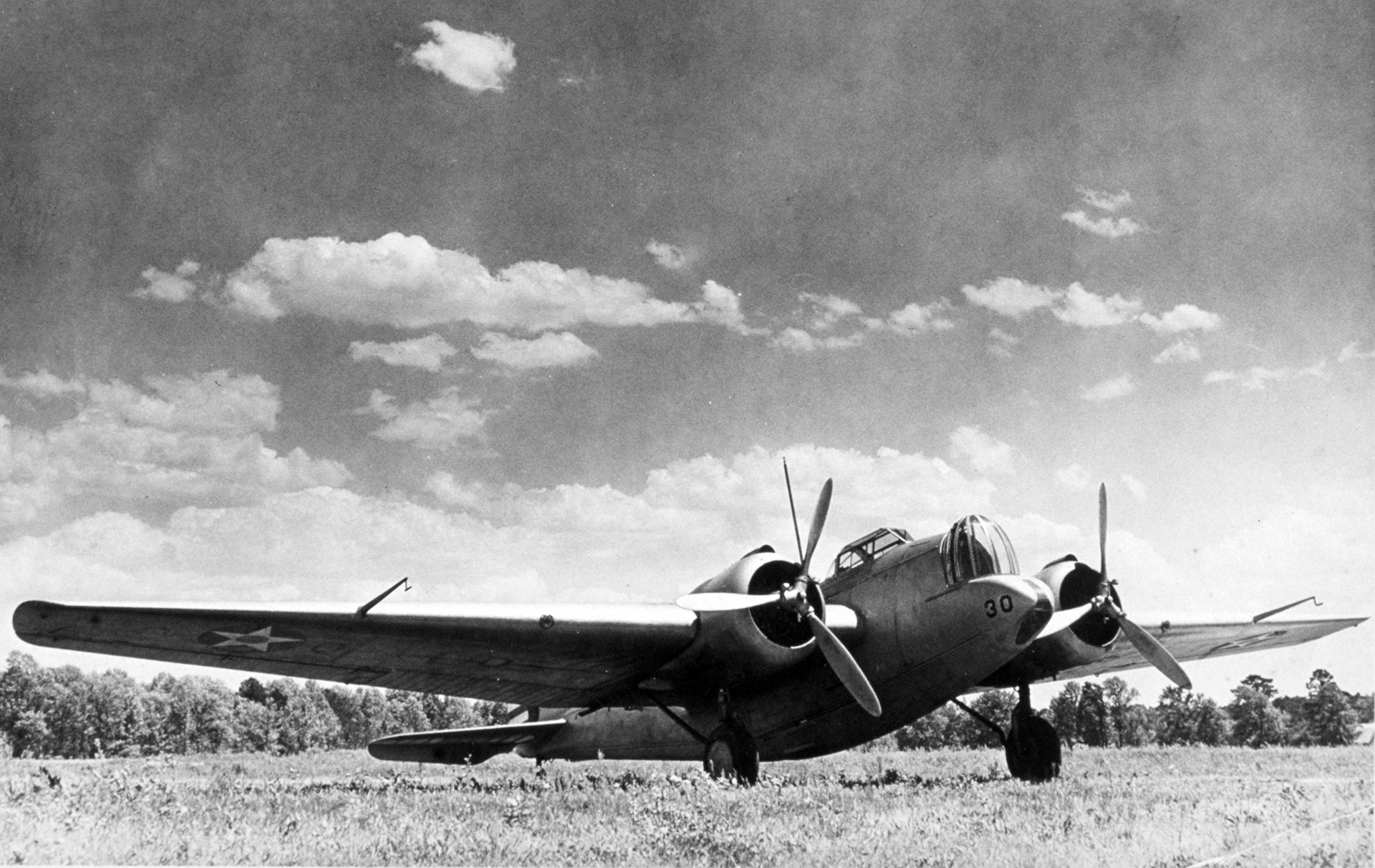
The B-10 was America’s first large all-metal monoplane, boasting a range of 1,400 miles and a top speed of 207 mph, 22 mph faster than its competition.
The Army immediately ordered 14 B-10s, which established the aircraft as a marquee bomber, heralding a new age.
A Whale of an Aircraft
The creation of the B-10 came during an unusual moment of consternation for the company’s founder, Glenn Martin. Upset that early prototypes of his YB-10 were slower than its competition, he decided to take a vacation to refocus. Before he left, he told his engineers to move its bomb racks from under the plane’s wing to inside its fuselage.
The move inspired a series of key modifications, as Martin engineers expanded the wings to 70 feet in length while adding more powerful twin engines and enlarging the fuselage, inspiring the nickname “the Flying Whale.”
The moniker was deceptive. The B-10 was no whale in flight. It was the fastest bomber in the world, capable of outrunning nearly every pursuit plane in America’s arsenal. The aircraft’s internal bomb carriage, which was capable of carrying a 2,000-pound bomb load, and the addition of the world’s first enclosed rotating machine gun turret, an industry innovation, made it as formidable as it was fast.
In 1934, Lt. Col. Henry H. Arnold lead a flight of 10 B-10 bombers from Washington, ostensibly on a six-day mapping mission of the Arctic. Using Fairbanks as a base, Arnold’s B-10s photographed more than 200,000 square miles of previously uncharted territory, including new air routes over Russia and the Arctic Circle. But the flight was just as much a show of force to potential adversaries, rapidly moving state-of-the-art aircraft across the country and back again. After the mission Arnold would call the plane “the air power wonder of its day.”
Trophies and Salutations
The B-10 would go on to serve in every bombardment group in the Air Corps during the 1930s, carrying out the first test of the Norden precision bombsight in 1935, which helped bombardiers calculate the exact moment when a bomb should be dropped to hit a designated target. A year later, variants of the B-10 would be exported overseas, eventually reaching a diverse range of nations, including Russia, China and Argentina.
The B-10 earned Glenn Martin the 1932 Collier Trophy, given for the most outstanding achievement in American aviation. The trophy was personally presented to Martin by President Franklin Roosevelt. It would be the first of six times Martin’s company would have its name inscribed on the bronze trophy.
Sources and Additional Reading
- “The Bomber is Born.” Flying. Oct. 1943.
- Breihan, John R., Stan Piet, and Roger S. Mason. Martin Aircraft, 1909-1960. Santa Ana, Calif.: Narkiewicz/Thompson, 1995.
- Harwood, William B. Raise Heaven and Earth. New York: Simon & Schuster, 1993.
- Lorell, Mark A. The U.S. Combat Aircraft Industry, 1909-2000. Santa Monica, Calif.: Rand Corporation, 2003.
- Murphy, Justin D. and Matthew Alan. Military Aircraft, 1919-1945: An Illustrated History of Their Impact. Santa Barbara, Calif.: ABC-CLIO, 2008.