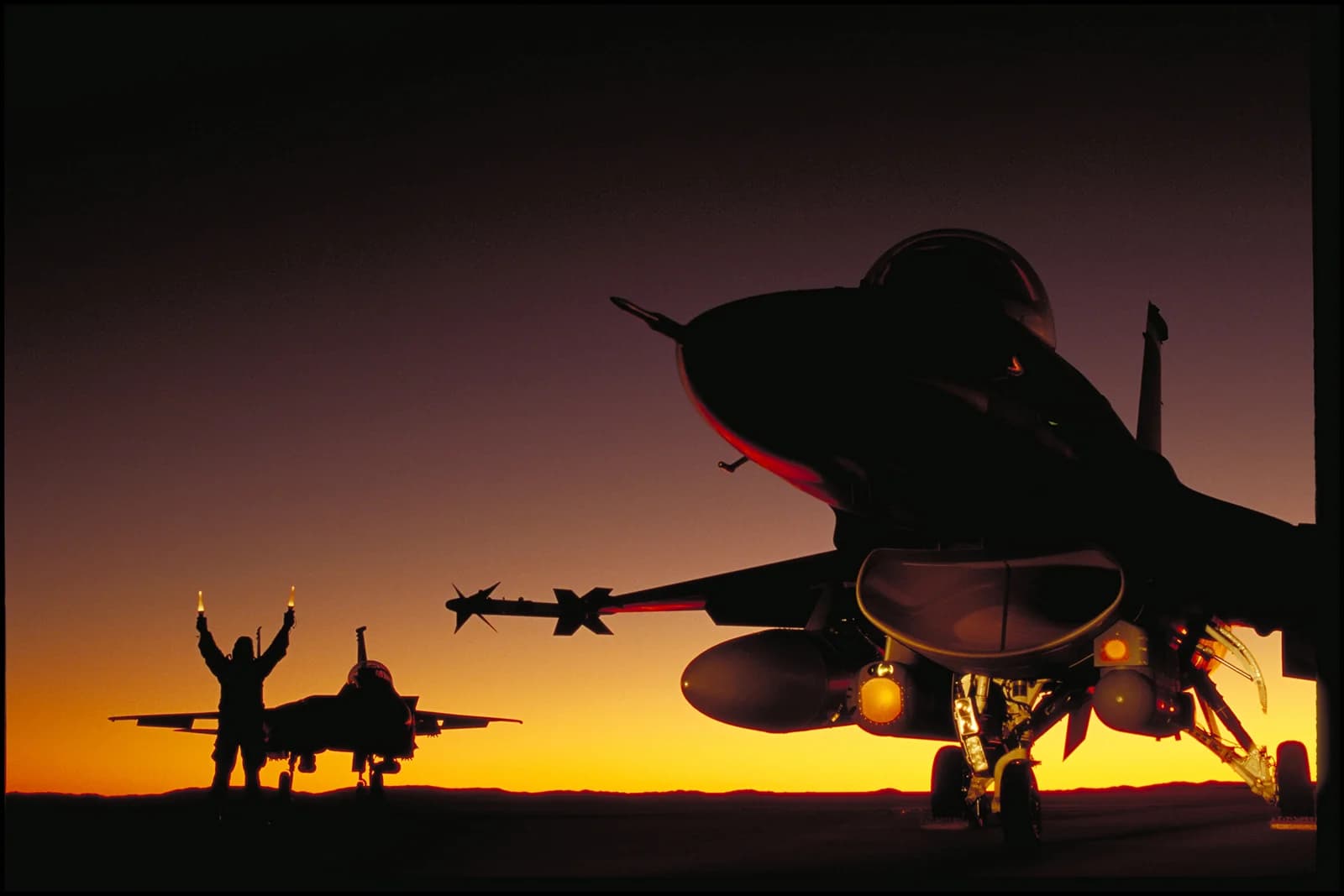
The dispatch from operations was urgent, calling for the pair of F-15s flying out of Bagram Airfield in eastern Afghanistan to make an immediate U-turn. On the other side of country, a special-operations task force was pinned down in the town of Bala Morghab. Explosives had deterred a ground-based rapid-response team. Helicopters couldn’t reach the site. A hundred insurgents were circling.
The F-15s were their only hope.
Forty minutes later, the F-15s arrived, immediately flipped on a special navigation and targeting system and swooped in, flying at low altitudes through blinding cloud cover as if they’d slipped through pure blue skies. They acquired targets. Fired. And sent the insurgents scrambling, saving 30 coalition troops. Their secret weapon? A special Lockheed Martin device capable of turning darkness into light.
The navigation device’s name was LANTIRN, short for Low Altitude Navigation and Targeting Infrared for Night. First conceived in 1981, the device allowed fighter jets—first F-15s and F-16s and later F-14 Tomcats—to see in abject darkness and adverse weather conditions by transforming heat patterns outside the aircraft into vivid, glow-in-the-dark displays on cockpit monitors.
The system’s special Terrain-Following Radar (TFR) then scanned the topography of its surrounding area, plotting a course that allowed jets to streak at low altitudes in speeds in excess of 500 miles per hour, rendering them nearly invisible to enemy radar. In addition to day/night imagery, the system allowed pilots to pinpoint targets and cue the delivery of precision guided weapons.
The world’s first around-the-clock aerial strike force had been born.
The revolutionary effect of the LANTIRN system didn’t become clear, however, until Operation Desert Storm, when F-15s, under the cover of night, swept into Iraqi encampments and bombed “hidden” Iraqi tanks, which had been buried under sand to camouflage their positions. Because desert sands cool faster than metal vehicles, the LANTIRN’s infrared sensors could pick up the hotter signature and lock-on for easy hits.
Building on the LANTIRN’s success, Lockheed Martin would create an advanced targeting pod for fighters and bombers called Sniper®, offering twice the resolution, triple the recognition range and 10 times the geopointing capability of the LANTIRN. Integrated across the F-15, F-16, A-10C, B-1 and B-52, Sniper continues LANTIRN’s legacy, further solidifying the U.S. military’s sovereignty over the skies.
Sources and Additional Reading
- Harwood. Raise Heaven and Earth.
- Holmes & Laurier. F-14 Tomcat Units of Operation Enduring Freedom
- Larson. “Moments & Milestones: Trophy Mission.” Air & Space. Published: November 2011.
- Tucker. The Encyclopedia of Middle East Wars: The United States in the Persian Gulf, Afghanistan, and Iraq Conflicts, Vol. 1
- U.S. Air Force. “LANTIRN.”