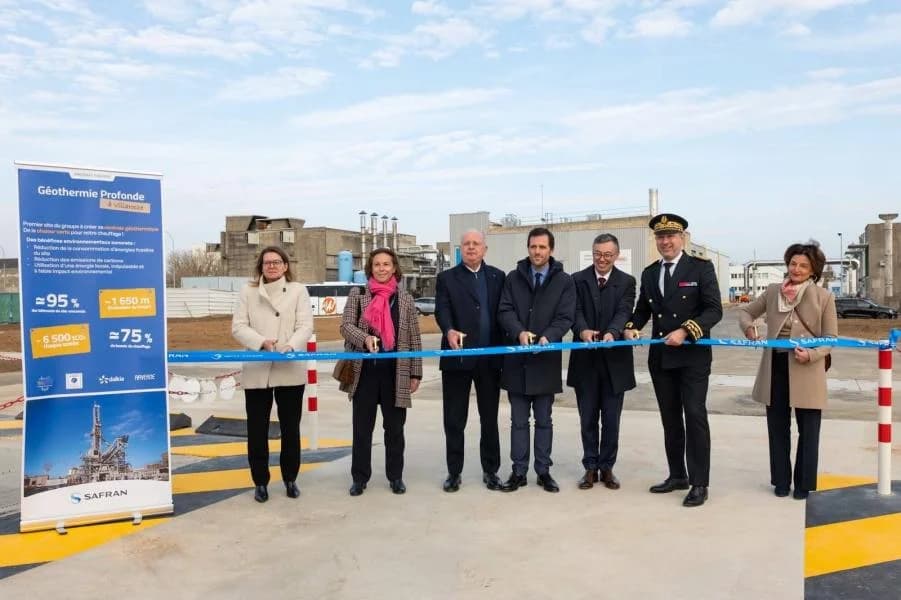
On November 4th, the Villaroche deep geothermal power plant was inaugurated in the presence of Mathieu Lefèvre, Minister Delegate for Ecological Transition, Ross McInnes, Group Chairman of the Board, and Stéphane Cueille, Chief Executive Officer of Safran Aircraft Engines. As the first industrial geothermal power plant in Ile-de-France, the facility harnesses the Earth's natural heat by capturing naturally heated water at 75°C from a depth of 1,650 meters. Combined with heat exchangers and heat pumps, this solution produces local, renewable, and low-carbon energy.
The Villaroche geothermal power plant aims to cover 84% of the site's heating needs and will thus avoid the emission of 6,500 tonnes of CO2 per year. Launched in March 2025, the project was carried out with Dalkia, as project manager, and Arverne Group, for the drilling. The State also supported the project, contributing 20% of the total investment, through the Agency for Ecological Transition (ADEME).
In total, 34 million euros were invested on the Villaroche site. The realization of this project is the result of collective work and strong coordination between the teams of the Human Resources Department and the Infrastructure, Services and Environment Department (DISE) of Safran Aircraft Engines, as well as those of the Industry, Procurement, Performance and Sustainable Development departments of the Group.
"Villaroche is a historic site of Safran Aircraft Engines and Safran's largest site in the world, with 6,500 employees. It is symbolic to invest massively in decarbonization on this site. It is not just a new energy infrastructure, it is a symbol of everything we want to do at Safran: produce, design, and consume responsibly," emphasizes Stéphane Cueille, Chief Executive Officer of Safran Aircraft Engines.
"I would like to warmly thank the State and local government services that support this industrial ambition. Because behind this power plant, there is ultimately a conviction that we share: energy transition and reindustrialization are not at odds. They can, and they must, move forward together."
This project represents one of the pillars of Safran Aircraft Engines' low-carbon plan and contributes to Safran's objective: to reduce CO2 emissions from its operations by 50% by 2030, compared to 2018.
"There is no ecological transition without businesses. Ecological transition and the economy have long been opposed in public debate, yet here, through this decarbonization project, we manage to combine environmental performance, corporate social responsibility, and competitiveness. Long live business, long live Safran, and long live the ecological transition," concludes Mathieu Lefèvre, Minister Delegate for Ecological Transition.
A production well extracts hot water from the ground (75 degrees) using a submerged pump. A heat exchanger recovers this heat to warm the heating water that circulates in the buildings, while a heat pump boosts production. The geothermal water and heating water never mix. After use, the extracted water is returned to the Dogger aquifer through an injection well, with no environmental impact.