Enterprise AI agents are moving from experimentation to production. But scaling agents is not just about building more workflows, adding more tools, or integrating more systems. The real challenge is how do you measure whether your agents are effective, efficient, governed and safe at scale.
Agent orchestration is often described as a coordination layer for enterprise agents. But in mature organizations, orchestration becomes something more powerful, it becomes a measurable control plane and is the difference between experimentation and enterprise-grade AI. If you cannot measure your agents, you cannot scale them.
This paper provides a practical KPI framework, a ready reckoner for CIOs, CTOs, Enterprise Architects, and Platform Engineering stakeholders evaluating or deploying agentic systems.
Note: Not all KPIs discussed in this framework are natively exposed as out-of-the-box dashboards. See the footnote at the end of the writeup.
Why KPIs Matter for Agentic Systems
APIs and their governance and observability cannot be afterthoughts. The same logic applies to agents as well. Agents introduce a variety of activities and risks like, Non-deterministic behavior (LLMs), External knowledge retrieval (RAG), Autonomous execution, Multi agent collaboration, Dynamic tool invocation and Real time orchestration across systems. Without measurable guardrails, risk compounds silently.
The question is not about “Can we orchestrate agents?” but “Can we measure and control agents at scale?”
To answer that, we evaluate maturity across four dimensions.
Agent Effectiveness
The first dimension is all about the output quality. If agent responses are not grounded, consistent and reusable, orchestration does not matter.
At early maturity, teams track latency but at advanced maturity we need to be able to track factors such as hallucination trends over time, retrieval quality drift, knowledge freshness degradation and capability duplication.
If you cannot measure grounding and reuse, your agent ecosystem will fragment rapidly. Centralized orchestration, registry visibility, and traceability makes these KPIs measurable across distributed agents.
Agent Performance
Agent performance is not just about speed, it is about observability across distributed, multi-agent workflows.
Most AI pilots monitor response time. Enterprise AI platforms monitor:
- Cross-agent trace continuity
- Orchestration failure patterns
- Drift in invocation patterns
- Detection and recovery latency
Unified traceability is critical when agents invoke APIs, other agents, and downstream systems. Without trace coverage, root cause analysis becomes guesswork.
Developer Efficiency & Platform Savings
Scaling agents blindly is expensive. Token consumption grows, model invocations spike, redundant calls multiply and rollback failures cost infrastructure. Efficiency becomes a board level discussion.
If your system design lacks the right foundations and is not well architected, AI spend will be unpredictable. Mature organizations measure:
- Cost per business outcome
- Spend per workflow
- Rollback reliability
- Remediation automation
Orchestration level visibility is what enables model routing governance, execution tracing, and lifecycle controls, turning AI cost from reactive to managed.
Governance & Security of Agents
This is where orchestration becomes controlled. Agents operate in dynamic, generative contexts. Governance must be measurable.
If you cannot answer the following questions, then orchestration is not controlled. It becomes delegation without oversight.
- How many agents exist?
- Which ones are governed?
- Which ones violated policies last quarter?
- How often prompt injection attempts were blocked?
Centralized governance control points make these metrics measurable at scale.
Measuring Agent Maturity
A practical way to evaluate your organization:
Scaling agents without progressing across these stages leads to:
- Escalating AI spend
- Governance blind spots
- Duplication of capabilities
- Production instability
An Operational Checklist for CIOs and Architects
Before expanding your agent footprint, ask yourself the following questions:
- Do we measure grounded response accuracy and hallucination rate?
- Can we quantify cost per agent workflow?
- Is every agent registered and governed?
- Do we have full trace coverage across agents and APIs?
- Can we detect and block prompt injection attempts?
- Do we measure reuse versus duplication of agent capabilities?
- Is AI spend trending with business value delivered?
If the answer to these is unclear, orchestration alone will not solve the problem, measurement will.
Final Thought
The next phase of enterprise AI will not be won by teams who build the most agents. It will be won by teams who govern and control them. MuleSoft as an ally enables orchestration, KPIs enable control and together they enable scale.
Agentic systems are not just about connecting agents, they represent a journey from orchestration to measurable control, making:
- Agent behavior observable
- AI spend predictable
- Governance enforceable
- Performance diagnosable
- Lifecycle measurable
Enterprises that treat orchestration purely as a coordination layer will eventually hit scale limits. Those that treat it as a measurable control plane will scale responsibly.
From Framework to Execution
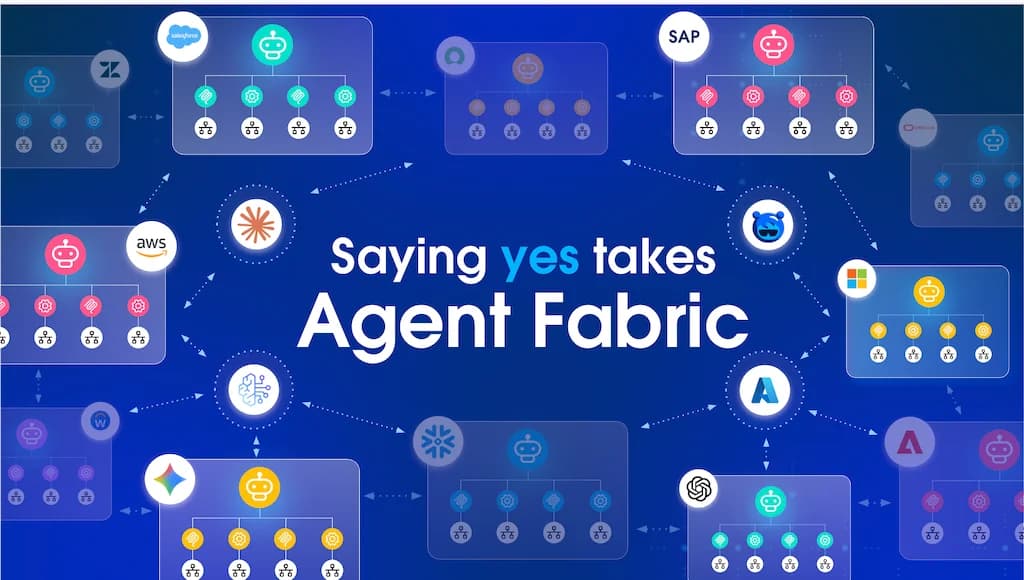
MuleSoft Agent Fabric establishes a unified control plane to discover, orchestrate, govern and observe agents across ecosystems. The AI Gateway extends this control to LLMs, MCP, and A2A interactions with intelligent routing, unified access and centralized policy enforcement. Together with MCP Bridge and Omni Gateway, enterprise systems become agent ready while ensuring consistent security, cost control and end to end observability.
At some point in a board meeting or in a risk review meeting or during an incident troubleshooting, someone is going to ask: what exactly are the agents doing and how do you know? The organizations that can answer these questions with confidence, backed by data and governance records will have earned the right to scale. Measurement is not the boring part of agentic AI. It is the part that makes everything else sustainable.
Footnote: It is important to distinguish between two categories of metrics:
- Native Metrics – Directly observable through Agent Fabric orchestration telemetry, registry visibility, and Anypoint Monitoring capabilities.
- Enabled Metrics – Not surfaced as pre-built dashboards, but made measurable because Agent Fabric centralizes orchestration, governance interception, traceability, and execution metadata.