Picture a coding agent working through a routine task.
Along the way it opens a file it had no particular reason to touch, unearthed an API token that allowed it more access than it should have, and decides to use it in an effort to achieve its task.
Nine seconds later, the company’s production database is gone, backups included. It sounds like fantasy, but it actually happened.
Horror stories like this travel fast across the tech landscape. Publicly, everyone remains bullish on AI–but internally, a healthy degree of skepticism can begin to form.
Most agents aren’t intentionally designed to cause harm; they simply have more reach than they were meant to, and there was no mechanism in place to deter such non-deterministic agency. The production database was unintended, massive collateral damage in the quest for AI efficiency.
Unsurprisingly, this causes compliance & security review boards to take a beat whenever a new agent crosses their desks–and AI-derived value sits indefinitely on the shelf of production-review purgatory.
In research from Salesforce and Atlantic Insights, 62% of leaders running agents in production say they want more from those agents than they can safely allow. And 77% have had a rollout paused or reworked in the past year because a trust question surfaced late.
The appetite is there; what’s missing is a fast, confident way to approve it for production.
Every approval comes down to four questions
Whoever signs off on an agent, whether that’s a security architect, a compliance lead or a CFO, ends up asking some version of the same four questions.
What can this agent reach? Who is it acting for? Can we stop it if something goes wrong? What will it cost?
When a team can answer all four with evidence, approval is much easier. When the answers rest on assurances, that’s when production agents stall.
Those answers are hard to produce because agents don’t live in one place. Business units build them on different platforms, often on standing credentials, connected to shadow assets. Most tools see only part of that picture; agent platforms govern their own agents, while cloud providers govern traffic on their own gateways.
The biggest gaps sit between those tools, and that’s where agents tend to operate.
Say yes, wherever agents act
Closing those gaps means enforcing trust at the point where agents act. That covers both the agent layer, where agents are built and run, and the connectivity layer, where they reach your APIs, tools and models. It also has to work independently of any single cloud, identity provider or gateway, using the identities and gateways you already run, with nothing to replace.
With that foundation in place, the task splits.
You need to understand what an agent can reach, who it’s acting for and whether you can stop it, which are matters of Agent Trust.
- Agent Trust Governance that finds agents on every platform, applies one set of rules across every gateway, and leaves an audit trail that speeds up the next approval. Security that ties every action to a real user, limits agents to approved tools, and stops a rogue agent without stopping the rest.
- Governance that finds agents on every platform, applies one set of rules across every gateway, and leaves an audit trail that speeds up the next approval.
- Security that ties every action to a real user, limits agents to approved tools, and stops a rogue agent without stopping the rest.
You also need to understand what it will cost, and that’s a matter of Agent FinOps.
- Agent FinOps Budgets that cap spend per agent, team or app before it runs away, and show what every agent costs across MCP and agent-to-agent traffic. Optimization that trims wasted tokens on every model and MCP call, routing to right-sized models and caching repeated answers, with no change to agent code.
- Budgets that cap spend per agent, team or app before it runs away, and show what every agent costs across MCP and agent-to-agent traffic.
- Optimization that trims wasted tokens on every model and MCP call, routing to right-sized models and caching repeated answers, with no change to agent code.
Both have to hold where most agent activity happens: in the MCP calls agents make and the LLMs they rely on.
MCP & LLMs are where agents meet your business
More and more of that activity runs through the Model Context Protocol, the standard agents use to plug into the systems you already run, from SAP to Salesforce to the custom apps your teams built years ago. Two problems tend to show up early. Agents reach SaaS apps easily, but the custom APIs that run the business are often left out. And teams are already connecting AI tools to MCP servers that nobody has reviewed. The best time to get MCP right is before those servers number in the hundreds.
Getting it right starts with what already works. Existing APIs become MCP servers in a click instead of being rebuilt, scanners find the MCP servers teams have already stood up, and the user’s identity travels with every tool call. Trimming bloated tool descriptions and filtering verbose responses at the gateway means agents spend fewer tokens and return better answers.
Models follow the same logic. Teams want the best model for each job, and that model changes constantly. One governed endpoint to 140+ models lets developers move between them freely, while every new model inherits the authentication, rate limits and audit trail you already enforce, so security doesn’t have to start a fresh review each time a new model ships.
The time to start is now
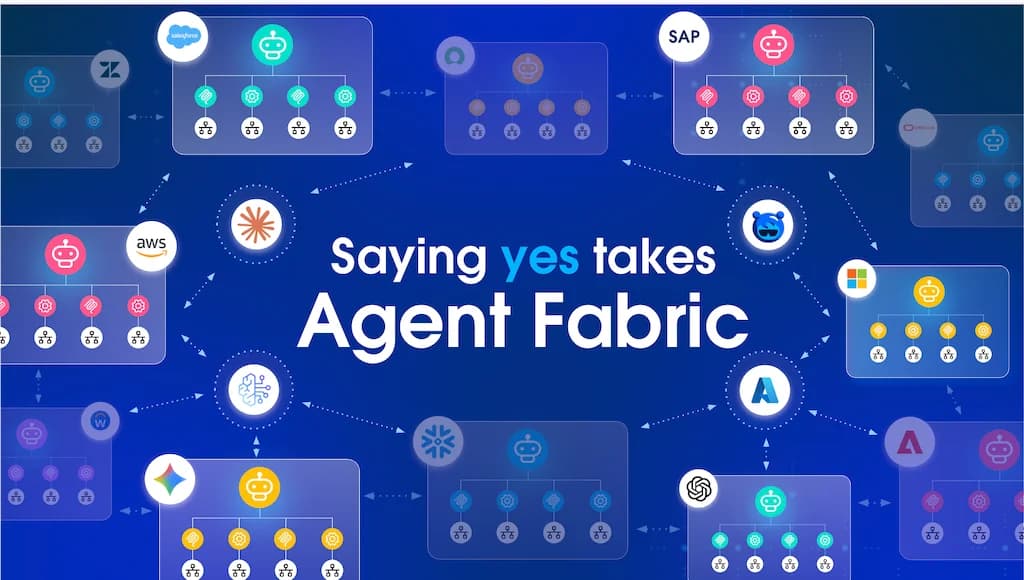
That’s what Agent Fabric is built for: governance, security and Agent FinOps in one solution, enforced through Omni Gateway across agents, MCP servers, models and APIs, wherever they’re built.
You don’t need a sweeping program to begin, but the time to get started is right now.
Employees are already experimenting with agents faster than any review process can keep up, and regulators are asking how you’d stop an AI system if you had to. Start with the agents and MCP tools you have today. Put governance, security and financial operations in place, and every agent after them gets easier to approve. That’s how review boards start saying yes to more agents.
If you want to make the review board’s life even easier, be sure to share the Agent Fabric security and compliance packet with them. It’s a whitepaper for your security and compliance teams to show them how Agent Fabric can help satisfy their requirements, starting the conversation from evidence instead of assurances.
For more practical guidance on getting agents into production, subscribe to Technically Speaking, our monthly LinkedIn newsletter.