A customer recently asked us about the difference between a deepfake and a cheapfake. That question actually raises a bigger issue: AI detection has developed its own vocabulary, and it isn't always clear what the terms mean or how they relate to one another.
So we compiled a list from across the AI detection spectrum, from the language in standards documents to the slang people use in group chats. Entries are short on purpose. Some are non-technical, some assume you work in security or telephony. Where a term has a colloquial cousin, we have marked it. The goal is to give you enough to hold your own in a meeting, call a vendor's bluff, or explain to your board why this line item exists.
If you're new to the subject, start with deepfake, voice cloning, and speech-to-speech. If you're comparing detection products, look at confidence score, false negative, and model coverage. For questions about content authenticity and regulation, C2PA, watermarking, and Article 50 of the EU AI Act are good places to start.
Four pairs of terms people often confuse
The glossary
Account takeover (ATO): When someone gains unauthorized access to another person's account, usually to steal money, information, or other resources. Deepfakes can help fraudsters get past identity checks by using a cloned voice during phone verification or a face swap during a video identity check. Account takeover is one of the outcomes that organizations use deepfake detection to help prevent. See also KYC and vishing.
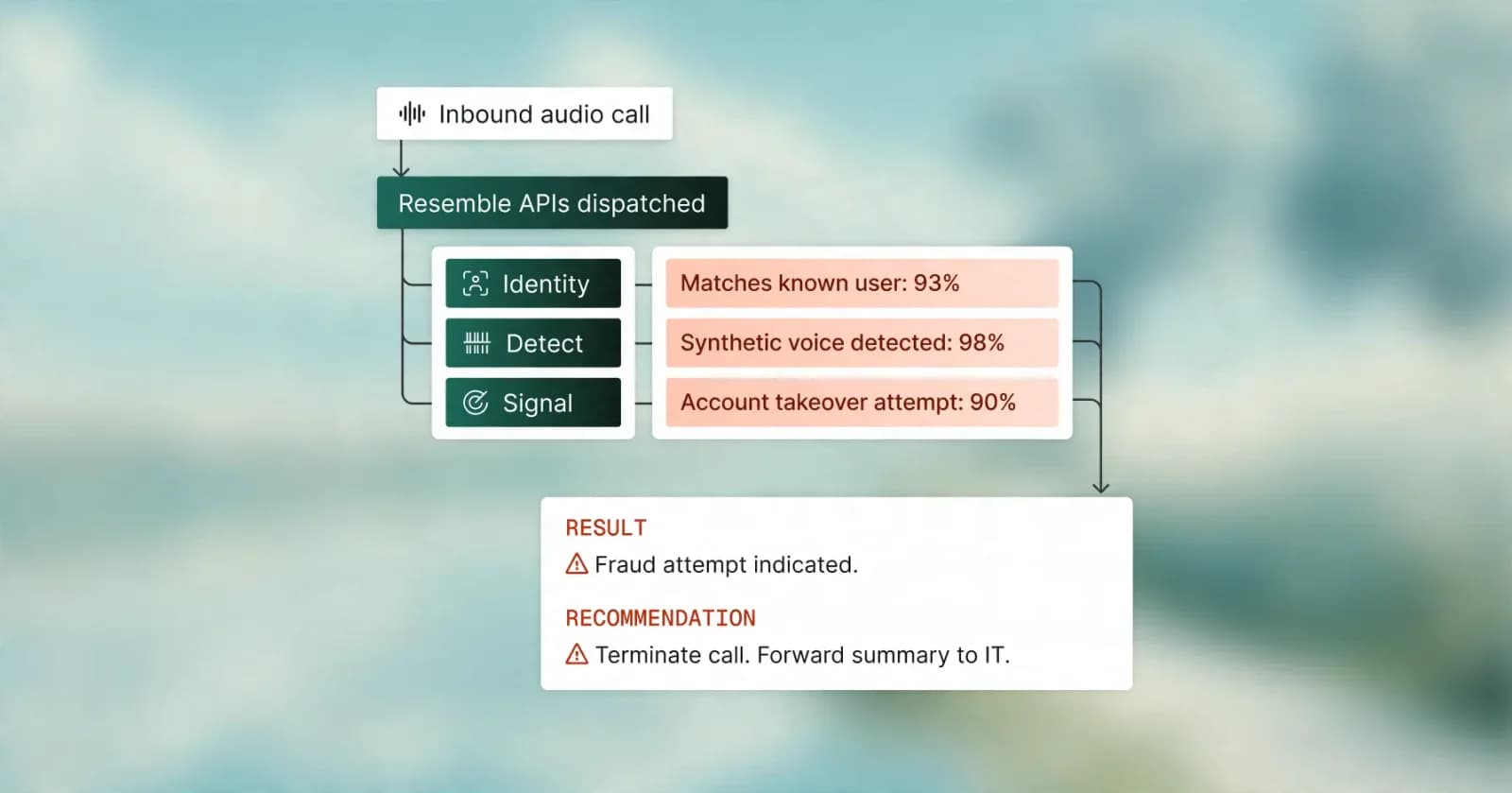
Agent detection: Identifying whether an entity interacting with a system is a human, a conventional bot, or an AI agent. This is different from deepfake detection, which examines media for signs of AI generation or manipulation. AI agents can interact with websites, applications, and phone systems to complete tasks, sometimes without making their identity clear. In contact centers, for example, they can navigate IVR systems, request account information, and automate interactions at scale. Traditional web bot detection may not recognize agents operating through voice channels. Resemble Agent Detection identifies AI agents on live calls, including those that traditional bot detection tools may miss.
Adversarial attack: An attempt to manipulate a machine learning model into producing an incorrect result. This can involve making small changes to an input, sometimes changes that are difficult for a person to notice, that cause a detector to misclassify a file. Adversarial robustness testing examines how well a model performs when someone deliberately tries to fool it. It's an important part of evaluating detection systems intended for security applications.
AI detection: The process of determining whether audio, video, images, or text have been generated or altered using AI. Detection systems analyze media and return a result, often alongside a confidence score. This has become increasingly important as generative tools improve. In a test conducted by Resemble AI at MWC Barcelona, around 70% of security professionals couldn't distinguish real voices from AI-generated ones. The free Chrome Extensionmakes it possible to check content directly in your browser.
Artifacts: Irregularities left behind when media is generated or manipulated. In images, these might include distorted edges or inconsistent details. In audio, they can include unusual background noise or unnatural transitions. Some artifacts are visible or audible to people, but many are subtle and become harder to identify as generation tools improve. In digital forensics, the term can also refer to the specific features a detection model analyzes when assessing a file.
Audio deepfake: Audio that has been generated or manipulated using AI to make someone sound as though they're saying something they never said. A common example is a cloned executive voice used in a fraudulent phone call. Audio is particularly relevant to enterprise security because a convincing voice can be delivered over an ordinary phone line, where the recipient has few ways to verify the speaker's identity. See also vishing.
Batch detection: Analyzing media files after they've been recorded or uploaded, rather than while they're being created or transmitted. Batch detection is commonly used to review archived recordings, investigate reported content, or screen large collections of files. Because the system can analyze the complete file without the time constraints of a live interaction, it can use more processing time to assess the media.
C2PA / Content Credentials: C2PA, short for Coalition for Content Provenance and Authenticity, is a technical standard for recording information about the origin and editing history of digital content. Cameras, editing software, and AI platforms can use it to attach a signed record to a file. Content Credentials is the name used for the associated system of credentials that people can inspect. The record can include details about who created the content, which tools were used, and whether the file has been modified. This information can help establish a file's history, provided the credentials remain intact. Files without provenance information still need to be assessed using other methods, including detection.
Cheapfake: Media that has been edited or presented in a misleading way without using AI generation. Examples include slowing down a video, removing part of a speech, or adding a misleading caption to genuine footage. Cheapfakes can be just as deceptive as deepfakes, but they don't leave the same generation signals. A detector looking for AI-generated media won't necessarily identify a genuine video that's been taken out of context. Provenance checks and contextual investigation are often more useful.
Confidence score: A numerical result that indicates how strongly a detection model supports its classification. A score of 0.91, for example, reflects the model's assessment based on the signals it analyzed. It shouldn't automatically be interpreted as a 91% probability that the content is fraudulent. Scores can vary depending on factors such as audio compression, background noise, accents, and file quality. When evaluating a detector, it's worth asking how its scores perform on the types of media your organization handles.
Deepfake: Synthetic or manipulated media that uses AI to make a person appear to say or do something they didn't. Deepfakes can involve someone's face, voice, or both. The term originally became associated with face-swapping technology, but it's now widely used for AI-generated audio and other forms of synthetic media. In fraud, common examples include cloned executive voices used in payment scams and manipulated video used to impersonate employees or customers.
DETECT-World: Resemble AI's third-generation deepfake detection model. It combines an artifact detection layer with a reasoning architecture that evaluates whether the content is consistent with the physical world. For video and images, this includes examining physical relationships and inconsistencies that may indicate manipulation. The model supports audio, image, and video detection through a single API. It ranked first on the August 2026 Podonos Audio Benchmark with 99.5% accuracy. See the live benchmarks.
Diffusion model: A type of generative AI model used to create images and increasingly, video. Diffusion models work by starting with random noise and gradually removing it to produce an image or other output. They're behind many of the image-generation tools people use today. Their output can lack the obvious visual irregularities associated with earlier generation techniques, making detection more challenging. Detection systems need to be trained and tested against content produced by these models.
Embedding: A numerical representation of the characteristics of a piece of media. An audio clip, image, or video frame can be converted into an embedding that captures patterns in the original content. Detection systems can compare these representations against patterns learned during training to help classify media. Resemble AI's Signal product, for example, works at the embedding level. Audio is converted into a numerical representation for analysis, without storing spoken content, personal information, or transcripts.
EU AI Act, Article 50: Article 50 of the European Union's AI Act sets out transparency requirements for certain AI systems and AI-generated content. These include requirements for providers to ensure that synthetic audio, image, video, and text content is marked in a machine-readable format, subject to the provisions and exceptions in the regulation. The relevant transparency obligations take effect on August 2, 2026. Watermarking and other machine-readable marking techniques are among the approaches used to support compliance. Learn about Resemble's Watermarker.
Explainability: Information that helps a user understand why a detection model returned a particular result. This might include the section of an audio recording, a specific video frame, or an image feature that contributed to the classification. Explainability is particularly useful in enterprise settings, where analysts may need to review a result or explain a decision to a fraud team, regulator, or customer. A score alone doesn't always provide enough information to investigate a suspected deepfake.
Face swap: A technique that replaces one person's face with another person's face in a photo or video. In real-time applications, the replacement can follow the original person's head movements and expressions, making the person on screen appear to be someone else. Face swaps are commonly used in video deepfakes and have been used to impersonate employees and executives during video calls.
False negative: A manipulated or AI-generated file that a detection system incorrectly identifies as authentic. In a security setting, false negatives can allow fraudulent calls, impersonations, or manipulated media to pass through a verification process. The false negative rate (FNR) measures how often this happens. Resemble AI's DETECT-World has a 1.4% FNR on the Podonos Audio Benchmark. When comparing detection providers, ask for false negative results alongside overall accuracy, and check which datasets and test conditions were used.
False positive: Genuine media that a detection system incorrectly flags as AI-generated or manipulated. False positives can interrupt customer interactions, delay legitimate transactions, and create additional work for fraud and support teams. The false positive rate (FPR) measures how often genuine content is incorrectly flagged. Detection thresholds are often adjusted to balance the consequences of false positives and false negatives for a particular use case.
GAN (Generative Adversarial Network): A machine learning architecture used to generate synthetic content. A GAN consists of two neural networks: a generator that creates content and a discriminator that evaluates whether the content is real or generated. The two networks train against each other, with the generator improving its output as the discriminator gets better at identifying fakes. GANs played a major role in the development of early deepfake technology. Diffusion models are now widely used for image and video generation, although GAN-based techniques remain relevant in some applications, including face swapping and voice generation.
Heatmap: A visual representation of the areas of a file that contributed to a detection result. In audio, a heatmap might highlight particular sections of a recording. In video or images, it can show regions that influenced the model's classification. Heatmaps help analysts review model results and understand which parts of the media warrant closer examination.
Image deepfake: An AI-generated or manipulated still image. Examples include entirely generated portraits used in fake social media profiles, face replacements in existing photographs, and images where objects or other details have been added, removed, or changed using AI. Image detection differs from audio and video detection because the model has only a single frame to analyze. It must rely on visual patterns and other signals in the image rather than changes over time.
IVR (Interactive Voice Response): An automated phone system that allows callers to navigate menus using spoken responses or keypad inputs. IVR systems are used by banks, insurers, contact centers, and other organizations to route calls and handle routine requests. AI-generated voices and automated agents can interact with these systems, creating opportunities for fraud and account probing. Detection needs to process incoming audio quickly enough to assess a call while the interaction is still underway. See also real-time factor (RTF).
Injection attack: An attack in which synthetic audio or video is introduced directly into a system through virtual camera or audio software. Rather than presenting a fake through a physical camera or microphone, the attacker feeds manipulated media into the computer's input stream. This can bypass security checks that only examine what a device's camera or microphone captures. Detecting injection attacks requires visibility into the media entering the call or application.
KYC (Know Your Customer): The identity verification procedures financial institutions use to establish who their customers are. KYC checks are required in many jurisdictions to help prevent fraud, money laundering, and other financial crimes. Deepfakes create new risks for these processes. Fraudsters can use AI-generated faces, cloned voices, and manipulated identity documents to try to pass verification checks. See also synthetic identity fraud and account takeover (ATO).
Lip sync manipulation: Altering the mouth movements in a video so they match different audio. This can make it appear that someone said words they never spoke, while leaving the rest of their face and the surrounding footage unchanged. Because most of the original video remains intact, lip sync manipulation can be difficult to spot through visual inspection alone.
Live meeting detection: Analyzing participants in a video call while the meeting is taking place. Unlike batch detection, which examines an uploaded recording, live meeting detection needs to return results quickly enough to be useful during the conversation. It can help identify manipulated video or audio before a participant acts on a fraudulent request. Resemble Meetings provides detection across Zoom, Microsoft Teams, Google Meet, and Webex, with results in 3 to 5 seconds.
Liveness detection: A check used during identity verification to establish whether a live person is present. It may ask someone to move their head, blink, or perform another action in front of a camera. Liveness checks help prevent simple presentation attacks, such as someone holding up a photograph or playing a recording. They don't necessarily establish the person's identity or determine whether the video itself has been manipulated. A deepfake may be able to pass certain liveness checks.
Model coverage: The range of AI generation tools and techniques represented in a detection model's training and testing data. A model may perform well against the generators it has been tested on but struggle with tools or techniques it hasn't encountered. Coverage is therefore an important part of evaluating a detection provider. Resemble AI's DETECT-World currently covers 250+ models, with additional models added weekly to bi-weekly as new generators become available. When comparing providers, ask which generation tools they cover and how frequently that coverage is updated.
Multimodal detection: Detection across multiple types of media, such as audio, video, and images. A multimodal system can assess different formats through a single platform or API. This is useful when an attack involves more than one type of synthetic media, such as a face swap paired with cloned audio during a video call or an AI-generated image used in a scam video.
PerTh watermark: Resemble AI's watermarking technology for audio, video, images, and text. It embeds an imperceptible signal in media that can be used to identify content originating from a particular pipeline. The watermark is designed to survive common forms of media processing, including compression and re-encoding.
Pig butchering: A type of investment scam in which fraudsters build a relationship with someone over weeks or months before convincing them to put money into a fraudulent investment platform. The name comes from the Chinese phrase "sha zhu pan." Scammers often use fake identities, fabricated investment returns, and increasingly, AI-generated media to make their stories more convincing. Deepfake video calls and cloned voices can help maintain the illusion of a real relationship. FTC data puts reported losses at $1.14 billion across more than 64,000 victims, with an average loss of $177,000 over 6 to 12 months. Some of the criminal operations behind these scams are based in Southeast Asian compounds where workers are also subjected to human trafficking.
Presentation attack: An attempt to fool a biometric system by presenting a false representation of a person. Examples include holding a photograph in front of a camera, playing a recording of someone's face, or using a mask. The term comes from biometric security standards, including ISO 30107. Presentation attacks can involve simple physical materials or sophisticated digital manipulation, so the category is broader than deepfakes alone.
Provenance: Information about where a file came from and how it has changed over time. A provenance record might identify the creator, the software used, and edits made to the original content. Standards such as C2PA provide a way to attach verifiable provenance information to digital files. The information is most useful when it can be maintained from the point of creation. Files received from unknown sources may have no provenance information, which is where detection can help assess their authenticity.
Real-time factor (RTF): A measure of how long a system takes to process media compared with the duration of that media. An RTF of 0.40 means a one-second audio clip takes 0.40 seconds to analyze. An RTF below 1.0 indicates processing faster than real time, which is important for applications such as live call screening and meeting detection. Resemble AI's detection runs at 0.33 to 0.40 RTF.
Replay attack: An attempt to pass an identity check by playing a recording of a real person's voice or video. For example, a fraudster might play a recording of an account holder's voice to get through a phone verification process. Replay attacks don't require AI generation, which means a detector focused exclusively on synthetic media may not identify them.
SIPREC (Session Recording Protocol): An IETF standard that allows a telecommunications system to send a copy of a live call's audio to another system for recording or analysis. Contact centers use SIPREC to connect call recordings and analytics tools without interrupting the conversation. For AI detection, it can provide a way to send live call audio to a detection service such as Resemble Signal.
Social engineering: The use of deception or psychological pressure to persuade someone to share information, provide access, or take an action. Fraudsters might impersonate a colleague, executive, family member, or service provider to convince someone to transfer money or disclose credentials. AI-generated voices and video can make these impersonations more convincing. Detection can help identify manipulated media, while verification procedures and employee training address the broader social engineering risk.
Speech-to-speech: A technology that converts one person's speech into another voice while retaining characteristics such as pacing, rhythm, emotion, and emphasis. Unlike text-to-speech, it doesn't require the user to start with written words. An attacker can use a recording of someone speaking and convert it into a target voice. This makes speech-to-speech particularly relevant to voice cloning and impersonation attacks.
Spoofing: The act of falsifying an identity or signal to make something appear legitimate. Examples include caller ID spoofing, forged email headers, and attempts to imitate someone's face or voice. Voice spoofing can involve recordings, synthetic speech, or AI-generated voice clones.
STIR/SHAKEN: A caller ID authentication framework used by telecommunications providers to help combat caller ID spoofing. STIR (Secure Telephone Identity Revisited) and SHAKEN (Signature-based Handling of Asserted information using toKENs) work together to verify information about the originating phone number. They help establish whether a caller ID has been spoofed, but they don't verify the person speaking. A fraudster using a cloned voice from a legitimate phone number can still pass caller ID authentication. Voice-level detection addresses a separate part of the problem.
Synthetic identity fraud: A type of fraud in which someone creates a fabricated identity using a combination of real and false information. For example, a fraudster might combine a real Social Security number with a fictitious name and an AI-generated face. Unlike a deepfake, which generally involves impersonating an identifiable person, a synthetic identity may not correspond to any real individual. Organizations need different checks to identify fabricated identities and detect attempts to impersonate real people.
SynthID: Google DeepMind's watermarking technology for identifying AI-generated content created using Google's generative models. It embeds signals into generated media that can later be detected using compatible tools. SynthID is designed for content created by Google's own models, so organizations handling media from other generators may need additional detection or watermarking solutions.
Synthetic media: Content generated or substantially altered using AI. The term covers audio, video, images, and text, and is often used in policy and technical discussions. Synthetic media isn't necessarily deceptive. An AI-generated voiceover created with the speaker's consent is synthetic media, as is a cloned executive voice used in a fraudulent call. The context, consent, and intended use help determine whether the content is legitimate or harmful.
Text-to-speech (TTS): Technology that converts written text into spoken audio. Modern TTS systems can produce natural-sounding speech in a wide range of voices, languages, and accents. Some tools can also reproduce the characteristics of a specific person's voice. This has made TTS useful for legitimate applications such as accessibility and content production, but it can also be used to create synthetic voices for impersonation and fraud.
Video deepfake: Video that has been generated or manipulated using AI. This includes face swaps, lip sync manipulation, full-body reenactment, and entirely AI-generated scenes. In enterprise fraud, face swaps and manipulated video calls are common concerns because they can be used to impersonate colleagues, executives, or customers. Detection systems need to examine visual information across frames and account for different types of manipulation. See face swap and lip sync manipulation for more detail.
Verdict: The classification returned by a detection system. Common results include authentic, manipulated, and inconclusive. An inconclusive result means the system doesn't have enough information to make a confident classification. This can happen when media quality is poor or the content falls outside the conditions the model has been tested against. Having this third option gives analysts a way to review uncertain cases rather than treating every result as a simple yes or no.