AI rank tracking tools help you see how often ChatGPT, Gemini, Google AI Overviews, and other AI platforms recommend your brand, where you appear in their answers, and how you compare with competitors.
But not all tools track visibility the same way, and their pricing can be difficult to compare.
In this guide, I’ll compare eight AI rank tracking tools by price and features. I’ll also share findings from my own research into AI rankings, including why tracking brand mentions often tells you more than tracking positions alone.
Contents
- How rank tracking works in AI visibility tools
- AI rank tracking tools: price comparison
- AI rank tracking tools: how their pricing works, feature highlights
- Ahrefs Brand Radar
- Rankscale
- SE Visible
- Peec AI
- Otterly AI
- Nightwatch
- Scrunch
- Profound
- Why rank tracking works differently in AEO and SEO
- Final thoughts
How rank tracking works in AI visibility tools
Tools that track rankings in AI answers are usually called AI visibility tools or AI visibility trackers. Rankings are just one feature, and usually not the main one: the broader focus is brand mentions, citations, and competitor visibility.
They collect answers by scraping AI chat interfaces—sometimes through third-party data providers—or through API calls. Scraping captures the consumer-facing experience, so it can be more representative of what users see than API responses. APIs provide an alternative, including when scraping isn’t available; Brand Radar, for example, uses Claude’s API and scraping for the other 6 AI systems.
The tools then parse and store those answers, identify brands and sources, and calculate metrics such as mention rate and position.
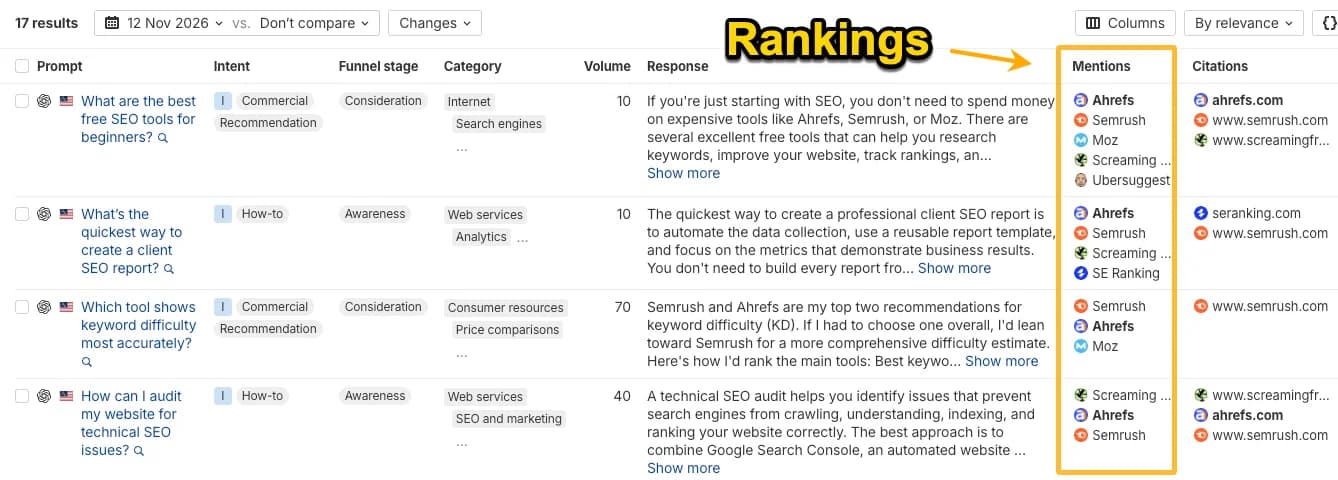
In Ahrefs Brand Radar, for example, you can see the order in which tracked brands were mentioned in a single answer—their ordinal rank:
This shows which tracked brand was named #1, #2, and so on. Being mentioned first doesn’t necessarily mean being recommended as the best.
There’s more nuance to interpreting rankings in AEO, which we’ll get to later.
AI rank tracking tools: price comparison
A good way to find the right AI visibility tool is to test two or three using the same 10 prompts and compare the results.
To help you narrow down your options, the table compares each tool’s monthly plan price, daily prompt allowance, and included AI platforms. It’s sorted by cost per daily tracked prompt: the monthly plan price divided by the number of prompts tracked daily.
The cost per daily prompt is the monthly plan price divided by the number of prompts tracked daily. Platform coverage differs between tools, so these figures aren't directly equivalent.
Pricing checked November 3, 2026.
Tool
Monthly price, plan
Daily prompts
AI platforms available
Platforms included in cost
Cost per daily prompt
Ahrefs Brand Radar
$50, Basic
~83
$0.60
$99, Pro
160
17+ (most by API)
$0.62
$89, Basic
All 5
$1.19
$95, Brands Starter
Choose 3 of 6
$1.90
$29, Lite
All 4
$1.93
$99, Starter
$1.98
$250, Core
125 (daily for 14 days)
4, non-daily
Not comparable
Custom quote, Brand Enterprise
Custom
Up to 10
Depends on plan
Quote required
Some tools offer cheaper annual billing or lower-tier plans with different tracking limits. Costs may also vary by platform and checking frequency.
Higher-volume plans can bring the cost down considerably. For example, Ahrefs Brand Radar's Scale plan works out to $0.30 per daily tracked prompt, while SE Visible's Agency plan costs about $0.40.
AI rank tracking tools: how their pricing works, feature highlights
Price is a useful starting point, but it doesn't tell the whole story. Let's take a closer look at what each tool includes, where it stands out, and what limitations to consider.
Ahrefs Brand Radar
Ahrefs Brand Radar gives you two ways to track AI visibility.
With custom prompt tracking, you pay per check: one prompt run on one AI platform in one location. You choose what to monitor and whether to check it daily, weekly, or monthly. Basic costs $50/month for 2,500 checks, Growth $100 for 7,000, and Scale $250 for 25,000. That's $20, about $14 and $10 per 1,000 answers, respectively, on platforms that use one check per answer. Claude uses eight checks per answer.
Extra checks cost $0.010 to $0.020 each if you enable pay-as-you-go; otherwise, tracking pauses when your allowance runs out. You don't need an Ahrefs subscription to track custom prompts.
The separate AI Visibility Index lets you explore existing AI answers without setting up prompts. It covers more than 500 million questions, with data dating back to 2025, and estimates impressions based on how frequently people search for those topics. Access starts at $199/month per platform or $699/month for all platforms, including 2,500 custom-prompt checks. The index updates monthly.
Highlights
Brand Radar lets you start small. Even the entry package covers the core AI visibility features most teams need:
- Flexible tracking setup: Monitor a brand, product, person, or even a specific word, not just company names.
- Languages and locations: Compare your visibility across different markets and languages.
- Mentions, citations, and retrieved sources: See when your brand is named, which pages are cited, and which sources were retrieved without being cited.
- Mention and citation gap analysis: Find where competitors get mentioned or cited and you don't.
- Sentiment analysis: See whether mentions of your brand are positive, negative, or neutral.
- Prompt volumes: Use volume figures to help prioritize which questions to research or track.
- Prompt research and competitor suggestions: Find relevant questions and competitors to include in your monitoring.
- Intent and funnel-stage classification: Separate early research from comparisons and purchase-related questions to see where you're visible.
- Source classification by page type: Compare the kinds of pages AI retrieves and cites.
That's enough to see where you stand in AI answers. But AI visibility doesn't exist in isolation. The pages AI cites also rank on Google, attract links, and earn traffic. That's where the rest of Ahrefs comes in.
Starting with Ahrefs’ Lite plan, you can look up cited pages in Site Explorer to check their estimated Google traffic and backlinks. A page that AI cites frequently might get little search traffic, while another could offer exposure through both channels. Bringing those signals together gives you a better basis for choosing outreach targets than citation counts alone.
You can extend that research from individual pages to the topics behind your tracked prompts. Depending on your plan, Ahrefs’ SEO tools let you investigate related Google searches and the competitors ranking or advertising for them. That gives you a broader view of their activity across AI search, SEO, and paid ads, drawing on Ahrefs’ extensive web, keyword, and backlink data.
And when the question you want to answer doesn’t fit a ready-made report, you can build your own. Letaido, Ahrefs’ AI workspace, lets you turn your data into custom dashboards, reports and apps.
For example, you could build an app that checks tracked AI answers against facts about your business, with checks tailored to the claims you want to monitor.
Using your Ahrefs data in Letaido requires an active Ahrefs subscription, but reading that data doesn’t use up API units.
Vast amount of website stats from backlinks to keywords, everything is there. Now even AIO data is also there, it's so easy to find trending aio queries with ahrefs and optimise your website. We use ahrefs everyday to find latest keywords trends and what actions we need to take in order to keep our website error-free from SEO perspective
Khushal R., SEO Specialist, G2
Further reading
Rankscale
Rankscale charges credits for each AI check rather than limiting the number of prompts you can add. Essentials starts at $17/month, billed annually, with 120 credits.
A check costs 0.25 credits on ChatGPT, Gemini, AI Mode or Perplexity, but 2 on Claude. That means 120 credits cover about 16 daily prompts on one cheaper engine.
Higher plans offer more credits and features: Pro starts at $84/month with 1,200 credits and exports, while Pro+ starts at $195/month with 3,000 credits and API access. Larger plans start at $327/month. A free 7-day Pro trial is available.
Highlights
Rankscale gives you more control over tracking than tools with a fixed daily schedule. You can choose which prompts to monitor, which AI engines to use, and how often to check them, from hourly to monthly. It also shows the sources AI engines use, the related searches they make, and opportunities to improve your pages.
Shopping and ad analytics are available on Pro, while AI referral reporting through GA4 and Search Console is still in beta.
Rankscale offers the most flexible LLM Rank Tracking on the market.
Verified User in Marketing and Advertising, Small-Business, G2
SE Visible
SE Visible charges by the number of prompts, projects, and locations you track. Basic starts at $71/month billed annually ($89 monthly) and includes 75 prompts checked daily across supported AI platforms, 5 projects, and one location per project.
API access, MCP, and unlimited team members are included from the start.
Core ($151/month annually) raises the limit to 200 prompts, 10 projects, and unlimited locations. Agency ($319/month annually) offers 1,000 prompts and 30 projects.
Tracking the same prompt in several locations uses a separate prompt slot for each location. There's a free 10-day trial.
Highlights
SE Visible makes it easy to share AI visibility data across a team without paying for extra seats. It includes prompt research, citation gap analysis, sentiment tracking, client access and regular reports.
API and MCP access are available even on the cheapest plan, so you can connect the data to your own reporting tools. It also fits into SE Ranking's wider SEO toolkit if you want traditional search data alongside AI visibility.
What makes SE Visible stand out for product marketing is how well it centralizes AI search performance metrics in a single, easy-to-read view. The main dashboard pulls together overall visibility, Share of Voice, position tracking, and brand sentiment, with clear period-over-period comparisons. It gives you that “one score” that works for executive reporting, while still keeping the underlying, granular data close at hand to support and explain the performance numbers.
Senior Product Marketing Manager, Computer & Network Security, Mid-Market, G2
Peec AI
Peec charges mainly by the number of prompts, projects and countries you track.
Starter costs $80/month billed annually ($95 monthly) for 50 prompts checked daily across 3 AI models, with one project and one country.
Pro starts at $205/month annually and increases the allowance to 150 prompts, 2 projects and 3 countries, with API access.
Advanced starts at $420/month annually, with 350 prompts, 5 projects and Looker Studio. Team members are unlimited on every plan.
Extra models can cost more, while separate agency plans start at $205/month and use tracking credits instead of fixed prompt allowances.
Highlights
Peec focuses on helping marketing teams understand and improve their presence in AI answers.
Its Gap Analysis shows which sources AI platforms cite for competitors but not for you, while recommended actions help identify what to improve.
You also get fact-checking, an AI Agent, ads and shopping tracking, and prompt tags to organize results by product or campaign.
Otterly AI
Otterly charges by the number of prompts you track, with separate fees for additional AI models.
Lite starts at $25/month billed annually ($29 monthly), with 15 prompts checked daily across four platforms.
Each country uses its own prompt slots. Standard starts at $160/month billed annually and includes 100 prompts, API access, and Looker Studio.
Premium starts at $422/month annually with 400 prompts. On Standard and Premium, you can buy extra prompts in packs of 100 for $85/month billed annually. Gemini, AI Mode and Claude cost extra, with prices depending on your plan.
Highlights
Otterly offers a useful range of features even on its cheapest plan. Alongside brand mentions and citations, it tracks sentiment, the searches AI platforms make and whether AI crawlers can access your content.
Its Brand Profiling feature also reveals the claims, qualities and concerns AI associates with your brand. Website audits, recommendations, and ads and shopping tracking help you move from monitoring visibility to improving it.
Really simple and user friendly AI search monitoring tool AI Search analytics tool Great to monitor and optimise brand visibility on ChatGPT Great for optimising my website citations on ChatGPT Was very quick and easy to implement and intergrate with current processes. I use it daily to check in.
Robyn P., Communications Manager, Small-Business, G2
Nightwatch
Nightwatch combines traditional SEO rank tracking and AI visibility in one subscription.
Starter costs $79/month billed annually ($99 monthly) and includes 500 Google keywords, 50 AI prompts and 1,500 AI answers a month.
Professional starts at $159/month billed annually, increasing the allowance to 150 prompts and 4,500 answers, with API access and Looker Studio.
Agency starts at $399/month annually, with 500 prompts and 15,000 answers. The monthly answer allowance may limit how many AI platforms you can track, but Nightwatch doesn't clearly explain how answers are counted across platforms. There's a free 14-day trial.
Highlights
Nightwatch is useful if you're already tracking traditional search rankings and want to add AI visibility without managing another tool. It covers Google, Bing, YouTube and Google Maps, alongside AI answers. You also get keyword and prompt research, website audits, Content Studio and an SEO MCP server. That makes it a practical choice for SEO teams that want to connect AI visibility with their existing search work.
I've been using Nightwatch.io for 4 years and it has been a game-changer for my SEO efforts. The platform offers a robust set of tools that allow me to track rankings, analyze competitors to some extent, and manage multiple projects with ease. The accuracy of the data and the level of detail provided is exceptional, making it easier to make informed decisions.
Luka L., SEO Manager, Small-Business, G2
Scrunch
Scrunch charges by prompts and monthly AI responses, with limits on team members, countries, and platforms.
Core costs $250/month for 125 prompts, 5,000 responses, and 5 seats across four AI platforms.
New prompts are checked daily for 14 days, then every 72 hours by default, so tracking isn't continuously daily.
Enterprise pricing is custom and adds more platforms, locations, API access, and reporting features.
Agency Core starts at $500/month. Annual discounts are only available on Enterprise. There's a free 7-day trial that becomes a paid subscription unless you cancel.
Highlights
Scrunch combines AI answer tracking with data on how AI bots visit your website. That helps you see both what AI platforms say about your brand and how they interact with your content.
Core also includes sentiment and citation analysis, recommendations, website audits, and page optimization. It's a useful combination for teams looking to turn visibility data into website improvements.
I chose Scrunch for my small digital marketing agency, so I use it daily to track AI visibility across multiple clients. My account rep was great to work with and helped me quickly set up an instance for a prospect I was about to pitch. It makes prompt tracking easy. The automatically generated prompts give you a good place to start when setting up a brand, and then you can refine the prompts as you get to know the landscape better.
Tehra P., Owner/President, Small-Business, G2
Profound
Profound doesn't publish prices for its main Enterprise plan, so you'll need a quote.
Its free 7-day trial tracks 50 fixed prompts daily across three AI platforms, but doesn't include editable prompts, exports or API access. Enterprise adds these features, along with more platforms and historical data.
Agencies have a separate option starting at $99/month, with ongoing client workspaces costing an additional $399/month each. Those workspaces include 100 daily prompts across three platforms.
Profound's AI Agents use a separate credit allowance for content and marketing tasks, rather than visibility tracking.
Highlights
Profound goes beyond tracking brand mentions by offering AI tools that help teams act on the results.
Its AI Marketer and reusable Agents support content and marketing work, while Agent Analytics shows how AI systems interact with your website. Integrations with services such as Cloudflare, WordPress, and Google Analytics help connect visibility reporting with website activity. Its Pages feature also brings traditional search visibility data alongside AI results.
The product is constantly developing: new features, new AI model integrations become available day to day those become available though vendors (OpenAI, Anthropic, etc.), better workflow design. The ability to integrate Profound with the project management tools we use every day such as Slack. And what is the most important all that are not just features – it's the toolkit that help us and our clients get proper AI exposure we need.
Anastasiia K., AEO Enthusiastic, Marketing and Advertising, Small-Business, G2
Why rank tracking works differently in AEO and SEO
Traditional SEO focuses heavily on where a page ranks. AI search is different because the order of recommendations can change even when the same brands keep appearing.
To understand how much rankings fluctuate, I tracked 15 "best tools" prompts across seven AI platforms for 76 days, collecting 6,790 answers that mentioned at least three tools.
The results showed just how unstable individual positions can be.
When a tool appeared on consecutive days, it kept the same position only 36% of the time.
Rankings changed on 77% of days in Gemini, compared with 53% in Google AI Overviews, the most stable platform in the study.
“Position changed” measures rank changes among tools named on both days; “same #1” measures whether the top tool stayed first. The two figures aren't meant to add up to 100%
But the brands AI chose to recommend were much more consistent.
Most prompts had around three tools that appeared in nearly every answer. When these regularly recommended tools appeared, they were mentioned again the following day 98% of the time, even though their positions often changed.
Think of it as a guest list that stays largely the same, while everyone switches seats.
Rankings or mentions: which matters more?
My research also found a strong relationship between how often a brand gets mentioned and how high it appears.
Tools mentioned most frequently appeared in the top three positions in 61% of answers that named them. For tools mentioned only occasionally, that figure was just 12%.
This suggests that both metrics reflect how strongly AI associates a brand with a topic.
But mention rate is usually the more useful starting point because average rankings leave out an important detail: how often your brand doesn't appear at all.
For example, in one set of prompts I tracked, Ahrefs appeared in only 30% of answers. Yet when it appeared, its average position was number one.
Looking at ranking alone would make that performance seem much stronger than it really was.
What to report instead
Instead of reporting a single AI ranking position, track these three metrics for each AI platform. Compare the last four weeks with the four weeks before to see what's changing.
- Mentions: How often does AI recommend your brand? Mention rate: The percentage of answers that mention your brand.Mention count: The total number of answers that mention your brand.Mention trend: Whether your mention rate is increasing, staying steady, or falling.
- Mention rate: The percentage of answers that mention your brand.
- Mention count: The total number of answers that mention your brand.
- Mention trend: Whether your mention rate is increasing, staying steady, or falling.
- AI share of voice: Your brand's share of all mentions among you and the competitors you're tracking.
- Average position: Where your brand typically appears in answers that mention it. Track this over at least a week, and always report it alongside your mention rate, never on its own.
For any custom calculations, you can use Agent A in Ahrefs. Just describe what you want to measure, and it can work with your data. You can also export the data or connect it to another AI assistant through an API or MCP.
For example, here's a prompt you can use to calculate mention rate and average position:
Calculate Ahrefs’ mention rate for each date when any of the tools included in the report were mentioned. Also, calculate the average position at which Ahrefs appeared. Exclude Ahrefs-branded prompts from both calculations.
Final thoughts
Ironically, rank tracking might be the least important feature to look for in an AI rank tracker.
My research showed that positions can change frequently even when the same brands keep appearing. Knowing how often AI includes your brand tells you more than a snapshot of where it places you.
So it’s more useful to think of these as AI visibility tools. Look beyond rankings to what else they help you understand: which questions bring up your brand, which sources get cited, and how you compare with competitors.
Choose the tool that helps you decide what to investigate and improve, then price the setup you actually need: the prompts, platforms, and checking schedule. If you’re buying for clients, compare agency plans separately. That’s a stronger basis for choosing than whether it can tell you you’re number one.
Once you know where your brand stands, the next step is improving its visibility. Our free Answer Engine Optimization (AEO) guide covers how to earn more AI mentions and citations, make your content easier for AI to find, and improve how AI represents your brand.
Thanks for reading! You can also find me on LinkedIn and Substack.