Hotels that stick to fixed rates risk missing out when demand spikes or losing bookings when it suddenly drops. Pricing once a season, or even monthly, is no longer an option.
Hotel dynamic pricing gives you the flexibility to stay competitive in constantly changing markets. By adjusting rates in response to real conditions, you protect occupancy and stop leaving revenue behind.
And dynamic pricing doesn’t have to mean more work. With the right revenue management system, pricing updates can run in the background, freeing your team to focus on guests and strategy.
Key takeaways
- Hotel dynamic pricing is the practice of adjusting room rates and stay restrictions to real-time demand, competitor rates, and booking pace instead of a fixed calendar.
- The three core hotel dynamic pricing strategies are occupancy-based rate changes, stay restrictions such as MinLOS and closed to arrival, and competitor-based pricing against your compset.
- Dynamic pricing does not mean changing rates daily, so match your review and update cadence to how your guests shop.
- Cloudbeds RMS recommends hotel room rates, helping you maintain a dynamic pricing strategy
What is dynamic pricing for hotels?
Unlike the old-school approach of static hotel pricing (keeping room rates the same regardless of demand), hotel dynamic pricing is about adjusting rates and stay restrictions in response to changes in local demand and market conditions.
It’s a core tenet of revenue management and yield management, the practice of managing pricing and room inventory to maximize a hotel’s revenue and profitability. The goal of any pricing strategy is to sell the most rooms at the highest possible rate.
What drives hotel room rates?
Whether you set rates by hand or hand the job to software, the same signals move the price:
- Booking pace and pickup compared with the same point last year
- Occupancy for each date and how much inventory you have left
- Competitor rates across your compset
- Lead time, since a room sold 60 days out and a room sold tomorrow are different decisions
- Length of stay and day of week
- Local events, holidays and seasonality
- Cancellations, which quietly reopen inventory you thought was gone
Those signals can shift daily, sometimes hourly, which is hard to track by hand. That’s the case for automating your pricing.
Why hotel dynamic pricing matters in 2027
As consumers, we run into dynamic pricing everywhere, from airline fares to tickets for a high-demand game to markdowns at the local grocery. If you use ride-share apps like Uber and Lyft, you know prices “surge” during busy times and drop during slower ones. And Amazon reportedly updates the prices of different products millions of times per day.
Consumers have grown so used to price fluctuations that they now expect them, and the hotel industry is no exception. Chances are your competitors adjust their rates frequently, and if you don’t, you risk being out of sync with the market and pricing your rooms either too low or too high.
The 2027 forecast makes that harder to ignore. STR and Tourism Economics project U.S. hotel ADR growth of just 1.6% in 2027, down from 3.1% in 2026, with RevPAR growth easing to 2.1% from 4.4%. When the market stops lifting your rates for you, your pricing has to do the work.
Guests have also stopped treating a fixed price as a commitment. Oliver Winter of a&o Hostels put it this way on The Turndown:
Given this uncertainty in the world… people are less committed, so to say, to place fixed bookings. So the flex, I would say, is the new default.
Given this uncertainty in the world… people are less committed, so to say, to place fixed bookings. So the flex, I would say, is the new default.
So don’t be hesitant about charging fair market value for your available rooms. Guests expect rates to fluctuate if they wait to book.
3 hotel dynamic pricing strategies
Hotels who aren’t practicing dynamic pricing yet are often held back by not knowing where to start, or by the fear of pricing themselves out of a booking.
What if you charge too much and occupancy suffers? Or charge too little and sell out with low-rated business? RoomPriceGenie’s 2026 survey of 450 hoteliers found that 43% of hotels still lack a revenue management system to help guide these decisions.
43%
of hotels lack a revenue management system
The three levers below give you a defensible answer to both fears, because each one is tested against real booking data before you commit further.
We’ll use one scenario throughout. A major concert is announced for a Saturday night three months from now, in what is normally a quiet stretch.
1. Adjust room rates based on occupancy and pace
Occupancy tells you how full you are. Pace tells you how fast you’re getting there compared with the same point last year, and that’s the signal that should move your price.
Say two hotels both sit at 20% occupancy for the concert night. One was at 8% at this point last year and is pacing hot. The other was at 35% and is pacing cold. Same occupancy, but opposite pricing decisions.
When pace runs hot, raise rates in steps. At 20% occupancy, rather than jumping 40% and risking the booking, raise rates 20% to test the market. If pace holds and occupancy reaches 50%, raise another 10%. Each increase is an experiment, and if bookings keep coming at the higher rate, demand is deeper than you thought. If they stall, you’ve found the ceiling and can hold or ease off.
The logic works in reverse. If you’re only 60% booked and the concert is less than a week out, lower your rate to capture last-minute demand. A room sold at a discount beats a room left empty, once pace tells you the remaining demand is price sensitive.
2. Adjust stay restrictions to protect the nights around the peak
Rate is one lever and rules are the other. Minimum length of stay (MinLOS) and closed to arrival shape who can book and when, without touching the price.
The concert Saturday will sell on its own. The nights at risk are the Friday before and the Sunday after, because every one-night concert-goer leaves two empty rooms behind. A two- or three-night MinLOS around the show, or closing the Saturday to arrivals, sells the weekend instead of the night. Even at a lower nightly rate, a three-night stay beats one night plus two holes in your calendar.
Think of restrictions as a pressure valve. Tighten early, when demand is likely to be strong and loosen as the date approaches if the gaps won’t fill on their own. And don’t save them for events: any pattern in demand, such as slow weekdays and busy weekends, is a candidate.
3. Adjust room rates based on competitor activity
Your compset is the group of five or so properties most likely to attract the same guests as you. Travelers compare those hotels before they book, which makes their rates a live read on demand. If three of your five competitors raise rates for the concert weekend and you haven’t, either they know something you don’t or you’re underpriced.
Price too high next to comparable hotels and guests book elsewhere. Price too low and your rooms sell first, leaving the higher-paying bookings to your competitors. So position on purpose. To build occupancy, you could price 10% below the top of your compset, and to protect rate once pace confirms demand, hold at or above the middle of it.
The demand signals behind all three strategies
The concert makes the strategies easy to follow, but real pricing rarely comes with marquee event. Most demand shifts are subtler: a forecast that turns, a bank of delayed flights, a competitor’s conference block, a school break that starts a week early.
Pace, restrictions and competitor rates are the levers you can see. What moves them is a wider set of demand signals:
- Weather, since a heat wave, a storm warning or an early snowfall changes who travels, how far and for how long
- Flight disruptions and airline capacity, from cancellations that strand travelers overnight to new routes that open a market
- Overlapping events, such as the conference, the match or the graduation weekend that lands on the same dates as your concert
- School and public holidays, which shift by region and by year
- Search interest in your destination, which often climbs before bookings do
- Cancellations and no-shows, which reopen inventory without warning
- Currency swings and travel restrictions, which change what international guests can afford or are allowed to do
No team can watch all of these by hand, and this is where technology earns its place.
Automating pricing with Cloudbeds RMS
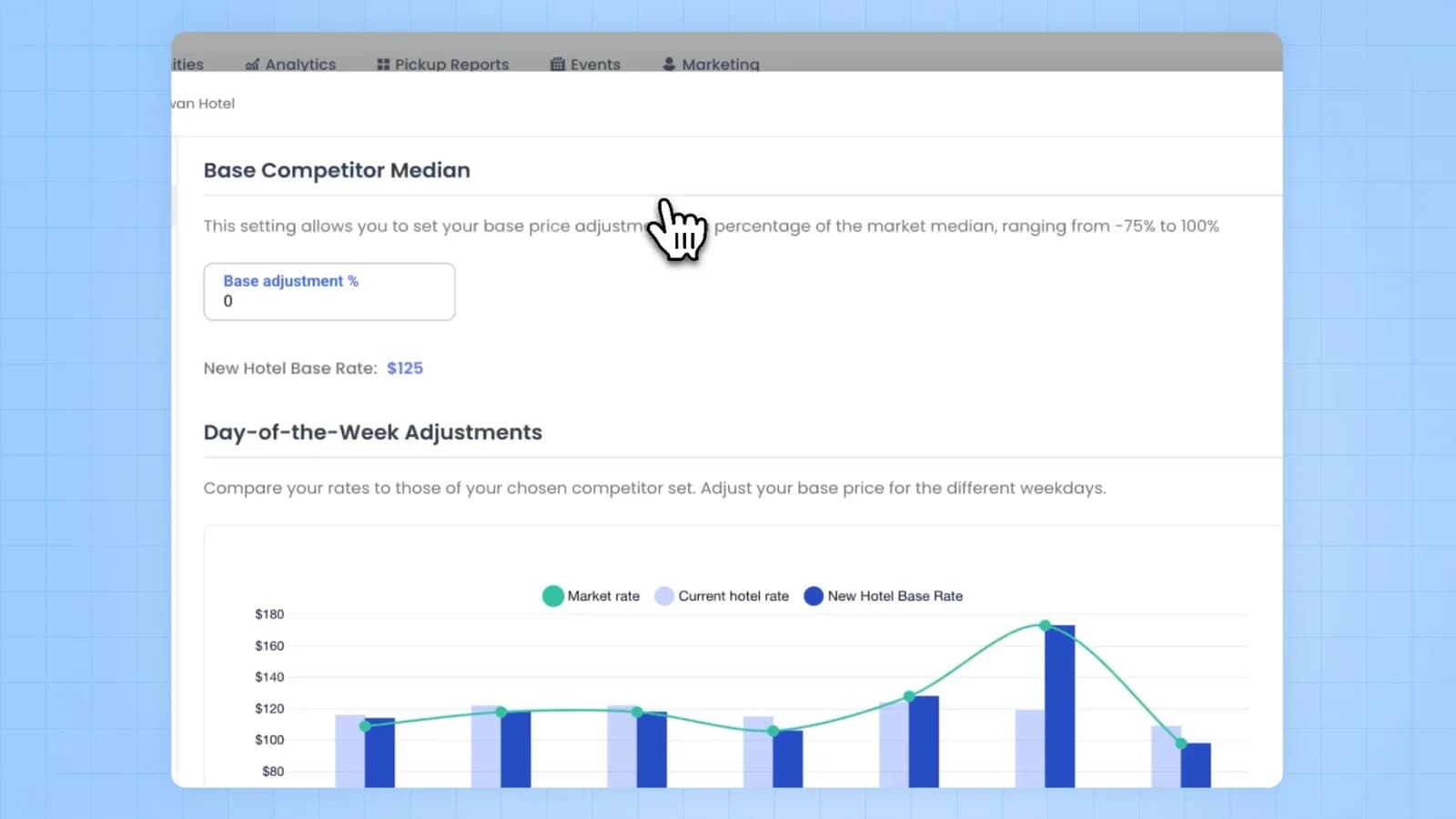
Cloudbeds RMS, an integrated part of the Cloudbeds platform, reads time to arrival, length of stay, channel behavior, competitor rates and market demand together, then shows you what to charge and why.
Each recommendation comes with a plain-language reason, such as stronger booking pace, a change in competitor rates or an expected rise in demand, generated by the same real-time data that runs the rest of your platform.
You decide how much to hand over. You can accept a rate, edit it or override it, or let Autopilot run it inside limits you set. Because Cloudbeds RMS runs natively on your live PMS data, there’s no export, sync delay and or second system to keep updated. Approved rates flow through your channel manager and booking engine to your distribution channels.
Here’s what that looks like day to day:
- See the recommended rate, current and forecast performance, and your compset on one calendar, then accept, edit, or override in a single click
- Open the forecast and price breakdown one click further when you want the reasoning behind a number
- Set minimum and maximum rates, room-type rules, target occupancy and locked dates once, so nothing moves outside the guardrails you built
- Start by reviewing your most important recommendations, then hand routine dates to Autopilot when you’re ready
- Update rates, room-type relationships, and occupancy targets across weeks or whole seasons in one bulk action
- Manage by exception, saving your attention for unusual dates and major group opportunities
How a two-person team prices 29 hotels
At Mine Hospitality manages nearly 1,000 rooms across 29 independent boutique hotels with a two-person revenue team, and that team accepts Cloudbeds RMS recommendations the large majority of the time:
I would say confidently, 85% to 90% of the time, we’re accepting the recommendations with Cloudbeds RMS… which I think is very good.
I would say confidently, 85% to 90% of the time, we’re accepting the recommendations with Cloudbeds RMS… which I think is very good.
Overrides still happen, and that’s the point. You stay in control while the system handles the routine dates.
When demand dips, rate isn’t your only lever. RMS flags soft dates early, and Cloudbeds Guest Marketing lets you respond with a targeted campaign to the right guests instead of a blanket rate drop that drags your ADR down. Pricing and marketing pull from the same data, so the plan for a slow Tuesday is coordinated.
Put hotel dynamic pricing to work
Revenue management tools let independent hotels compete with bigger brands on pricing, without a revenue team behind every date. With a bit of know-how and a system like Cloudbeds RMS, you don’t have to be a revenue management expert to maintain a dynamic pricing strategy.
Static pricing is out.
See how Cloudbeds can help you price dynamically without the extra work.
Book a demo
About Kristy Espat
As Product Marketing Manager at Cloudbeds, Kristy puts her experience operating as an independent hotelier to good use. With properties in Peru (www.palla.pe), Germany (www.hotel-am-markt.eu), and Spain, Kristy brings the unique perspective of an international hotelier to the Marketing and Product teams. When she isn’t hard at work for Cloudbeds or one of her hotels, you’ll find her by the water. As a Belizean native, Kristy loves the ocean and is a certified rescue diver who travels around the world in search of that perfect dive spot.