Get the MCP basics
See which data sources to connect with MCP and sample questions by role here.
Your revenue renews by account, churns by account, and expands by account. Yet most analytics tools still count users, which leaves a gap between what you measure and what drives the business. Mixpanel MCP helps close it.
Connect your data sources, pick your preferred AI client, and ask questions in plain English, including questions about entire accounts. Here are 12 sample questions B2B SaaS teams can use to get answers faster.
12 B2B SaaS questions you can answer across your data with MCP
Product manager
B2B SaaS PMs need both a cross-functional and an iterative understanding of their product. They want to know what’s happening, why it’s happening, what users it’s impacting, and what’s changed. Using Mixpanel MCP gives them access to those answers quickly, without starting an analytics workflow for every new query.
Question 1: What’s the weekly retention for users who completed 3+ key actions in their first session?
Having this information helps PMs understand whether early product engagement is associated with stronger retention. It also shows them which behaviors indicate successful activation. Thereafter, PMs can refine onboarding and conduct experiments to encourage actions tied to higher retention.
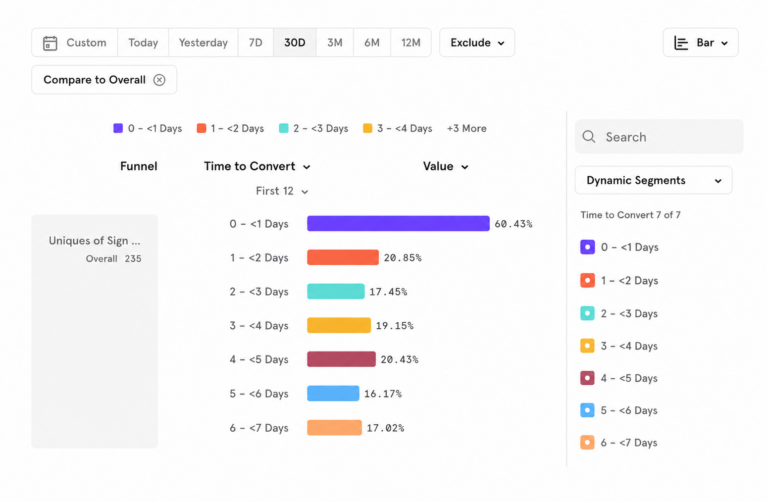
Question 2: What’s the average time-to-value (how long to reach our “aha moment” event)?
Understanding average time-to-value is the first step to helping users reach value faster. With this data, PMs can spot friction in onboarding or early product flows and use the information to evaluate whether product changes facilitate users reaching the “aha moment”.
Data analyst
B2B SaaS data analysts use MCP to connect product usage data with context from other platforms without repeatedly pulling data or manually building out every query, report, and dashboard. Natural language prompts allow analysts to spend more time on deeper analysis and strategic insights.
Question 3: Segment all users by company size and show engagement metrics for each.
Segmenting data by company size reveals whether users from different-sized companies have different activity levels in the product. Depending on what the data shows, the findings can inform decision-making for product, marketing, sales, and customer success teams, who can tailor their strategies and initiatives to various customers.
Question 4: What data quality issues exist? Events with low property fill rates or inconsistent naming?
This question helps data analysts uncover gaps and data inconsistencies that could make analyses unreliable if not corrected. Analysts can use the findings to prioritize tracking fixes and to standardize event and property naming when inconsistencies are found.
RevOps/Sales lead
MCP helps B2B RevOps and sales leads identify and qualify product-qualified leads (PQLs) by looking at their engagement behavior. They also connect product usage data with account and revenue context to understand which behaviors signal engagement, expansion, or churn risk.
Question 5: Which features are most used by accounts that expand within 12 months?
Here, RevOps and sales leads can use this data to identify product behaviors and feature usage associated with account expansion, giving them signals of upsell or cross-sell opportunities. They can also use the data to identify high-value accounts and prioritize outreach.
Question 6: Win rate for deals where the champion is a heavy user vs. outbound-sourced deals?
If strong product engagement from a sales champion is associated with higher deal win rates, then RevOps and sales leads have a potential product-usage signal for sales effectiveness. They can use that data to identify high-engagement prospects, refine PQL or lead-scoring criteria, and help sales teams prioritize accounts with stronger product signals.
Learn more
See more MCP questions and use cases for B2B SaaS in our docs.
Customer success manager
B2B SaaS CSMs use product engagement data to understand customer health and identify accounts that may need attention. MCP makes it easier to ask those questions, so that CSMs can quickly spot changes in usage and identify customers who are underusing key features. With these insights, they can personalize customer conversations and conduct proactive outreach.
Question 7: Health check for [Account Name]: WAU, feature adoption breadth, trend vs. baseline
This question gives CSMs a quick, data-driven view of an account’s current product health and whether engagement is improving or declining. It can identify accounts that need proactive intervention, make it easier to spot specific usage patterns, and uncover opportunities to promote adoption of underutilized features.
Question 8: Support event pattern for my top 5 largest accounts?
With this data, customer success managers can identify recurring support-related behaviors across their most important accounts. This reveals spikes in usage of different features or patterns, indicating friction that CSMs might otherwise have missed. It can also make it easier to spot common adoption or engagement issues across high-value accounts before they become bigger retention concerns.
Engineering lead
B2B SaaS engineering leads can use Mixpanel MCP to connect the technical work their teams are doing with actual user behavior. This gives them better visibility into how product changes affect adoption, engagement, and retention, and allows them to use that data to identify underused or problematic features, validate the impact of releases, and spot areas where engineering effort could have the greatest user impact.
Question 9: After our last deploy, did error event volume or rate change?
Asking this question allows engineering leads to monitor deployment impact, so that they can spot whether a release may have introduced issues. It’s valuable to correlate errors with affected user segments or features and determine whether further remediation is needed. It can also validate when a release is reducing error rates and improving product reliability.
Question 10: Which platform has the highest crash or error events per session?
Engineering leads can use this question to spot platform-specific reliability issues. Having this data makes it easier to prioritize debugging and engineering resources and focus testing where it is most needed. In the long run, it can also help teams measure whether platform-specific fixes are improving product reliability.
Instead of spending hours digging through dashboards to understand an incident, today we can ask a question and get the full story, from user impact to potential root cause, in minutes.”
Randi Waranugraha
VP of Engineering at DANA
Executive
For B2B SaaS executives, MCP combines product and customer signals with business performance, without execs having to build custom reports to answer every question. They can track trends in adoption, engagement, and expansion and use natural language queries to connect those insights to broader business goals.
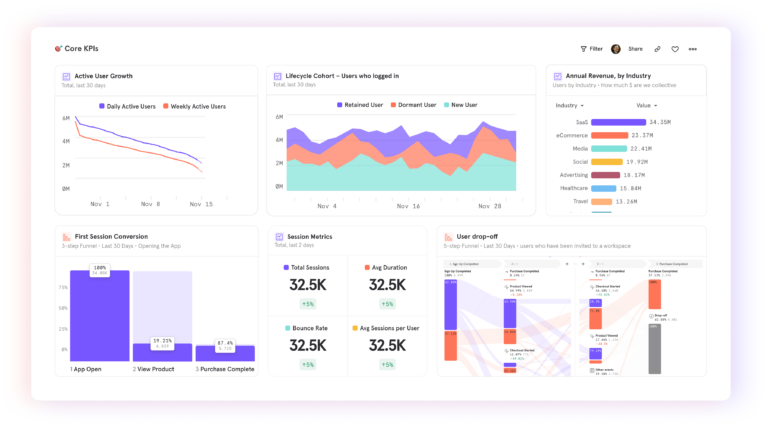
Question 11: Company dashboard: WAU, DAU/MAU ratio, activation rate, trial conversion, net retention (week-over-week and quarter-over-quarter)
Asking MCP to create a dashboard like this gives B2B SaaS executives a concise view of key business metrics and trends over time. They can use that information to track product signals and focus leadership discussions and initiatives on areas that need attention.
Question 12: Free-tier engagement vs. paid — are we converting our most engaged free users?
The answer to this question connects product engagement to revenue growth. This gives executives insights into behaviors that are associated with free users becoming paying customers, and helps uncover potential opportunities to improve conversion. It can also inform decisions about product-led growth and pricing strategies.
The biggest unlock [with MCP] is that our AI agents now have the same data literacy as a senior analyst.”
Zohar Amouyal
Founder at SKIO Music
MCP takes you from question to answer faster
MCP helps the entire B2B SaaS team turn their product data into answers, without adding another analytics workflow. Once you’ve got your initial answers, use our sample prompts documentation to go even deeper with questions like:
- What’s the funnel from trial to activation milestone to upgrade conversation to paid conversion?
- What’s the engagement pattern in the 2 weeks before upgrade?
- Show me the impact of our last release: new feature adoption and retention change.
- Which enterprise trials invited 5+ team members? Those are strong signals.
- Accounts only using 1–2 features — these are shallow adoption and at risk
Combining data from different sources and querying it with natural language offers a more complete picture of your data, faster.
Connect Mixpanel to your data sources via MCP and start asking today, or book an MCP demo to learn more.
Analytics for everyone.
Senior Content Marketing Manager @ Mixpanel