Most product questions come back to three things. Who is actually using your product? Did the change you shipped work? And how do you hold on to what you learned, so the next decision is easier than the last one?
None of those questions are new, but the answers are getting harder to reach. More of your traffic doesn't come from people. More of your team's analysis runs through AI tools. And there’s more code being produced than ever, so how do you make sure you're building and shipping the right things?
Here are six updates to Mixpanel that each close one of those gaps.
Discover: Understand who's using your product
Separate human, bot, and agent traffic with Agent Classification
Who is actually using my product?
More than half of internet traffic is now automated, and AI agents are the fastest-growing part of it. For years, the standard advice was to filter bot traffic out so it didn't skew your numbers. That still makes sense for scrapers and crawlers. But a growing share of that traffic is AI agents doing real tasks for real people, and filtering them out means losing sight of how your product is actually used.
Agent Classification labels the traffic in your Mixpanel data as human, bot, or AI agent. Use it as a breakdown or filter in any report, compare funnels by traffic type, or pull up replays of agent sessions only. And if you'd rather keep bots out of your data entirely, you still can.
Measure the AI agent you built with Agent Intelligence
Is our agent actually helping?
Agent Classification is about agents that show up to use your product. Agent Intelligence is about helping you gain insights on the agent you’ve built in your product, most importantly: Is our agent actually helping our customers accomplish what they’re trying to do?
Agent Intelligence brings your agent's traces into Mixpanel, right next to the product data you already track. Open any conversation to see every turn and tool call, track cost, latency, and errors without building a dashboard, and use agent events in Funnels, Retention, and Experiments. So you can answer the question that matters most: Do users who talk to your agent convert or retain better?
Experiment: Make every test count
Plan experiments with more confidence using our sample size calculator and your own data
How long should this test run?
Working out how many users or how much time a test needed used to mean leaving Mixpanel, looking up your metric's baseline, and typing numbers into a separate calculator by hand.
Mixpanel's sample size calculator automatically pulls in your actual conversion rates and traffic, so you can get more accurate estimates without manually gathering and entering data.
Simply choose your primary metric, set your minimum detectable lift, confidence, and statistical power, and Mixpanel calculates the sample size and estimated duration you'll need. You'll also get a quick assessment of whether your timeline is realistic, with the option to apply the recommendations directly to your experiment in one click.
The sample size calculator is available today. Learn more.
See how experiments impact your key metrics with Experiments on Boards
Where do I check how the test is going?
Track how your tests are performing alongside the KPIs and reports your team already monitors. No more jumping between pages to piece together what's happening.
Add any experiment to a Board to see key details like primary metrics and lift by variant, exposures over time, variants, and hypotheses. Each card stays in sync with the experiment's settings and date range, so you're always looking at consistent results.
Experiments on Boards is available today. Learn more.
Grow: Keep building on what you learn
Start in Claude and go deeper in Mixpanel with Claude Dashboards
Can I get answers without switching tools?
Your teams work across a lot of tools, and Mixpanel should meet them where they already are. With Claude Dashboards, you can start an analysis in Claude and go deeper in Mixpanel with cohort breakdowns, root-cause analysis, Session Replay, etc.—without losing the thread.
Pick up where you left off with User Memory
Why do I have to explain this again?
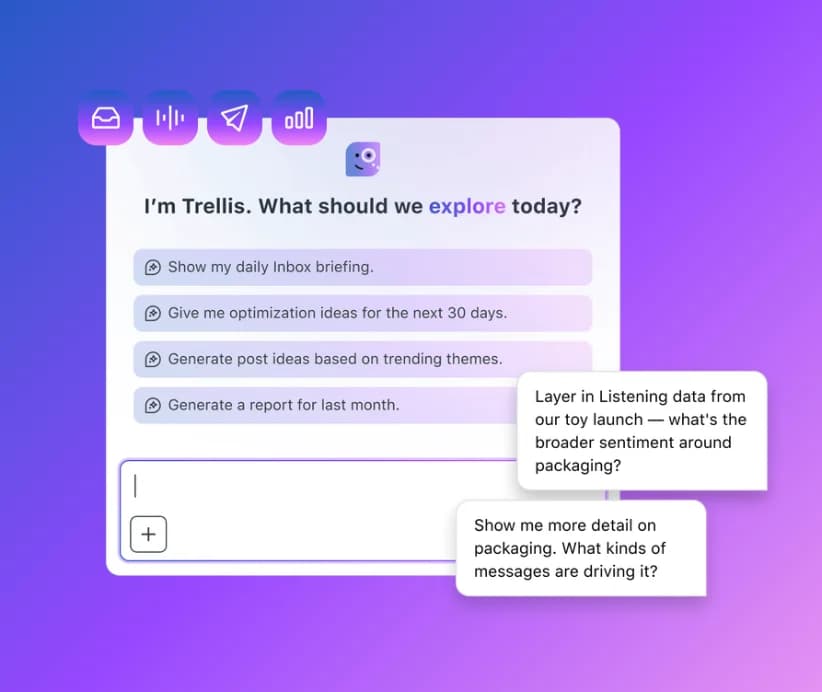
Every time you come back to Mixpanel, you shouldn't have to start from scratch. With User Memory, Mixpanel AI builds on your previous conversations and learns your role, your team, and how your data is set up. You spend less time repeating context and more time going deeper on your analysis. And you stay in control: You can ask what it remembers, correct it, or tell it to forget.
More availability details for User Memory are coming soon.
Different questions, same goal
None of these updates share a single theme beyond this one: Each removes a reason a team might stop short of an answer. You can't see who's using your product. You don't know how long to run the test. You have to re-explain your data to an AI tool for the fifth time.
Those are small things on their own. Together, they decide how fast a team learns.
If you want everything that's shipped recently, it's all in the changelog.