There’s a moment in every architecture shift when the surface changes and the backend stays. Jony Ive made the iMac case translucent because the engineering underneath was finally worth showing off. The same principle holds in headless architecture: once the back end is right, the surface in front of it becomes personalized and the beautiful internals can be shown off. Web, app, voice, whatever comes next.
The surface that’s just arrived is the biggest one yet: natural language. When you can reach your systems by describing what you want, the interface is an LLM and no longer a screen. Your backend lights up anywhere language is understood, whether that’s Claude, Cursor, or an agent someone on your team built last week. Agents are becoming how work gets driven, reaching straight into the systems you spent years getting right. That’s the opportunity, but the problem is what happens next.
Everyone is building, and no one has the full picture.
Users arrive one at a time, but agents arrive everywhere at once. The number of specialized agents has more than doubled in the first half of 2025 alone, with projections suggesting over one billion active agents worldwide by 2029. Your sales ops team deploys in one platform, your engineers build in another, and HR pilots something in a third. Each team picks its own models, its own tools, and its own systems of record. Innovation happens, but it happens in isolation.
The result is a gap between investment and return that most IT organizations are feeling. According to our MuleSoft research report, 64% of IT leaders report being concerned about meeting their AI implementation goals. AI is spreading faster than organizations can operationalize it. When you dig into why the return isn’t showing up, three barriers come up again and again.
First, action. Most agents can reason, but they can’t act through enterprise systems. They generate text. They don’t complete transactions, update records, or move work forward.
Second, governance. Too few agents make it into production because there is no consistent way to secure and govern them. Security and compliance teams cannot sign off on what they cannot inspect.
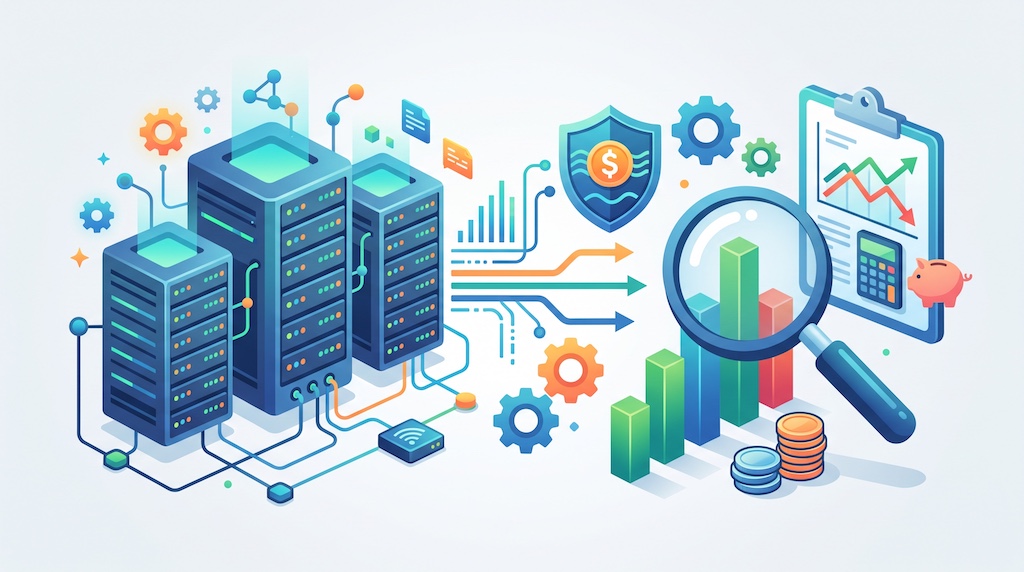
Third, cost. For the agents that do reach production, token spend outpaces value with no ceiling. Premium models handle work that cheaper models could do. Usage runs unchecked. The bill grows faster than the outcomes. You can’t solve this agent by agent, as that’s how the sprawl started.
One layer of control between asking and acting
What’s missing is not another agent. It’s a single layer of control between everyone who is asking and everything they are acting on: an AI control plane. APIs and MCPs are the tools that carry a request to a system and bring the answer back, and the control plane sits above them, deciding whether a request is allowed, where it should go, and recording what actually happened.
On one side is everyone who wants to act on your enterprise: your people, your applications, and now your agents. On the other side is everything they need to reach: systems of record, data, models, and increasingly other agents. The control plane governs every interaction, whether agent to system, agent to tool, or agent to agent, so each one is authorized, routed, and logged from one place.
Four layers on a shared foundation
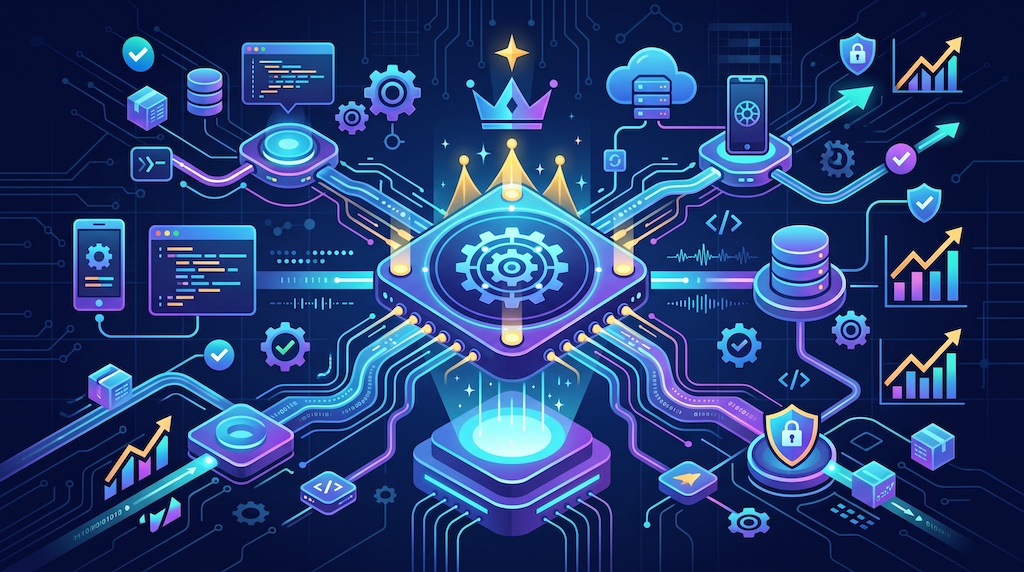
The control plane is built on four layers, each resting on a shared foundation.
Registry is the first requirement. One catalog of every agent, every API, and every tool across your estate, regardless of platform. Scanners feed the registry through automated discovery, continuously finding and cataloging new agents and tools as they appear.
Governance is the checkpoint. Every request passes through the AI Gateway. This is where you enforce identity and access, screen for sensitive data before it reaches a model, set rate limits, and apply one set of policies across every model, agent, and API. The reason most agents never leave the pilot phase isn’t the model, it’s that no one can prove the agents will behave. When every request is authenticated, screened, and bound by policy at a single checkpoint, security and compliance teams get the evidence they need. The gateway is also the first cost lever: policies cap runaway usage, and semantic routing sends each request to the right-sized model so you stop paying premium prices for cheap work.
Orchestration is where work gets done. A request arrives, often in plain language, and this layer reasons about intent and routes it to the best-fit agent or tool. Instead of guessing, it matches the task to the right capability. Autonomy scales from fully scripted and deterministic to fully open-ended, depending on what the work demands.
Visualization answers the question every leader eventually asks: what is all of this actually doing? A live map of your agent landscape shows request flow in real time, traces the exact decision path an agent took, and surfaces insights before something goes wrong.
None of these layers stand alone. They rest on a shared foundation: trusted data so agents reason on real context instead of guesses, a single identity and access model so permissions mean the same thing everywhere, and compliance and monitoring so everything is auditable. One foundation, four layers, and one system.
Control plane for the agentic enterprise
That’s the reference architecture in its simplest form. On one side, anyone or anything that can ask a question or trigger work: your people, your applications, and your agents. In the middle, one plane where every agent is discovered, governed, orchestrated, and visualized. On the other side, all of your systems of record, data, and models, reached through a single controlled path. The architecture isn’t a new product you bolt on, it’s a layer that sits between asking and acting, making sure every interaction is visible, authorized, and accountable.
You can finally see everything, act through it, get it to production, and align cost to value. That is what Agent Fabric is built to be: the control plane for the agentic enterprise. One place to gain visibility into every agent, API, and MCP, turn AI into action, get more AI into production, and keep every dollar of AI spend tied to real value.
Watch the video for the full architecture walkthrough.