AI adoption has reached the point where people are getting real value from it, but turning those individual wins into business outcomes is getting harder.
That gap is what we set out to understand in The State of Intelligent Collaboration, our study of 9,500+ leaders and employees across North America, Latin America, Europe, and Asia-Pacific, run in September and October 2026. We asked people to assess their own AI maturity, how far along their organization is with AI implementation, and to tell us what’s getting in the way of the business gaining real value at scale from AI. Here’s what we found.
AI maturity in 2026: a global snapshot
We took a snapshot of AI maturity on two fronts: how people use AI themselves, and how far along their organization is with implementation.
Organizations are forging ahead with AI implementation. While 16% of respondents say their company is still experimenting ad hoc and 24% have moved into early pilots, over a third say AI is now embedded in select processes with defined ownership. A quarter say it’s scaled across functions or has transformed their operating model.
While adoption is growing on the ground amongst workers, individual AI maturity is a mixed picture: 64% of knowledge workers use AI mainly for information or task assistance, asking questions or getting first drafts to build on. Only the most advanced 17% have reached partly or fully autonomous workflows.
The jagged frontier of AI across regions and industries
AI maturity varies widely by region and industry, and there’s a common thread: the further ahead an organization is with AI implementation, the further behind its people tend to be. In the race to drive company AI mandates, are we investing enough in employee enablement?
“Rolling out AI tools is the easy part. The efficiency gains only show up when organizations take responsibility for bringing the hesitant majority along, and start measuring fluency instead of licenses. My own approach: launch AI lighthouse projects on real business problems, then open up the playbook in internal sharing sessions, so colleagues see it working before they are asked to change how they work.” Strategy leader at an aviation company
“Rolling out AI tools is the easy part. The efficiency gains only show up when organizations take responsibility for bringing the hesitant majority along, and start measuring fluency instead of licenses. My own approach: launch AI lighthouse projects on real business problems, then open up the playbook in internal sharing sessions, so colleagues see it working before they are asked to change how they work.”
Strategy leader at an aviation company
AI has improved productivity, but fragmentation blocks organizational impact
Individually, people are more capable than ever: 83% agree AI has made individuals more productive, and 73% say their speed of output has increased. But only 56% say quality has improved, and most have yet to see improved decision-making or collaboration.
One reason is that adoption scaled quickly but independently — each person with their own tools, chat histories, and workflows. Sixty-nine percent of respondents say most AI-assisted work happens in private sessions rather than shared spaces.
“We’re putting out stuff that looks and feels convincing, but has fundamental thinking and conceptual flaws. And this is the dangerous bit — by following that route, we have collectively bypassed our own understanding of what we’re building.” Head of Product Design at a hardware company
“We’re putting out stuff that looks and feels convincing, but has fundamental thinking and conceptual flaws. And this is the dangerous bit — by following that route, we have collectively bypassed our own understanding of what we’re building.”
Head of Product Design at a hardware company
At the top: misalignment and AI governance challenges
Half of leaders struggle with informational and functional silos, and over two in five cite technology silos. The consequences are consistent:
- Slow, uninformed decisions: 47% call out slow decision-making, 45% point to longer review and feedback cycles, and 44% have seen decisions made without all the relevant context.
- An inability to govern and scale AI: 40% of leaders rate their visibility into adoption, usage, and best practices as poor or non-existent, and between 53% and 58% flag privacy, compliance, security, and governance as top challenges.
On the ground: increasing cognitive strain, declining well-being
For survey respondents, day-to-day work with AI is still taking shape, and there’s real friction:
- More to review: 59% report more AI-generated output to review and 55% report more AI slop. Some now push reviews through AI, too. A Product Manager noted that “the outputs you would normally get from a human review have changed.”
- More context switching: 44% say it has increased in the past 12 months.
- Worries about roles and culture: 60% say AI has blurred previously distinct roles, 47% worry roles may merge, and 44% say company culture has become less collaborative. Nearly one-third say social connection with colleagues is decreasing, and one in five find work lonely.
AI workhubs are the new team homebase
Gartner® predicts that through 2027, use of enterprise AI assistants and agents will create the first true challenge to mainstream productivity tools in 30 years, prompting a $58 billion shake-up. Its new category, AI workhubs, consolidates fragmented collaboration tools into a single, cohesive AI interface, linking siloed data to cut context switching and cognitive load.
Two-thirds of decision-makers want one within the next 12 months. What they’re asking for:
- Integration: 67% say it’s important or critical that a workhub can surface information from any enterprise source, and 60% say the same of standardized protocols like MCP.
- Security and control: 66% rate enterprise-grade security and compliance as important or critical, and 64% see granular governance as a must-have.
- Flexible formats: 56% want editable outputs in any format, and 47% want high-fidelity conversions between them.
“Companies won’t win because they have the most co-pilots. The ones that win are going to be the ones that set governance they can stand by.” CEO of a professional services firm
“Companies won’t win because they have the most co-pilots. The ones that win are going to be the ones that set governance they can stand by.”
CEO of a professional services firm
A digital canvas is the critical foundation for AI workhubs
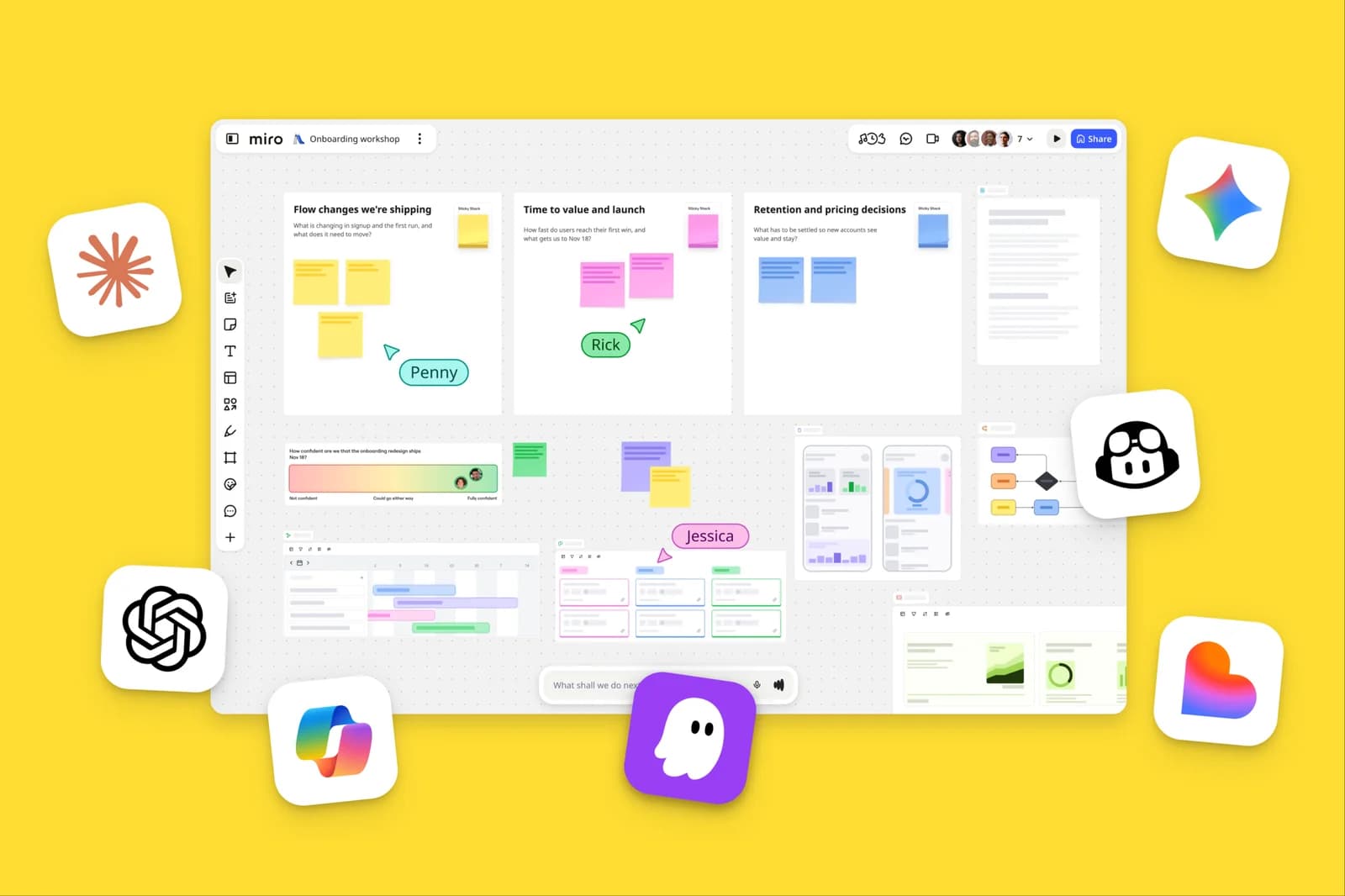
Gartner notes that multimodal human collaboration facilitates real-time and asynchronous collaboration within a central canvas, featuring rich presence, granular version control, and comprehensive change management for transparent, accountable co-authoring. And 53% of decision-makers agree that’s an important or critical capability. A Product Manager described working in Miro: “At the end, there was no surprise for anyone when we released something; it is exactly what they saw and what they expected.”
What leaders and employees expect
Over half expect faster, more informed decision-making. Others expect better alignment, less context switching, and less rework. Leaders are looking beyond individual gains: 54% expect better individual and team productivity, 43% better cross-functional collaboration, and 50% the ability to scale AI workflows and best practices.
Recommendations
- Prioritize team impact and alignment as the real measure of AI transformation success. Individual gains stay siloed, because according to 69% of respondents, most AI-assisted work happens in private sessions rather than shared spaces. To tackle this, make shared workflows the unit of AI adoption, rather than individual tool preferences.
- Build in visibility and governance as a default. Between 53% and 58% of leaders indicate that AI governance, security, privacy, and compliance are top challenges. Establish clear ownership, audit what’s already in use, and treat governance as the enabler of scale rather than a brake on it.
- Invest in the people side of AI transformation. Pair AI mandates with real employee enablement, and ease the review burden, AI slop, and role blurring experienced by up to 60% of employees. Clear expectations will protect well-being and yield results.
- Consolidate fragmented tools around a shared AI workspace. Sixty-six percent of leaders are interested in implementing an AI workhub in the next 12 months. To pick the right one, evaluate AI workhubs that connect enterprise data, support open standards like MCP, and give people and agents a shared canvas.
In this study, Miro conducted an online survey of 9,500+ leaders and employees from cross-industry product development, IT, operations, and other functions based in North America, Latin America, Europe, and Asia-Pacific to understand the current state and challenges of AI transformation at their companies, and their views on AI workhubs. Respondents were offered a small incentive as a thank-you for time spent on the survey. The study began in September 2026 and was completed in October 2026.
Gartner is a trademark of Gartner, Inc. and/or its affiliates.