Article
The TL;DR
Reach more guests, maintain your sanity. A channel manager automates updates so you can focus on revenue, not extranets.
The room you sold on Booking.com at 9:02 a.m. is still showing as available on Expedia at 9:03, and that one-minute gap is where double bookings are born.
Guests can’t book a room they can’t find, and nobody forgives a room that’s already gone. If you’re still logging into a separate extranet for every online travel agency (OTA), you’re spending your precious hours on copy-and-paste work and still risking costly mistakes.
A channel manager closes that gap. It syncs your inventory, rates, and restrictions across every sales channel in real time, so one update in your dashboard reaches all of them, and every new booking updates room availability everywhere else.
This guide covers what a channel manager is, how it works, what to look for, and how the top providers compare, whether you run a boutique hotel, a hostel, a portfolio of vacation rentals, or a multi-property group.
Key takeaways
- A channel manager syncs rates, availability, and restrictions across every OTA, metasearch, GDS, and your booking engine in real time.
- Pooled inventory, clean room mapping, and two-way API connections are what prevent double bookings and overbooking.
- Selling on about five to six well-chosen channels is the sweet spot, and direct bookings stay the margin you protect.
- A channel manager is the delivery system for your pricing strategy, and it makes rate parity and dynamic pricing practical.
- A platform that puts your PMS, channel manager, and booking engine on one data layer means fewer logins, fewer errors, and faster updates.
- Consistent, accurate data across channels matters more as AI assistants start recommending and booking hotels.
What is a channel manager?
A channel manager is software that keeps your room availability, rates, and restrictions in sync across every online booking channel you sell on, automatically and in real time. Change a price once and it updates everywhere.
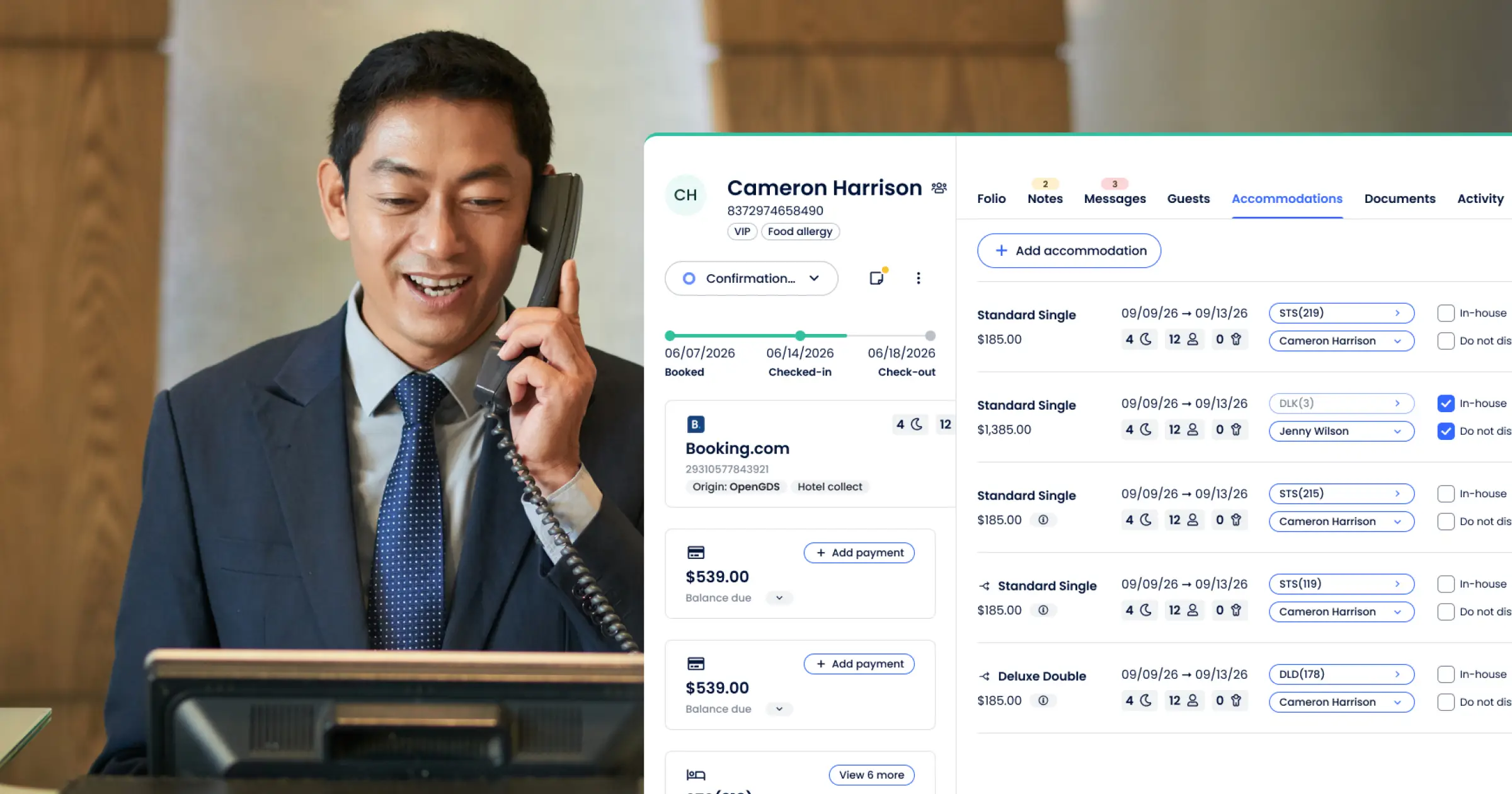
Instead of logging in to Booking.com, Expedia, Airbnb, and every other site one by one, you manage them from a single dashboard, usually inside your property management system (PMS). That means one source of truth for your inventory, no missed changes, and no overbooking.
Without channel management software, every property has to log in to the extranet of each online distribution site and make changes by hand. That caps how many channels you can realistically sell on, and it’s risky: a delay in updating a rate or availability could mean selling a room that isn’t available, or selling it too cheaply. The result is overbooking and weak yield management.
Channel management is the practice of actively managing rates and availability across your online booking channels, which can include:
- OTAs such as Booking.com, Expedia, Tripadvisor, and Agoda
- Metasearch engines such as Google, Kayak, and Trivago
- Global distribution systems (GDSs) such as Amadeus and Sabre
- Bed banks and wholesalers such as Hotelbeds
- Your own booking engine and website
Channel manager vs. PMS vs. booking engine vs. RMS
These four tools often get mixed up. They work best as a team, and here’s how the jobs divide.
How does a channel manager work?
At its core, a channel manager connects your PMS (or central reservation system, CRS) to all of your online sales channels: OTAs, metasearch, GDS, and your own booking engine.
When you update a nightly rate, close a room, or change a restriction in your main dashboard, the channel manager pushes that change to every connected channel. When a booking or cancellation comes in from any channel, it updates your availability everywhere else, so you never sell the same room twice.
In more technical terms, a channel manager uses two-way API connections (older connections use XML) to each channel. It pushes availability, rates, and inventory (ARI) updates out and, with two-way sync, imports reservations and cancellations into your channel manager, PMS, or CRS.
With one-way sync, reservations and cancellations are not imported, so you’re back to manual updates. With an advanced connection, the whole loop takes seconds: the average new Expedia booking reaches the Cloudbeds Channel Manager within seconds.
Channel managers prevent inaccurate rates and double bookings with a pooled inventory model. All inventory lives in one place, and every booking draws from that single pool based on real-time availability updates to and from your property management system. Because the same room can’t be sold twice from one pool, overbookings don’t happen.
Three more jobs sit behind that sync:
- Allotment: allocates inventory across channels according to your goals, either from the shared pool or as fixed blocks for specific partners
- Channel mapping: matches each room type in your PMS to the format each channel requires, so rooms display consistently everywhere and reservations land in the right place with no duplicates
- PMS updates: delivers every new reservation straight into your PMS with no manual re-entry
Why is it important to use a channel manager?
You can manage inventory by logging into each extranet, but it’s slow and prone to human error. These are the top reasons to use a channel management system.
More reach, more occupancy
A channel manager puts your property in front of more travelers. Because connecting to a new booking site takes little time, properties of all sizes can reach new regions and segments that are hard to serve by hand. More booking sources mean more visibility, and more visibility means higher occupancy, especially in low-demand periods when you need it most.
OTAs also reward accuracy. They rank properties higher when availability, rates, and restrictions update in real time, so a faster sync can improve your position in search results.
Fewer double bookings
Double bookings cost you twice: the walked guest and the review that follows. Lords Hotel in London knows the feeling. At one point the team updated availability on 12 channels by hand, and by the time they reached the last one, the room they’d just opened had already been booked by two different companies.
After moving to Cloudbeds, the 65-room hotel brought its PMS, channel manager, booking engine, and website onto one platform and stopped re-entering 10 to 15 bookings a day. While it shifted away from fixed allocations toward demand-based pricing and connected distribution, revenue grew from £1.3M in 2019 to nearly £2.3M in 2024.
Before Cloudbeds, we were managing up to 12 channels manually. Now everything is in one place, and that has made a day-and-night difference.
Before Cloudbeds, we were managing up to 12 channels manually. Now everything is in one place, and that has made a day-and-night difference.
A shared-inventory setup adds another safeguard. If you sell the same room as a dorm bed or a private single, the channel manager automatically ensures that a linked room is never sold twice.
Smarter pricing and rate parity
Your pricing strategies are only as good as your ability to execute them everywhere at once. A channel manager is the delivery system for revenue management: your RMS recommends the rate, you accept it, and the channel manager makes it live on every channel in seconds.
With Cloudbeds RMS, built on Signals AI, accepted recommendations push through the PMS to every channel, and Autopilot can accept and push recommendations automatically within guardrails you set.
That speed matters for dynamic pricing, because demand shifts by the hour. It matters for rate parity too. Rate parity means offering the same rate for the same room on every channel, including your own website, and it’s harder to hold than it sounds: in the 2026 European Hotel Distribution Study from HOTREC, one in two hotels reported that OTAs sell rooms below the hotel’s own direct price at least occasionally.
When your channel manager controls every rate from one place, you can spot gaps quickly, keep your direct rate competitive, and give metasearch ads a rate that wins the click.
More direct bookings
It’s counterintuitive, but selling on more channels can lift direct bookings. A guest who finds you on an OTA often searches your name and books on your website, a pattern known as the billboard effect. Wider reach means more of those moments.
The goal is a healthy mix, not an OTA exit. In our 2026 State of Independent Hotels report, OTAs delivered 63.4% of independent hotel bookings in 2025, and 21.8% of OTA bookings were canceled compared with 10.6% of direct bookings. Every point of mix you shift toward your booking engine means lower commissions and a more predictable book of business.
Time, money, and a better guest experience
Every extranet has its own interface, and updating them several times a day adds up to real payroll. One view gives you granular control over distribution costs: fill demand with lower-cost channels first, then move inventory to higher-cost ones to fill gaps.
Stop guessing your channel strategy.
Not every OTA deserves your time or margin. Learn how to use each on your own terms.
How many channels should you sell on?
A sophisticated channel management strategy is built on a diverse mix of high-performing channels, not the highest count. Each OTA has its own commission structure, so a profitable distribution strategy means choosing which channels to use, how much inventory to give each, and how to adjust the mix as demand shifts.
Cloudbeds data points to a sweet spot of about five to six channels:
If you go from two channels to three distribution channels, you’re seeing about a 70% lift in revenue growth. And after three, each additional channel lifts you up about 12% in revenue — that tends to level out at six channels.
If you go from two channels to three distribution channels, you’re seeing about a 70% lift in revenue growth. And after three, each additional channel lifts you up about 12% in revenue — that tends to level out at six channels.
What to look for in a channel manager
The best channel managers connect reliably to hundreds of booking sites with near-perfect uptime. Here’s what to weigh.
Connectivity
Look for two-way API connections that update in real time. The system should be cloud-based, which removes on-property hardware, and it should be built to handle millions of bookings per day.
Channel partners
Choose a provider that connects to the channels your guests actually use: major OTAs, niche OTAs, metasearch, GDS, and wholesalers.
Cloudbeds connects to 450+ global, regional, and niche channels with zero added commissions from Cloudbeds. Ask any provider whether they charge extra for connections or commissions on bookings.
Functionality and inventory management
Simplicity matters, because a tool your team avoids isn’t saving you anything. Beyond ease of use, look for:
- Rate, availability, and restriction updates in bulk, with rate plans per channel
- Allotments, closeouts, and pooled inventory controls
- Multi-currency support and per-channel pricing
- Reporting on channel performance and cost of acquisition
- Payment processing and multiple user roles
PMS and booking engine integration
Your channel manager should integrate tightly with your property management software and booking engine so that all your hotel management systems share the same data and you log into one place instead of three.
Scalability
A tool that works for one property should still work for ten. Check how easily you can add properties, copy settings, and report across a portfolio, and whether new channels can be switched on without a project.
Channel managers and property management systems
Your PMS is your hotel’s control center: reservations, check-in and check-out, rates, payments, guest communication, and reporting. The channel manager is the distribution engine that pushes availability, pricing, and restrictions out to every booking channel and pulls reservations back in.
How the two connect can make or break your efficiency. There are three main setups.
1. Platform approach
With a platform built on a unified data architecture like Cloudbeds, the PMS and channel manager are one product built on the same data layer, not two products joined at the login screen. That unified architecture is what makes the difference:
- One login and one dashboard for operations and distribution
- Real-time updates, so a rate change or closed room reaches every channel instantly
- Full feature alignment across amenities, photos, rate plans, and promotions
- Faster OTA updates, because one connectivity team applies and tests API changes in your main system
- More built-in tools, including a commission-free booking engine, payments, and marketing tools
- One support team, one partner to call, and one agreement to manage
Jason from Premier Advisory Group, who guides hotels through technology transitions, said it on The Turndown:
Watch the full episode.
Jason Edwards on what happens when new technology hits the front desk.
Watch now
2. Separate PMS and integrated channel manager
Some properties pair a PMS and channel manager from different vendors through an integration. That can work well when:
- The integration passes data in real time without delays
- You can manage two vendors, two support teams, and two contracts
- You double-check compatibility, since OTA updates must be applied on both sides
Cloudbeds supports this setup through integration partners.
3. Channel manager without a PMS
You can run a channel manager alone, but you’ll handle key operations manually: guest check-in and check-out, housekeeping coordination, invoicing, and reporting. You’ll need to decide where guest and payment data lives, how you’ll track reservations internally, and how you’ll message guests. It can work for very small properties, but most outgrow it fast.
What to look for in a channel manager for specific OTAs
Each major channel has its own quirks, so check for channel-specific depth, not just a logo on a list.
Booking.com
If Booking.com is one of your main OTAs, look for:
- 2-way API connection
- Rate parity adjustment
- Pooled inventory management
- Advanced rates integration
- Guest credit card integration
- Advanced tools such as messaging and no-show reporting
Check whether your vendor has earned a place in Booking.com’s Premier and Preferred partners program. Premier is the highest category for software companies with best-in-class connections, judged on how robust, fast, and stable the connection is, how well the vendor adapts to Booking.com products, how many properties are connected, and more.
Airbnb
If you list on Airbnb, or plan to, look for:
- 2-way API connection
- Content and image synchronization
- Taxes, fees, and pricing rules support
- Advanced pricing features
Airbnb is also evolving as a distribution channel in its own right. In August 2025, CEO Brian Chesky told financial analysts that the company is planning to go “significantly more aggressively into hotels,” increasingly positioning the platform as an alternative to traditional hotel booking sites rather than only a short-term rental marketplace. That makes strong connectivity even more important if you sell there.
Airbnb recognizes vendors that meet its technical benchmarks through its Preferred Software Partner program, so look for a Preferred Partner for the most reliable connection.
Expedia
Expedia Group’s family of brands is a key source of volume for many hotels. Look for a vendor with a strong record in Expedia’s connectivity partner program, fast reservation delivery, and careful rate-plan mapping, since mapping mistakes are the most common source of Expedia headaches.
Channel management in the age of AI
Search is changing, and distribution is changing with it. Travelers are asking AI assistants where to stay, and OTAs feed those answers. In our own study of AI hotel recommendations, more than half of all citations came from OTAs, which provide the structured, real-time rates, availability, reviews, and descriptions that AI models rely on.
For channel managers, that raises the stakes on data quality. Keep room descriptions, amenities, pricing, and images consistent across every channel, and use the same property name everywhere, so AI engines treat your listings as one trusted entity instead of several confusing ones.
Getting listed on niche and regional OTAs helps too, because AI assistants often cite specialist sites for specialist trips.
For an AI agent to book you, it needs live access to your rates and availability, a payment rail, and a confirmation system that talks to your PMS. That’s exactly the plumbing a unified platform keeps in one place, and a good reason to treat your channel manager as part of your future-ready tech stack, not a standalone utility.
What to consider when choosing a provider
Ask these before you sign:
Pricing model
Per-booking commission, flat subscription, or setup fees? Commission-based or channel-based pricing gets complicated and costly fast, and Cloudbeds adds zero commissions on any channel in its marketplace
Onboarding and support
How long does onboarding take, and who answers when something breaks on a Friday night?
Industry recognition
Major OTAs run partner programs for vendors that meet their technical benchmarks, and Cloudbeds holds Booking.com, Expedia, and Airbnb partner recognition
Security and compliance
Ask about data security, PCI DSS, SCA, and GDPR
Reviews and trials
Check online reviews on Capterra, Software Advice, and Hotel Tech Report, and ask for a free trial or demo account
9 best channel managers for hotels
Here are nine of the best options worldwide.
Cloudbeds
The Cloudbeds Channel Manager provides real-time, two-way API connectivity to 450+ global, regional, and niche booking channels, including major OTAs, metasearch platforms, and niche marketplaces. Rates, availability, inventory, and restrictions sync instantly from one dashboard, while reservations and cancellations flow straight into the PMS.
What sets Cloudbeds apart is that distribution isn’t a silo. Inventory, rate plans, promotions, payments, and guest data sit on the same data layer, so you can manage distribution as part of a broader revenue and guest strategy, not as a separate login.
SiteMinder
SiteMinder is one of the best-known channel managers worldwide and part of a broader hotel commerce platform that includes a booking engine, metasearch, payments, and GDS access.
D-EDGE
D-EDGE provides a 360-degree suite of solutions that covers all stages of hotel distribution.
HotelRunner
HotelRunner is a cloud-based channel management platform that promotes top-tier connectivity partner status with Booking.com, Expedia, and Airbnb.
Hotel Trader
Hotel Trader is an all-in-one distribution platform that gives hotels transparency, autonomy, and actionable data.
Profitroom
Profitroom delivers award-winning booking technology, marketing automation, and guest experience tools built to boost your direct revenue.
RateGain
RateGain pairs channel management with pricing and rate intelligence. It ranks among the top-reviewed channel managers for large hotels on Hotel Tech Report.
RoomBeast
RoomBeast connects you with the most important B2B wholesalers in your market.
STAAH
STAAH is a cloud-based platform offering channel management and website solutions, with a strong footprint in Asia-Pacific.
How Sweet Accommodations scaled distribution without losing control
Starting as a single hostel in Barcelona, Sweet Accommodations has grown into a diverse portfolio of hotels, hostels, serviced apartments, and co-living spaces across Barcelona, Sevilla, and Lloret de Mar. As the business expanded, managing availability and rates across multiple property types and booking channels became a challenge.
Their legacy systems made distribution harder to manage at scale, limiting flexibility and raising the risk of errors as the channel mix grew.
By switching to Cloudbeds, Sweet Accommodations centralized distribution with a modern, API-driven channel manager that keeps rates, availability, and inventory synced in real time across major OTAs and niche platforms. That let the team go beyond “sell everywhere” and focus on the channels that best matched their guests and locations.
We can connect our channel manager directly to co-living.com, which is unique, as most booking systems only integrate with general platforms like Booking.com or Expedia. With our focus on specific regions — like our proximity to France — we can connect with niche platforms that target these audiences. This gives us an edge in reaching the right guests.
We can connect our channel manager directly to co-living.com, which is unique, as most booking systems only integrate with general platforms like Booking.com or Expedia. With our focus on specific regions — like our proximity to France — we can connect with niche platforms that target these audiences. This gives us an edge in reaching the right guests.
The results speak for themselves. With distribution automated and centralized, Sweet Accommodations saw an:
–80%
reduction in manual work
+20%
increase in upsells & repeat bookings
Take back control of your distribution.
See how Cloudbeds helps you scale reach and sell smarter across channels.
Book a demo
FAQs
2-way synchronization refers to the connection between a Channel Management software and a booking platform (OTA, GDS, metasearch, etc.) by which your availability, rates, and inventory, and often property content are kept up-to-date. It’s also how bookings and cancellations are synced between individual channels and the Channel Manager.
Allotments are blocks of pre-negotiated rooms that are bought by a third party, such as a wholesaler, tour operator, hotel consolidator, travel agent, OTA or event planner. Allotments can be managed within a partner’s extranet or via a centralized channel manager.
A closeout is when a room type, booking site, or market segment is closed to further bookings. Closeouts are used to optimize booking sources, revenue, and profitability.
API stands for Application Program Interface. It’s a “bridge” used for two separate tools to communicate and exchange data. API is what makes it possible for data to flow seamlessly and accurately across systems that may be owned and operated by different companies with different data formatting standards.
iCalis a media type that allows users to save and exchange calendaring and scheduling information such as events, to-dos, and free/busy information. You’ve likely seen a free version on your own personal or professional calendars.
Each channel has its own calendar, which reflects the bookings made on that calendar. There are two types of channel calendars: one-way and two-way.
One-way channel calendars are only able to receive availability, so you will have to manually adjust inventory for any incoming bookings coming from a one-way channel.
Two-way channel calendars can receive availability one way and send back bookings the other way. That means the calendar stays in sync much more reliably. Note: calendar channels are only able to connect to one room type at a time because of how the calendar URL system is designed.
Mappingrefers to the process of synchronizing a room or unit in a Channel Manager (or PMS) with its corresponding room in a booking site. Since each platform has its own formatting requirements, you must make sure that each room type or unit is mapped to each individual channel’s layout.
XML (Extensible Markup Language) is a programming language that’s designed to transmit data effectively. With XML, data flows to and from your Channel Manager in a format that is “readable” by third-party systems it’s connected to, such as OTAs.
Published on 16 October, 2026
About Linda Pashaj
Linda Pashaj is the Director of Content Marketing at Cloudbeds, the hospitality management software for properties of all sizes. Her previous experience includes running the operations of a small short-term rental agency in Barcelona, as well as content management for a vacation rental software. She is passionate about travel tech, digital marketing and “all things cats”.


![Hotel reputation management: 10 strategies to win more bookings [+12 software to know]](https://embed-ssl.wistia.com/deliveries/adcc3d2c534cadd3620abd3e3634ec95.png)