Welcome to This Week in Neo4j, your fix for news from the world of graph databases!
NODES 2026 just happened last week – and the first videos are already in our playlist. During the event, we announced Relate, a new open-source graph database that runs in-process/in-memory and speaks Cypher. For the launch, we are hosting a Hackathon (submit by December 11).
Also this week: have fun with GrapHRAG in a playable movie quiz and a guide to giving a Pydantic AI agent a graph to work with and remember.
Happy Graphing,
Alexander Erdl
PS: Join our Neo4j User Research panel! Sign up here to share your experiences with a researcher and influence the future of Neo4j products.What’s in it for you? A chance to connect directly with product development teams, get paid compensation, hear about what we are working on, and more!
- Livestream: Going Meta: S04E02 on December 1
- Conferences: Find us at Databricks Data + AI World Tour Milan on November 24, WeAreDevelopers India on November 25-26, reinvent on November 30 – December 4, AI Dev NYC on November 30 – December 1, ODSC AI on December 2-3, Adopt AI on December 3-4, Databricks Data + AI World Tour | Paris on December 8
- Meetup: Meet us in Bengaluru. IN on November 24, Indore, IN & Ahmedabad, IN on November 28, Bangkok, TH on December 1 & Nagpur, IN on December 12-13
- All Neo4j Events: Webinars and More
Emmanuela designs scalable, secure multi-cloud solutions (AWS, Azure, GCP) that turn complex business requirements into practical results, and mentors emerging tech talent through Code Your Future.
Connect with her on LinkedIn.
She was speaking at NODES 2026: “From Vector Search to GraphRAG: Architecting AI Systems That Actually Work in Production “, where she compared vector search and GraphRAG, covering knowledge graphs, retrieval orchestration, LLM integration, observability, and production strategies for accurate, explainable enterprise AI.
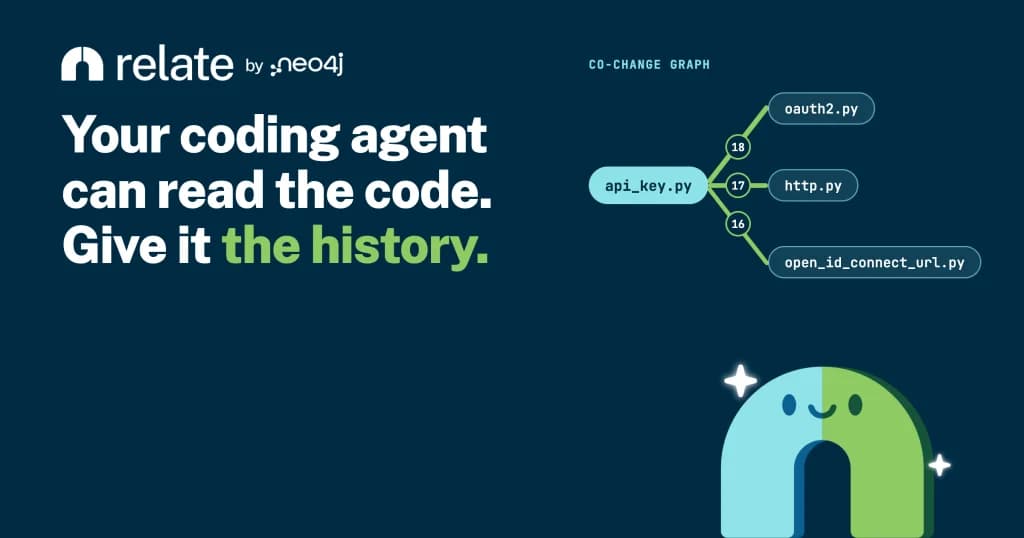
We are happy to announce Relate: a new open-source graph database that runs in-process/in-memory, with no server to set up, and it speaks Cypher, so agents can store what they learn as connected facts rather than loose text. In the demo, Claude Code audits the 24 direct dependencies of Google’s Agent Development Kit by building one small throwaway graph per package, where each package is a node and each “needs” link is a relationship. Learn more on and join our for your chance to win a Mac Studio!
Christoffer Bergmann turns his GraphRAG card game into a playable web quiz that shows the difference between plain RAG and GraphRAG. Players act as the LLM and can use a RAG lifeline (the top five cast of a movie) or a GraphRAG lifeline (the full path between movie and actor). All questions are generated on the fly from a Neo4j Aura graph built from Wikidata, which gives over half a million possible questions. The post also covers the Cypher side: one query shape takes minutes, while moving the uniqueness check after a random ordering returns an answer in seconds. Source code is on GitHub.
Kaustubh Darekar shows how to connect a Pydantic AI agent to Neo4j in two steps: first through the official Neo4j MCP server, plus typed custom tools, schema-validated answers, and human approval before risky queries run; then through neo4j-graphrag retrievers, where one Cypher retrieval query turns each matched text chunk into a dated passage linked to the companies it mentions. Persistent memory is also stored in the graph (via neo4j-agent-memory), so you can query, audit, and delete what the agent knows. Both parts come as notebooks in the neo4j-agent-integrations repo.
Vito Palermo helped build operating systems and hardware for the early internet, and he sees AI creating the same kind of distributed systems problem all over again. His stealth startup, Seismora, co-founded with Dino Farinacci, is an intelligent control plane that routes AI workloads across any network, neocloud, or edge device based on latency, sovereignty, and cost. Palermo calls it cognitive routing. He’s already living a small version of it at home, where a $300 camera and single-board computer spot the coyotes in his backyard and ask a hosted model what kind they are. Watch the interview
Are you building on graphs? The Neo4j Startup Program gives Series B and earlier startups up to $16K in Aura credits, time with graph engineers, and co-marketing, such as the interviews above. Apply now
- GraphAcademy: Get Started with Relate, our new open-source embedded graph database
- Learn on Your Schedule: Go deeper into graph intelligence on Neo4j’s On-Demand webinar library
- Workshops: Join our virtual classrooms workshops from Fundamentals to GenAI
- New Webinar: Designing Meaning: Integrating Ontologies Into Practical Graph Models – Americas, Europe, Middle East & Africa, Asia Pacific