We tend to assume that our chats are private because that's what we're used to.
We tend to assume that our chats are private because that's what we're used to.
AI can write the first draft of a performance review, but two steps around that draft still need a person. Before the prompt, the manager has to decide what stays out of it, and after the draft, the manager has to check it against what they know about the employee. Skipping the first step risks exposing sensitive information, and BambooHR's Redesigning Work report shows how common that is, with 71% of employees who use personal AI accounts for work having entered sensitive company information into tools their employer can't see. Skipping the second risks a review that reads smoothly and doesn't fit the employee. HR can't keep managers from reaching for AI, but it can give them a routine for both steps.
Kevin Anderson, SHRM-SCP, Senior Human Resources Business Partner at Riverside Research, is the dedicated HR partner to business unit directors and about 270 employees at a national security nonprofit. Before that he was a Global Human Resources Business Partner at Automattic, where he coached leaders on feedback and performance in a remote, asynchronous company. He has written a short set of rules for managers who use AI on performance reviews, and he lays out a routine that covers what to leave out of the prompt, what to add, and how to check the result before it goes to an employee.
"You still have to know what a good performance evaluation looks like. So you can then audit what you got from AI to make sure that it's accurate and fair and relevant and specific to the individual that you're writing it for," Anderson says. AI shortens the writing and leaves the standard for a good review with the manager. Anderson builds his routine around that, with a step before the prompt and a step after the draft.
AI earns its place in the dry middle of the review
Few managers enjoy writing performance reviews, and Anderson sees that as the strongest case for letting AI do the drafting. He says AI's strength is "taking the monotonous and very dry work and punching out the middle 80% for you." The manager usually has the assessment worked out already. "You have all the thoughts in your head and it just takes forever to translate them into the format that your HR team is looking for," he says.
The burden grows with team size. Supervisors with 10 or 15 direct reports have that many evaluations to write, and Anderson says that volume wears them down. He splits the job into three parts. The manager supplies the first 10% through the prompt, AI produces the middle 80%, and the manager owns the last 10%, the polish. The first 10% starts before anything gets typed, with a decision about what stays out of the prompt.
Rule zero is keeping real details out of the prompt
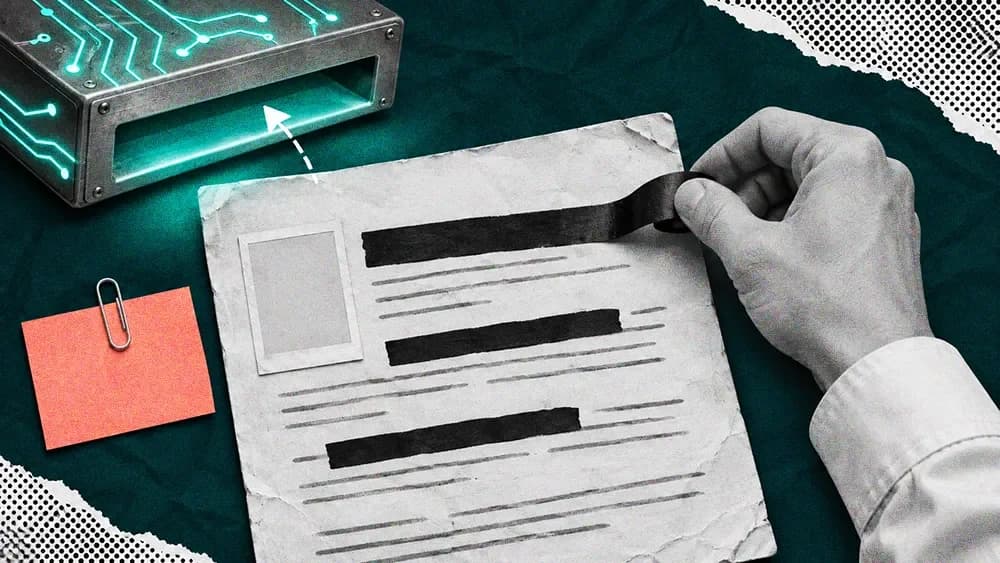
Anderson's first rule comes before the first prompt. He calls it Rule Zero, and the rule is to anonymize everything first. In practice, he says, the manager looks over the material quickly and swaps identifying details for code names. "Instead of using the individual's name, just call them Bob or Jane," he says. Projects become "Project A," and the company name comes out too. Merit increases are usually handled apart from performance evaluations, he adds, but where the two are combined, financial numbers stay out as well. Once AI has produced the first draft, the manager replaces the placeholders with the accurate details from the organization.
The habit runs against instinct because people treat a chat window like the one-on-one messaging they already use, Anderson says, and AI gets presented that way too. Behind the chat window, though, "there's a huge network of lots of interconnected computers that are all talking to each other." He treats that as a reason for caution. "Better safe than sorry," he says. The code-name pass keeps the time savings while limiting what goes in.
A specific prompt takes more work and returns a better draft
With the sensitive details out, Anderson turns to what the prompt should hold. He says good prompting "comes back to the old adage garbage in, garbage out." A one-line request to review an employee who's strong with people and missed deadlines gets a generic review back, in the same way a bare request for a job description gets a generic job description.
The fix is context, and he admits it adds effort up front. Managers should "take a little bit of extra time to add the context that you think is going to be helpful," he says. That can mean pulling specific items from a year of one-on-one notes, such as projects and learning goals, and running them through the same code-name pass as everything else. "The more context that you can give the AI, the more contextualized output that you're going to get," Anderson says.
The extra effort targets a cost the Redesigning Work report measured. Employees spend an average of 42% of their AI time on troubleshooting errors and prompt iteration, more than they spend on productive work, so giving AI context about the role and the company at the start goes after the biggest slice of AI time.
The last 10% is tone and the manager's own voice
Once AI returns the draft, Anderson's first check is tone, which matters most on constructive feedback, where wording can be hard to deliver sensitively. He has managers paste the draft back into the tool and ask how it reads. "Does this come across as too aggressive? Does this come across as too harsh?" he says. He offers a sharper version of the same prompt, asking whether the text sounds accusatory or focuses on intent versus impact. In his experience AI is a capable judge of tone.
The second check is voice. Wording that comes out stiff, polished, or corporate gets rephrased into the manager's own voice. "You don't want it to read like an AI punched it out, even though it did," he says. This polish is the final 10% of his split, and it's what makes the review sound like it came from the person delivering it.
Judgment and disclosure stay with the manager
Anderson says the shortcut is tempting, and he fell for it himself when he first started experimenting with AI. "'I can just ask it to do the work for me.' That's not true," he says. The audit he describes is a comparison of the draft against what the manager knows about the employee's year. He goes further, saying AI can't evaluate a team's work and only the manager can.
Whether to tell the employee that AI helped depends on the workplace. "It really is going to come down to the company's stance on AI as well as your team's stance on AI," Anderson says. On teams that talk about AI openly, he notes, it may be assumed that AI had a hand, and disclosure may not be needed. Personally, "I tend to err on the side of transparency, especially if I'm looking for feedback on a piece," he says. He stops short of blanket guidance for reviews, because each one is "a very personal conversation" between a person's work and the person judging it.
Give managers the routine along with the policy
The Redesigning Work report found that 54% of organizations don't have a clear, documented AI usage policy that's consistently communicated, which leaves many managers to make these calls on their own. Anderson's routine gives HR a concrete place to start when writing clear policies for managers.
He sums up where that leaves AI. "It can't replace the leadership aspect, but it can augment and expedite the leadership aspect and that's really where the value lies," he says.