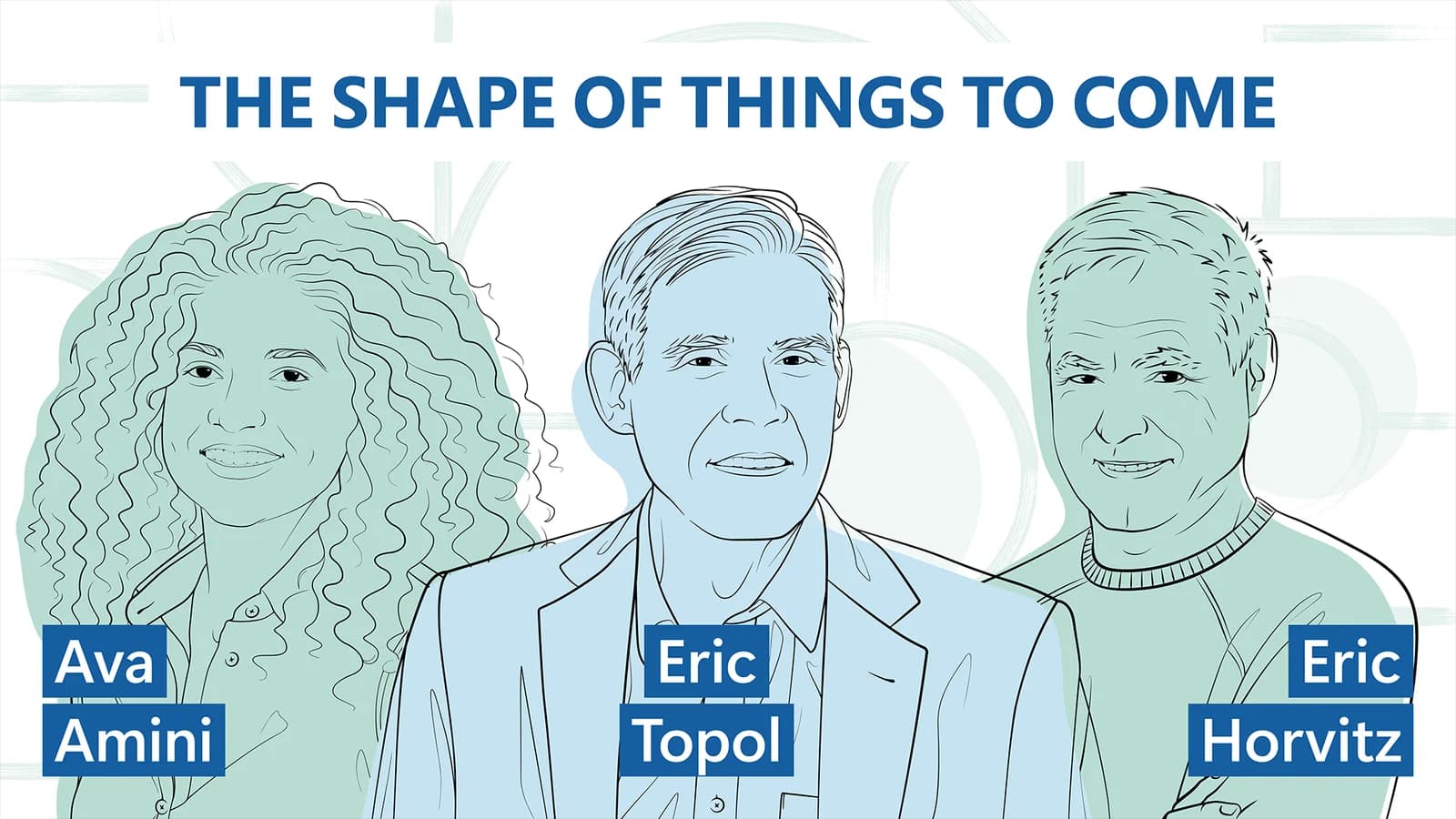
Technical advancement is moving at such a rapid pace that it can be challenging to define the tomorrow we’re working toward. In The Shape of Things to Come, Microsoft Research leader Doug Burger and experts from across disciplines tease out the thorniest AI issues facing technologists, policymakers, business decisionmakers, and other stakeholders today. The goal: to amplify the shared understanding needed to build a future in which the AI transition is a net positive.
Microsoft Principal Research Manager Ava Amini, Microsoft Chief Scientific Officer Eric Horvitz, and physician-scientist and Microsoft AI health advisor Eric Topol (opens in new tab) of Scripps Research join Burger to tackle a question with ramifications for every individual on the planet: What might the future of medicine look like with AI, and what needs to happen first?
Drawing from experiences in machine learning, bioscience, and clinical care, the group explores AI-assisted medical diagnosis, the untapped potential of leveraging AI in medical imaging, whole-patient models, virtual cells, and the role of biological foundation models in scientific discovery. The group also examines why promising research can be slow to reach patients, how AI could guide experiments and drug discovery, and why better biological data and real-world validation remain essential.
This episode delivers a research-grounded conversation of what AI can do today in the health space, the challenges and opportunities still ahead, and the shape of things to come.
Transcript
[MUSIC]
DOUG BURGER: This is The Shape of Things to Come, a Microsoft Research Podcast. I’m your host, Doug Burger. In this series, we’re going to venture to the bleeding edge of AI capabilities, dig down into the fundamentals, really try to understand them, and think about how these capabilities are going to change the world—for better and worse.
Today, I’m bringing three experts in the fields of biomedicine working on the frontlines of AI, biology, and medicine to see where healthcare is going, where the deep understanding of biology is going, what medical advances are coming, and how will AI change the future of health. These questions are really important because they will determine the shape of things to come.
[MUSIC FADES]
In today’s podcast, I’ve invited three leading researchers in medicine, biology, and machine learning/AI.
Eric Horvitz is Microsoft’s chief scientist [chief scientific officer] and is both a PhD and an MD. How you spent all those years in school, I have no idea. I’ve known Eric for decades and his work has shaped the entire field of machine learning. He’s a legend in the machine learning community and is a good friend.
Eric Topol is our second guest. He’s the executive vice president of Scripps Research (opens in new tab), the largest nonprofit biomedical research institute in the United States. He’s published over 1,300 peer-reviewed papers. Shocking, [LAUGHTER] shockingly productive. Authored four books (opens in new tab). So just an amazingly impressive, prolific scientist and physician.
Finally, Ava Amini is a principal research manager in Microsoft Research. She’s a rising star in our organization, an expert in the intersection of AI and precision medicine, and she’s a co-lead of Project Ex Vivo, a collaborative effort between Microsoft and the Broad Institute that is focusing on defining, engineering, and targeting cell states in cancer.
So thank you all for joining today. I think we’ve got a really, really amazing set of people, myself excluded. And I’d like to start to my guests here.
It’s clear there’s a huge disruption happening at the intersection of biology and medicine and AI right now. Just, you know, we’re seeing things, breakthroughs, happening at an accelerating pace. Models are helping us to discover structures and create abstractions that are really useful for moving forward the field of medicine. I’ve seen some recent talks where scientists with cancer used AI to design drugs for themselves. I mean, just unbelievable.
And today, I’ve got some long-term questions for us to discuss, maybe a little bit provocative. But I’d like to start with what each of you see as what’s happening right now, like, on the, on the intersection of medicine and biology and AI.
I think each of you has a unique vantage point. I’ll go around the horn, and I know, Eric, there’s a, you know, you have a cover article on Science magazine (opens in new tab) that’s really exciting, and so maybe you could talk a little bit about that, as well. So I’ll start with you, and then I’ll go to Eric Topol and then Ava.
ERIC HORVITZ: Thanks, Doug.
I think healthcare and the biosciences are fortunate disciplines as in that there’s been a digitalization of content—whether it be protein structure over, over decades, electronic health records, and so on—that makes these fields amenable to being at the ready for AI inferences and innovation. And therefore, I’ve been extremely optimistic about the long-term futures as well as what we’ll see early on at the frontiers of AI when it comes to the biosciences and healthcare.
Just extraordinary to see what’s happened over just the last five to eight years in the biosciences with both discriminative and generative AI models. You know, the AlphaFold (opens in new tab) breakthrough was tip of the iceberg, and we see just a whole, in some ways, a crest and a crashing of the wave of possibilities now when it comes to experimental platforms, experimental design, data interpretation in the biosciences, hypothesis generation, I should say, as a, as an assistant and a companion to scientific reasoners and human scientists.
In healthcare, we have an extraordinary opportunity to address long-term challenges in patient safety, in getting to timely diagnoses, in accessibility of healthcare. And after a couple of years of intensive work, I and just fabulous colleagues at Microsoft worked intensively on taking healthcare challenges when it comes to applications of AI and benchmarking—medical diagnostic challenges, for example—and moved it into what I would call the realm of medical cognition, where instead of looking at a whole case that’s given to an AI system and looking at the accuracies that are reported on its ability to diagnose, for example, a form of differential diagnosis, we instead put the AI system in the, in the shoes of a clinician.
You get an initial set of symptoms, you get chief complaint, some history, a little window on what’s going on when a patient comes in in an ambulatory setting, and then it’s up to the clinician to ask the right questions and to then think about tests, balancing the information value with the cost of the tests. This is the sequential diagnosis challenge. And we applied AI to both the … formulating the hypothesis component of that as well as decision-making about the next best tests to order, questions to ask, and also when to call a diagnosis, even under uncertainty, as a concluding convergent diagnosis and getting on with things with therapy, for example. And showed just, I think, remarkable abilities of a number of frontier language models to do a fabulous job.
And, you know, and again, did some comparisons with human generalist physicians, which have to be taken at face value and with limitations in what we did with … on the comparison, but still show the promise of the methods for assisting clinicians of the future.
BURGER: Well, congratulations on the paper. It’s a really big deal.
Eric [Topol], moving on to you. You know, you’re the one person on the podcast who’s not a Microsoft employee [LAUGHTER], and so you see a very different, I think, set of things than we might see from our vantage point, although I think each of the three of us sees different things in general.
Could you just tell us what you’re seeing? Like, to somebody listening, you know, we have a broad listenership from all different segments, not just experts in AI or medicine. Like, what are you seeing that your, sort of, technical, smart, average listener would be able to take away?
ERIC TOPOL: Yeah, sure, Doug. I mean, I think first I do also want to congratulate Eric and the team at Microsoft because this was a seminal paper in Science. It was the first ever to take an agentic system and make more accurate diagnoses not just compared with physicians but a lot of the other frontier models. Markedly improved accuracy over physicians, almost doubling, but at lower cost. I mean, that’s stuff we haven’t seen. What we’ve seen is, you know, using AI to upcode and using AI to potentially raise costs. This really was the first demonstration you could have higher accuracy at lower cost. It’s kind of like eat more, weigh less, [LAUGHTER] or taste better, you know. Anyway, it’s pretty impressive work.
Now,what I’ve seen, which is striking, is that we have all attuned to the shiny object of generative AI, which is great. It’s, you know, four years in. But we’ve somehow missed using where it’s even more proven, which is in the image phase, a deep learning of medical images. Whether it be the retina, chest x-ray, electrocardiogram, all these things.
And so there’s this real paradox where, for example, we aren’t implementing all that we’ve learned from mammography—over a hundred thousand women in a randomized trial (opens in new tab)—or colonoscopy—44 randomized trials (opens in new tab)—and eking out all the embedded information that humans can’t see, but AI can interpret from every type of medical image that we know of. So we’re not harvesting that opportunity.
Now, why is that important? Well, the next phase of AI is, you know, I guess, what I’d call whole-patient models, whereby we would have, as Eric mentioned, electronic health records; we’d have all the images, raw images, and other layers of data. It could be genomics, could be proteomics; it could be, you know, the exposome—all these layers of data.
But we can only get the most out of that at the individual level for being able to predict diseases and when they might occur and what-if scenarios if we change something to defer or prevent the disease and using these sorts of, you know, remarkable datasets to really change medical care in a way we’ve never done before. So I’m excited about that. But we are still idling. We haven’t used the work that’s been done to affect patient care. I’m still waiting for that to happen. It’s vexing to say the least.
BURGER: Just before I go on to Ava, you know, since you raised that, and what do you think the community should do differently so that we’re not missing that opportunity? I mean, there’s a ton of research going on; there’s a lot of work; there’s businesses adopting AI. What is the community missing?
TOPOL: Well, it’s missing implementation. So it all sits in these great journals and, you know, gone through a peer review and just impressive data, particularly these randomized trials that were done in the real world, and not used in caring for patients or helping patients.
So there’s no real good reasons why this hasn’t moved forward. There’s lots of excuses, [LAUGHTER] but, you know, the medical profession is slow to adopt change. Oftentimes, there’s financial constraints; there’s unwillingness to invest at health systems level because, you know, they’re working at very low margins …
BURGER: Right.
TOPOL: … and, you know, they don’t, they don’t want to get into something that they’re not fully confident with.
You know, the one thing that’s noteworthy is the physicians are not clamoring for these advances. I mean, if I—or the patients. If you’re a woman undergoing mammography and you don’t get state-of-the-art AI, which almost, you know, no women in the United States do, you think you might run a revolt. Or you have to pay for it to get that interpretation in a very limited network. There’s so many of these things that people are not getting … that either the physicians who advocate for patients or the patients themselves, maybe that’s what we need to drive this forward.
BURGER: I’m going to come back to that. That’s a really, I think, important point because it touches on just the economics of the system.
But, Ava, let me, let me turn to you. You’re deep in it, right? You’re playing with the models and working with, you know, outside organizations and actually pushing on, you know, disease states. So what are you seeing right now?
AVA AMINI: Yeah, from where I sit specifically, it’s at the intersection of AI and biology. So more focused on the biosciences versus medical and healthcare, but the perspective is very complementary to what Eric and Eric were both mentioning because right now we’re at this phase of extreme excitement, a lot of optimism, a lot of energy, a lot of investment. But when it comes down to it, the reality is implementation again, where we have enthusiasm about building predictive and generative models, AI models for biology. But really, the question in my mind is: what are these actually going to solve? What questions can we deploy them towards? How are we going to implement them? How will they be adopted by experimental scientists and integrated into our workflows?
And that is a gap that I think still the community needs to bridge. We’re making steps towards bridging that. For example, through our collaboration with the Broad Institute, where we’re really trying to build bottom-up a joint research endeavor that marries both the AI side and the biological side. And so in the next phase, I think really the challenge and the test will be: how can we implement these models and systems in a meaningful way towards meaningful problems?
And then the second big piece that I’m seeing and I’m really strong on is very aligned with this vision of the whole-patient model. And it comes down to the fact that biology is incredibly complex because it’s inherently multi-scale, right. We have operation at the level of molecules that then go on to the level of individual cells that organize into tissues and organ systems, and those organ systems all function within an organism in a remarkably coherent way. And that’s a machine learning and computational challenge that is very hard to find in any other field—how you actually integrate across these scales of the hierarchy in a coherent way such that context and information from all the way down at the molecular level can be brought up meaningfully to insights at the patient level or the human level.
And so because of these complexities, there’s so much opportunity, as well, for real AI innovation in terms of how we bring data to these models, how we represent the data, what type of data we need, how much of it, how diverse should it be. All these very fundamental technical questions. And then juxtapose with the real biological questions of, let’s say, we did have a whole-patient model. What is the No. 1 or No. 2 or No. 3 highest set of priorities that we would deploy such a system for? Or do we democratize and, you know, go after a breadth rather than a depth of applications? So, really, it’s a tremendously exciting time for research on both the computational side and biology side for these reasons.
BURGER: We keep coming back to the whole-patient model. So I want to toss out maybe a provocative question, and I’ll use my platform to draw back to my old historical area.
You know, so I’m … I think as you all know, I’m a computer architect by training so build systems out of chips and software and wires, and, you know, one of the things in that part of the field, in computing, is that we, humans, have built these incredibly complex systems, like literally billions of circuits on a postage-sized stamp chip. But we understand pretty much everything about them because we’ve built them from the ground up. We’ve created the abstractions; we’ve created the, you know, the rules of going from one layer to the other. But of course, deep inside, you know, the transistor junctions, it’s a messy stochastic dance, quantum dance of, you know, electrostatic forces and, you know, the p-n junctions are really stochastic devices, but we just build these abstractions that are clean.
Do you all ever think we’ll get to a point where biology is the same way? Like we understand it well enough, we have a hierarchy of abstractions, and we know what everything does, and we can point to any part of the system and say, “That’s it”? Or is it always going to be this messy thing that’s just so complex we can’t possibly understand it?
HORVITZ: Can I, can I say, Doug, that once we run a deep generative model on that very clear, precise set of abstractions that you’ve provided in your career, we we’re back into a messiness again in really trying to understand the algorithmic behavior, especially when it’s stochastic. My sense is—carrying the analogy forward to a multi-scale dynamical system, the human body—is that there’s going to be very high degrees of complexity when it comes to the dynamics and interactions of parts at different levels of abstraction. And thus we’ll have to think through what are ways to manage that complexity in our inferences and in our tests and in our studies and in our data collection such that we could, we could—again keeping … moving the analogy forward—to come up with techniques for interpretability of what we see and what we can intervene as well as causal models and abstractions that help us understand both intra-level and cross-level interactions.
BURGER: I think that was a no. [LAUGHTER]
HORVITZ: Well, you know, it was a no that we want … that we will never understand the, you know, the details—the critically important details—down to the precise atomic level of the kind that you had and have had in architectures and in systems design. So, yes, I should have … I could have been very much … I could have just said no.
BURGER: No, no, no. [LAUGHTER] I’m just, I’m trying to simplify it for the audience, right? Because …
HORVITZ: Sorry, sorry, audience. I went on a long discourse.
BURGER: I did, I did a low-rank approximation [LAUGHTER] on Eric Horvitz and got one bit. Sorry to boil you down.
HORVITZ: It’s, it’s helpful.
BURGER: Any other comments here?
TOPOL: Yeah, I just throw a …
BURGER: Does anyone disagree?
TOPOL: … a couple here. Firstly, as you know, there’s a lot of interest in creating the virtual cell, …
BURGER: Yeah.
TOPOL: … where you would be able to do any number of perturbations and predict its response and that would help to whether it’s discover drugs or unravel a lot of biology.
Now, at the patient … human … the virtual human level, we are so weak right now. We’re not even—the virtual cell’s a ways off, but the virtual patient kind of analogy, like, for example, if you had a polygenic risk score or even a genome sequence, you might say, oh, this person has risk for, say, heart disease. But we don’t know whether it’s age 50 or 90. You know, that’s not really that helpful.
So what it turns out is when you … even the models that have been done so far and published, they already can give us some timing. They can already color this. And we are still looking for deep … that’s just with electronic health record and lifestyle or electronic health record and polygenic risk score. We don’t have deep and long data yet at scale. Wait till we get that. So I do think we’re actually going to get to some more mature whole-patient models before we get to the virtual cell. We’re never going to get to be able to do all the perturbations you could do at a cell level, but there’s a lot of different cells in the body.
BURGER: Yeah.
TOPOL: But one other point about this is that we really need to be beyond “you’re at risk for.” We have a real, a chance to enable prevention, which we’ve never really done in any meaningful way in healthcare. So I think it’s an exciting step forward, but it is going to take a lot of effort to make it real.
BURGER: I was at a conference this past weekend on the intersection of AI and medicine, and that topic, Eric, came up: prevention. And I think the argument that some very thoughtful speakers made is that our economic model of healthcare is just fundamentally at odds with preventative medicine. Like, the system isn’t incentivized to do it. People can choose to do it, but, you know, you go into the doctor when you get sick and the hospital treats you and then you—and they might give you some advice. But there’s no fundamental incentive for the system to invest to prevent future problems out, outside of maybe your general practitioner. Do you agree with that?
TOPOL: Well, I would just say welcome to the United States. [LAUGHTER] That’s the model. But if you go elsewhere, you’d find there are incentives to keep the population healthy. Huge economic, no less health burden incentives. So we are in this peculiar, unique situation where we have disincentives because of all the structures that are, you know, one year of insurance coverage. Why would they care to prevent diseases …
BURGER: Yeah.
TOPOL: … when they have such short-term interests? And, you know, just very poor structurally to make this shift. But it doesn’t mean it won’t happen. It may not happen here or only here in select entities like a Kaiser program or certain ones that are more geared for this, sort of, shift.
BURGER: Ava, I want to turn to you, back to the original question. Like, so digital systems are, you know, precise abstractions built on a stochastic mess. Do you think we’ll be able to get precise rules about biology on top of all the stochastic messiness, even though it’s more complex?
AMINI: I would like to almost turn the question on its head. Instead of saying, “Will we get there,” do we need to get there? And I would argue that it’s perhaps not necessary to have that complete, you know, atom-wise or interpretability of where every, you know, molecule in a cell is moving at any given time and how it reacts to this perturbation and so on and so forth. I think it’s far more important to think about, what are the necessary outputs from a model or a system that’s an orchestration of many models perhaps to actually enable the discoveries that a scientist is going to, you know, want to undertake?
And for a lot of things that, you know, are immediate in terms of being able to look ahead one year, two years down the line to experimentally validate, I don’t think we need that level of interpretability. Whether or not we get there is, you know, I think we can debate about that. I would lean on to the side of Eric H. in saying maybe … I don’t think we will ever precisely get there because of just the inherent entropy and dynamics of biology. But I would take a strong stance of saying, do I think it’s necessary? No.
HORVITZ: Yeah, there’s huge headroom, Doug, between what you asked for when it came to the precision of a systems architect and a hardware architect and what we can do to deliver incredible benefits to patients under some uncertainty, under stochasticity, with much deeper knowledge about causation in … across the levels of understanding in, in human physiology.
AMINI: Exactly. You know, what level of that do we need to enable discovery or enable better interventions or treatments or preventative measures, right? You know, I don’t think that fine-grained precision is strictly necessary for that.
BURGER: Yeah, I certainly don’t think you need to have that level of understanding to do very, very useful and important things. But I think what the two of you were just doing is very nicely saying, “Doug, you’re overly biased by your 30 years in your field, [LAUGHTER] butt out and stop trying to apply your lessons to biology,” which I take as a fair point. It doesn’t mean I will, but I hear the feedback.
TOPOL: It is a tough one to unpack, Doug, because there’s so many different dimensions of this. Like for example, the use of ambient scribes to shorten the amount of data clerk time that doctors and clinicians have, which is starting to really take off throughout the US, and those who are frequent users are really, you know, being rewarded for saving a lot of that keyboard time…
BURGER: Right.