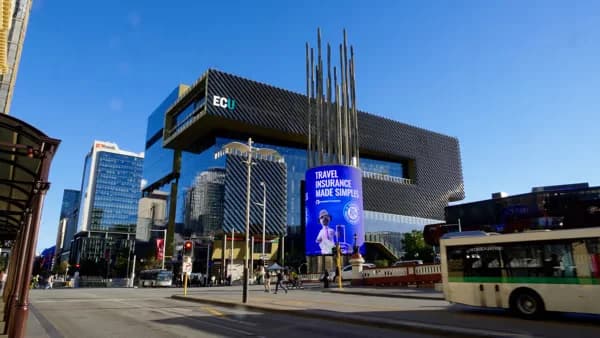
Case Study: Edith Cowan University’s new A$852 million city campus turned to Sennheiser to make mobile, hybrid-ready teaching possible, equipping hundreds of learning spaces with ceiling-first speech capture.
Perth, Australia, 24 November 2026 - For Edith Cowan University (ECU), a new Perth city campus was a chance to rebuild teaching around movement and equity. Lecturers roam freely, and remote students never feel like an afterthought. Turning this into reality took more than 100 Sennheiser TeamConnect ceiling microphone arrays, commissioned efficiently and precisely inside a still-active building site.
“Sennheiser’s Control Cockpit proved to be the difference – we chose TeamConnect as the preferred platform,” says David Jones, Director of Vizcom Technologies. “When you have around 120 ceiling mic arrays on site, it was Control Cockpit that saved us so much time in the commissioning phase.”
ECU’s new campus brings together general learning areas, flat-floor rooms with reconfigurable furniture, collaborative theatres and varied meeting pods. Chris Cooper, from ECU's Digital Services Collaboration team, was embedded in the city campus project for three years, working closely with integrator Vizcom Technologies to deliver a consistent learning experience across hundreds of different spaces.
The university's teaching philosophy treats lecturers as facilitators who roam the room, engaging students directly. Hybrid participation was a priority from day one, with the university determined that online students should have the same experience as those physically in the room.
The audio problem of a room with no fixed centre
That philosophy created clear technical demands. Voice pickup had to work from anywhere in the room without lapel microphones. Student questions had to be audible throughout the space and cleanly captured for Teams calls and recordings. The system had to hold up across many room types and sizes, and ECU’s inner-city site, with its glass, plasterboard and nearby public event spaces, demanded a high density of reliable wireless channels.
An 18-month pilot at ECU's Joondalup campus confirmed any solution would need to be both high-performing and simple enough for academic staff to use without a second thought, day to day.
A ceiling-first approach to speech capture
To meet those demands, Sennheiser TeamConnect Ceiling 2 (TCC 2) and TeamConnect Ceiling M (TCC M) microphone arrays were selected as the core speech-capture solution across ECU's learning spaces. The arrays deliver comprehensive, natural-sounding coverage, so lecturers can teach from any position in the room while remaining clearly audible to both in-room and remote participants.
Meanwhile, for Vizcom, commissioning at this scale came down to one piece of software. Sennheiser's Control Cockpit, with its visual lobe-mapping tools, let the integration team set priority zones, including individual student pods, verify coverage in real time, and quickly refine pickup even amid noisy construction conditions.
Reliability for every voice across a crowded campus
Voice lift, or mix-minus, processing reinforces even the quietest question asked near the lecturer for the far side of the room, and captures it cleanly for recordings and remote participants, while levels stay natural close to the source. Low and high voice lift presets on the room touch panels suit different speaking styles, and priority zones can make a chosen student pod the array’s primary focus.
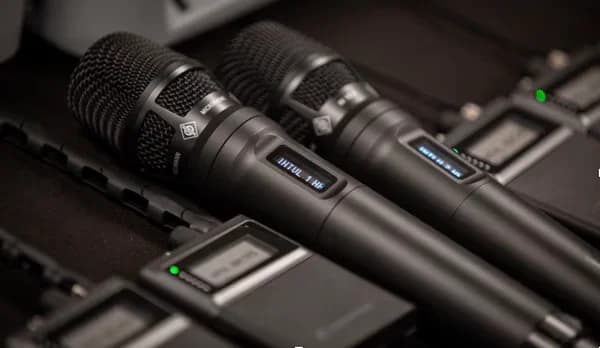
Where more mobility or gain is needed, Sennheiser EW-DX wireless handheld and belt-pack systems are installed in essentially every teaching space. Chosen for their narrow bandwidth and high channel density, they let a large number of reliable channels run across the campus with minimal interference, and network connectivity supports long-term management of the wireless inventory.
The microphones sit within a broader networked AV environment, including Crestron control and DM NVX, Q-SYS audio processing and Lightware USB-C connectivity. They remain the critical element that makes truly untethered, hybrid-capable teaching possible.
Teaching first, technology second
The city campus installation has become the standard for ECU’s other sites. Lecturers move freely, students contribute from anywhere in the room, and remote participants receive clear, intelligible audio. Support issues related to microphone use have stayed low because, as Cooper puts it, the system simply works.
“The ceiling microphones were essential to ensure that staff could wander anywhere in the room and be picked up in the Teams call or a recording,” says Cooper.
By placing high-quality, flexible speech capture at the centre of the design, ECU has built learning spaces that put teaching and learning first.