TL;DR — We took BART, an open-source MRI reconstruction toolbox, changed nothing but the FFT library underneath it, and measured the difference. Swapping stock FFTW for AOCL-FFTZ, AMD's Zen-tuned FFT library, on 5th Generation AMD EPYC™ Server CPUs delivered up to 11.8× faster FFT and up to 2.8× faster end-to-end reconstruction on real MRI workloads — with no application code changes and essentially identical numerical output.
Why the FFT is the engine of MRI
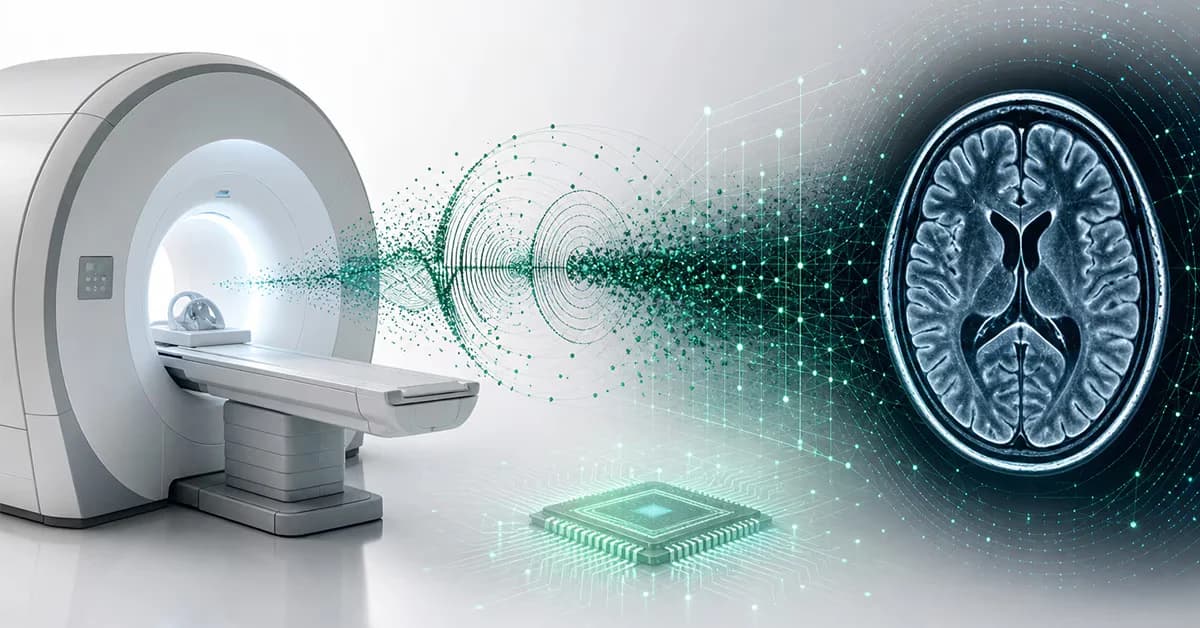
An MRI scanner does not record a picture. It records k-space — the spatial-frequency representation of the body. Turning that raw measurement into an image a radiologist can read is a computational step, and at the heart of that step is the Fast Fourier Transform (FFT).
For the most common clinical acquisition — Cartesian sampling on a regular grid — reconstruction is essentially an inverse FFT per receive coil, followed by coil combination and some image-domain cleanup. More advanced methods (parallel imaging, compressed sensing) wrap iterative solvers around the FFT, so the transform runs many times per image.
Figure 1: Where runtime concentrates in a Cartesian MRI reconstruction path — the FFT/IFFT step is the compute hotspot AOCL-FFTZ accelerates.
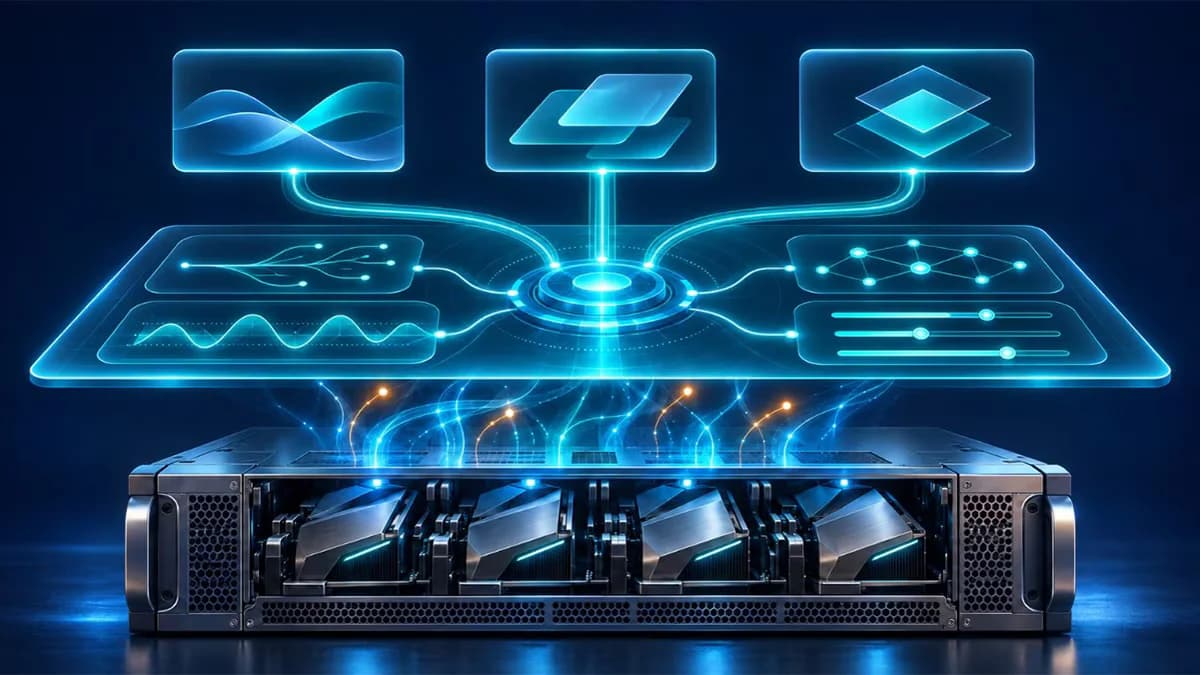
The practical consequence is simple: if the FFT is slow, MRI reconstruction is slow. At the API level the transform is a well-defined, standardized operation, but a fast implementation is not one monolithic kernel. Modern FFT libraries decompose each size into a solver plan — mixed-radix stages, twiddle setup, and smaller sub-transforms — and execute those stages with tuned vectorized kernels. That is exactly where a specialized library like AOCL-FFTZ can accelerate the work without changing the math.
Meet AOCL-FFTZ
AOCL-FFTZ is AMD's in-house FFT library, built from the ground up for AMD "Zen"-based processors and shipped as part of the AMD Optimizing CPU Libraries (AOCL) suite. AOCL-FFTZ is designed to provide:
- A single unified library covering single and double precision (LP64 and ILP64).
- High performance Real and complex, forward and backward transforms.
- Core compute kernels vectorized for AVX-512 / AVX-256 / AVX-128.
- Multi-threaded scaling via OpenMP.
- Runtime CPU detection and dynamic dispatch, so one binary runs well across Zen generations.
- An FFTW-compatible wrapper for a drop-in transition from FFTW.
That last point is the one that matters most for existing software. A huge amount of scientific and imaging code — including the toolbox we benchmarked — already speaks the FFTW API. AOCL-FFTZ's wrapper lets those applications adopt a faster transform without touching their source code.
That is what makes adoption seamless: there is no code to port, no API to relearn, and no integration project to staff. Because AOCL-FFTZ slots in underneath software that already calls FFTW, you keep your application exactly as it is, swap in the tuned library, and measure the gain.
The experiment: a fair, controlled swap
To make this an honest measurement and not a marketing demo, we isolated one variable.
We used BART (the Berkeley Advanced Reconstruction Toolbox), a widely cited open-source toolbox for computational MRI. We built it twice:
- A reference build linked against stock FFTW.
- An AOCL-FFTZ build linked through the FFTW-compatible wrapper.
Everything else was held constant. Same BART source, same compiler, same inputs, and the same linear-algebra libraries on both sides (AOCL BLIS for BLAS and AOCL libFLAME for LAPACK). The only thing that changed between the two builds was the FFT implementation behind the FFTW API.
Figure 2: AOCL-FFTZ drops in behind the same FFTW3 API — swap the shared library, not the application.
Test setup.
- Hardware: dual-socket (2P) AMD EPYC "Turin" (Zen 5), 128 cores per socket.
- OS / compiler: Ubuntu 24.04 LTS (Linux 6.8), GCC 13.3.
- BART: v1.0.00, built once per backend with identical options; AOCL BLIS and AOCL libFLAME supplied BLAS/LAPACK on both sides.
- Reference FFT — stock FFTW 3.3.10: single precision, compiled -O3 -mtune=native with SSE2/AVX/AVX2/AVX-512 enabled and no FFT threading (the reference is single-threaded).
- AOCL-FFTZ 6.0.0: used through its FFTW-compatible single-precision interface, with runtime AVX-512/256/128 dispatch.
- Planner: BART issues all transforms in FFTW's ESTIMATE planning mode (its default for one-shot reconstruction); both libraries were driven through this identical call path.
- Inputs: BART's built-in analytical phantom rendered to k-space with 8 simulated receive coils at each matrix size; the radial case used a generated radial trajectory (256x377).
We measured two numbers for every workload:
- Full workflow time — the end-to-end wall-clock time of the BART command, including FFT, non-FFT reconstruction work, file I/O, and process startup.
- FFT time — isolated using a lightweight LD_PRELOAD timer around the FFTW-compatible plan and execute calls.
Each command was run single-threaded five times, and we report the median to keep the comparison stable.
We exercised five workloads that represent different parts of a real MRI reconstruction stack:
Workload
What it represents
FFT role
Cartesian IFFT 512x512x8
Standard clinical image reconstruction (larger)
High
Cartesian IFFT 256x256x8
Standard clinical image reconstruction
High
PICS 128x128x8, 10 iter
Iterative parallel-imaging / compressed sensing
High, repeated
Radial NUFFT 256x377x8
Non-Cartesian reconstruction
Medium, plus heavy gridding
ecalib 128x128x8
Coil-sensitivity calibration
Lower, plus linear algebra
Results
1. The FFT itself gets dramatically faster
Across every workload, AOCL-FFTZ accelerated the FFT itself substantially — from 2.9× on the calibration-heavy ecalib case up to 11.8× on the large Cartesian reconstruction.
Figure 3: AOCL-FFTZ FFT runtime speedup vs stock FFTW across BART MRI modes.
2. Faster FFTs translate into faster reconstructions
The more time a workload spent in the FFT, the more its end-to-end runtime improved. The large Cartesian reconstruction — the cleanest FFT-bound case and the closest analogue to a routine clinical path — improved 2.83× overall, and iterative PICS reconstruction improved 2.25×.
Figure 4: FFT-only vs full-workflow speedup — workloads dominated by the transform gain the most end-to-end.
3. Watch the bottleneck move
This view ties the FFT gains to end-to-end runtime. The amber segment is FFT time; the slate segment is everything else. AOCL-FFTZ collapses the amber block while the non-FFT work stays essentially unchanged — so the total shrinks, and the FFT stops being the dominant cost.
Figure 5: Runtime composition before and after — FFT time (amber) shrinks while non-FFT work stays flat.
Said differently: before the swap, the FFT accounted for 70% of the large Cartesian workflow. After the swap, it accounts for 17%. The optimization target has moved on.
Figure 6: After acceleration, the FFT is no longer the dominant share of wall-clock time.
4. Same answers, just faster
Speed is only useful if the image is still correct. We compared the outputs of both builds with BART's own nrmse tool. The outputs matched as closely as you’d expect from normal floating-point rounding.
Reconstruction output
NRMSE (AOCL-FFTZ vs stock FFTW)
Cartesian IFFT 256x256x8
2.2e-07
Cartesian IFFT 512x512x8
2.5e-07
Radial NUFFT adjoint
1.3e-07
ecalib sensitivity maps
2.0e-06
PICS reconstruction
1.9e-07
How to read these numbers
Three patterns are worth taking away, because they generalize well beyond this one toolbox.
FFT-bound work wins the most. When a workload is dominated by regular FFTs — like Cartesian reconstruction — accelerating the transform moves the whole needle. This is where AOCL-FFTZ shone brightest (2.83× end-to-end, 11.81× on the FFT stage).
Iterative reconstruction compounds the benefit. PICS applies the FFT operator repeatedly inside a solver loop. A faster transform pays off on every iteration, which is why an iterative, clinically relevant method still improved 2.25× end-to-end.
Once the FFT is fast, the next bottleneck is not the FFT. For Radial NUFFT and ecalib, the FFT stage still sped up 9.2× and 2.9×, but end-to-end gains were smaller (1.34× and 1.18×) because those workflows spend most of their time elsewhere — gridding and interpolation for NUFFT, and covariance/eigen/SVD linear algebra for calibration. That is not a weakness of the FFT library; it is a signpost telling you where to optimize next (and, conveniently, AOCL has tuned BLAS and LAPACK for exactly that).
Does this apply beyond MRI?
BART is MRI software, and these results are an MRI story first. But the underlying lesson is portable: any pipeline whose runtime is dominated by FFTs stands to gain from a faster FFT, and the amount of end-to-end benefit tracks how large the FFT share was to begin with.
What makes this exciting is that the same reconstruction mathematics recurs across medical imaging, so the FFT hotspot — and the chance to accelerate it as a drop-in — appears far beyond MRI:
- Optical coherence tomography (OCT): Fourier-domain OCT (SD-OCT and swept-source OCT) recovers every depth profile (A-scan) by an FFT of the spectral interferogram — millions of FFTs per volume, making it one of the most FFT-bound modalities in the clinic.
- CT: Filtered back-projection applies its ramp filter in the frequency domain via FFT, and direct Fourier-reconstruction methods are FFT-based; FFT/NUFFT-based projectors are also used to speed up some iterative reconstructions.
- Ultrasound: Fourier-domain ("f-k" / Stolt migration) beamforming for plane-wave imaging, matched-filter pulse compression, and spectral (pulsed-wave) Doppler are FFT-based. Color-flow imaging is the classic exception — it estimates velocity with a phase-domain autocorrelator (Kasai), not an FFT.
- PET / SPECT: Fourier rebinning (e.g., FORE) and frequency-domain filtering sit inside tomographic reconstruction.
- Computational microscopy: Structured-illumination microscopy, Fourier ptychography, and many Wiener/Richardson–Lucy deconvolution pipelines rely on large 2D/3D FFTs.
- Photoacoustic and MR spectroscopic imaging (MRSI): Photoacoustic tomography often uses Fourier-domain or k-space reconstruction; MRSI applies spectral FFTs along spatial and chemical-shift dimensions.
In every one of these, the same two questions decide the payoff: how much of my time is in the FFT, and can I swap the library without rewriting my app? AOCL-FFTZ combines faster FFT execution with an FFTW-compatible API, so for FFT-heavy code you can adopt it as a drop-in rather than a rewrite. The broader worlds of computational physics and chemistry, radar, communications, audio, and seismic imaging benefit for exactly the same reason.
Try it yourself
Because AOCL-FFTZ provides an FFTW-compatible wrapper, evaluating it on your own FFTW-based application is intentionally low-effort:
- Build with the FFTW wrapper enabled.
- Point your application's linker/LD_LIBRARY_PATH at the AOCL-FFTZ FFTW-compatible library instead of stock FFTW.
- Re-run your existing workload and compare wall-clock time and output accuracy.
- If your workload is FFT-heavy, you should see it immediately; if it is not, profile to find where the time actually goes.
No API changes, no algorithm changes — just a faster transform underneath the same calls.
Key takeaways
- Swapping stock FFTW for high-performance AOCL-FFTZ accelerated FFT stages by up to 11.81× in real MRI reconstruction workloads.
- End-to-end reconstruction commands ran up to 2.83× faster, with iterative PICS at 2.25×.
- The win was a drop-in: no BART source changes, with BLAS/LAPACK held constant.
- Output accuracy was preserved (NRMSE ~1e-7 to 2e-6).
- After acceleration, the FFT's share of runtime fell sharply (e.g., 70% to 17%), shifting the next optimization target to gridding, calibration, and linear algebra.
Methodology and disclaimers
- Software: BART is open-source and research use only — not for diagnostic use. Full hardware, OS, compiler, library versions, build flags, and planner mode are listed under The experiment: a fair, controlled swap above.
- Measurement: five repeats per workload, medians reported, single-threaded (OMP_NUM_THREADS=1, BLIS_NUM_THREADS=1). FFT time isolated via an LD_PRELOAD timer around FFTW-compatible plan/execute calls; non-FFT time derived as total minus FFT.
- Scope: results are from a single test machine and specific problem sizes. The reference is stock FFTW, not every possible FFT implementation are benchmarked. Your results will depend on CPU, problem size, threading, and build options.
Further reading
- AOCL-FFTZ (source and releases):
- AMD Optimizing CPU Libraries (AOCL): https://www.amd.com/en/developer/aocl.html
- AOCL-FFTW (Fastest Fourier Transform in the West): https://www.amd.com/en/developer/aocl/fftw.html
- Accelerating Python Performance with AOCL on AMD "Zen" Cores: https://www.amd.com/en/developer/resources/technical-articles/2026/accelerating-python-performance-with-aocl-on-amd-zen-cores.html
- BART (Berkeley Advanced Reconstruction Toolbox):